2013/01/29

「direction」と「directions」の違い


Recently I ate these instant noodles from Thailand. I like instant noodles from southeast Asia because I can find vegetarian-friendly ones and the spices are much more suitable for my palate.
  • suitable to one's palate = matching one's taste 
  • palate 味覚
  • suitable ふさわしい、適切な
I needed to check the instructions on the package to make sure that I didn't cook them too long. There's nothing worse than soggy instant noodles.
That's when I noticed that there was an English mistake!
× direction
○ directions
  • soggy【形】〔水で〕ずぶぬれの、びしょぬれの (definition from Eijiro on the Web)
  • soggy noodles のびた麺
Check the definitions of these two words (definitions from Eijiro on the Web):
  • direction 1. 管理; 2. 指図[命令]すること; 3. 方向、向き
  • directions 指示(書)、説明(書)
"Direction" means, according to WordNet 3.0, "a line leading to a place or point".

"Directions", with an "s", means the same thing as "instructions", or a series of steps given to teach someone how to do something.

There are other meanings for the word "direction". For example, there is what movie directors do. They give direction to actors, camera men, and so on in order to make a movie.

Despite the mistake, I had no trouble making these instant noodles, and they were delicious.

If you need some direction on how to improve your English, please ask me! I'd also be happy for you to join one of our classes. If you are having trouble finding our classroom, we can give you directions.

2013/01/22

形容詞の語順について


These nuts were a yummy snack. It's too bad that the English was wrong.
× Nuts Select!!!
○ Select Nuts
Adjectives basically go in front of nouns. Here, "nuts" is the noun, and "select" is an adjective. It means, according to WordNet 3.0, "of superior grade" or "selected or chosen for special qualifications".
select
【形】(definition from Eijiro on the Web)
    1. 厳選した、えり抜きの
    2. 上等の、優良な
    3.〔会員資格が〕限定された
    4.〔牛枝肉の等級が〕セレクトの◆米農務省の定めた規格で、一般に流通している三つの中では下位の等級。プライム(prime)、チョイス(choice)に比べて脂肪の少ない赤身肉。 
There are some interesting exceptional cases where an adjective comes after a noun in English. This Wikipedia page describes it well, along with examples:
http://en.wikipedia.org/wiki/Post-positive_adjective
Last week, I gave you some select posts from the past. I realized that this blog goes back to 2009. That's a good feeling, knowing that a lot of people have had a chance to study from these posts.

Anyway, this mistake is proof positive (see the Wikipedia link above) that some people need English classes. If that's you, please arrange an appointment with us for a free lesson!
  • proof positive 確証 (definition from Eijiro on the Web)

2013/01/16

2012の人気のある検索語


About 72 percent of you readers came to our blog last year from search engines.
  • search engine《イ》サーチ・エンジン、検索エンジン、検索ソフト (definition from Eijiro on the Web)
These are the things that people were searching for the most:

3. disgusting 使い方

There were plenty of disgusting things that happened last year, like the mass shootings in the US or the horrible gang rape of a woman in India. For me, the election of nationalists in Asia is pretty disgusting.
  • disgusting【形】むかつくような、うんざりさせる、胸が悪くなるような、実に嫌な、気持ち悪い、気色悪い、感じ(の)悪い、汚らわしい、〔気分的に〕最低な (definition from Eijiro on the Web)
  • mass shooting 銃乱射事件 (definition from Eijiro on the Web)
  • gang rape 輪姦 (definition from Eijiro on the Web)
  • nationalist【名】国家主義者、民族主義者、国粋主義者 (definition from Eijiro on the Web)
I managed to avoid cooking anything disgusting in 2012. Maybe my cooking skills are improving.

I hope that 2013 will be a less disgusting year geopolitically.
  • geopolitics【名】地政学◆【用法】単数扱い (definition from Eijiro on the Web)
Johnny wrote a good post about "disgusting" back in 2009:
http://upgradeenglish.blogspot.jp/2009/06/as-train-pulled-up-to-shibuya-station-i.html
2. wetty

Remember, in English we don't say "wetty". "Humid" is better. It's certainly not humid now. Check this post from 2010 about "wetty":
http://upgradeenglish.blogspot.jp/2010/06/wetty.html
1. パーカー 英語

I think we've said enough about hoodies lately. There's lots on the blog about it. Somehow, though, people are really interested in them. If you are interested, there's this article at Wikipedia about hoodies:
http://en.wikipedia.org/wiki/Hoodie

2013/01/15

2012の人気のあるポスト


It's interesting to see what attracts people to the blog. Today I want to recap the popular blog posts in 2012.
  • recap ~に再び帽子をかぶらせる、〔タイヤを〕補修して再生させる (definition from Eijiro on the Web)

The posts from last year that were the most popular were:

Our old posts continue to be read by a lot of people. The most popular posts last year were:

I understand why everyone likes hoodies (remember, "parka" means something else in English).
  • hoodie【名】フード付きスウェットシャツ、パーカー  (definition from Eijiro on the Web)
I can't make it through winter without them. I'm wearing one now. Tomorrow, while wearing a hoodie, I'll tell you about the popular search terms in 2012.

2012/12/30

大掃除で使う言葉

It's time to put away the only Christmas decoration in the house: this small folding paper Christmas tree. I'm glad that Christmas has come to an end, because I'm not a fan of Christmas music that is played too loud everywhere, other than Vince Guaraldi:

https://www.youtube.com/watch?v=2gmiSPMHrWQ
  • put away【句動】片付ける、しまう、しまい込む、収納する (definition from Eijiro on the Web)
I'm sorry not to have written any posts in December until today. I wonder if I can do better next year.

Like a lot of you must be doing, I'm trying to clean up the house.
  • clean up【句動】きれいに掃除[清掃]する、片付ける、浄化する、後片付けをする、部屋をきれいにする、きちんと整理する、きちんと身支度をする、身なりを整える、着替えをする、体を洗う (definition from Eijiro on the Web)
There are lots of things to throw away. The windows should be cleaned. The bathroom and toilet should be scrubbed with extra effort, and all of the nooks and crannies should be dusted or vacuumed.
  • throw away【句動】~を投げ捨てる (definition from Eijiro on the Web)
  • scrub 洗う、磨く (definition from Eijiro on the Web)
  • nooks and crannies 隅々
  • dust【句動】~のほこりを払う、~のちりを払う (definition from Eijiro on the Web)
  • vacuum【他動】~を電気掃除機で掃除する (definition from Eijiro on the Web)
I think getting rid of a lot of things over the course of the year will make cleaning this year easier. It's nice to have more space, as well.
  • get rid of〔好ましくない物を〕取り除く、駆除する、一掃する、処分する (definition from Eijiro on the Web)
It seems to really be true that sprucing up your living space can do the same to your thinking. It's refreshing!
  • spruce up【句動】こぎれいにする、めかす、身なりを整える、美化する (definition from Eijiro on the Web)
After I have done some cleaning, I'll be back to wrap up our posts for 2012. I hope your cleaning up goes smoothly! I hope you will consider sprucing up your English next year at our school, too.

2012/11/28

「cost」と「cheap」の使い方

This is what I've really got to learn to cook. It's vegetarian char siu, which is Cantonese-style BBQ pork. This is a vegetarian one, so it's made with gluten and spices. The black parts, rather than being burnt meat, are a kind of fermented black bean sauce. I ate this in Hong Kong. It was so delicious, and I keep thinking about it and how to make it.
  • fermented【形】発酵した (definition from Eijiro on the Web)
There are vegetarian restaurants in Tokyo, but...
× the cost is cheaper in Hong Kong.
○ the [food is/restaurants are] cheaper in Hong Kong.
○ the cost is lower in Hong Kong.
The vegetarian food in Hong Kong is generally more delicious, too.

"Cheaper" means "lower in price". "Cost" is a synonym for "price". That means that the incorrect sentence above means:
  • The price is lower in price in Hong Kong. ← strange!
"Cost" or "price" is a number, so you should use "lower" or "higher". Use "cheap" for products.

If you happen to know a good recipe or tips for cooking char sui at home, please let me know, especially if you know how to cook the vegetarian version. The cost of making it at home is certainly lower than flying to Hong Kong to eat it again. If you know a way to get cheaper tickets to Hong Kong, though, I'd like to hear that, too!

2012/11/27

「claim」と「complain」の違い, part 2

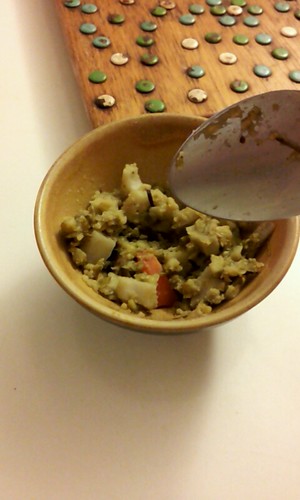
This was a really successful dish. I was already eating it when I realized I should take a picture of it so that I could show it to you. It's pan-fried mung beans with chopped lotus root, carrot, rosemary, and oregano.
  • mung bean 緑豆
  • lotus root レンコン
○ You might claim that it looks awful, but it really was yummy. ← you think it doesn't look delicious, but some people might not believe you

○ You might complain that it looks awful, but it really was yummy. ← you are expressing your dissatisfaction with the photo
  • dissatisfaction【名】不満、不平、不満の種 (definition from Eijiro on the Web)
Notice that "claim" and "complain" can both be used above, but that the meanings are different.   The common mistake, though, is to use "claim" when you mean to use "complain".

× Rather than claim about learning unfamiliar English words, just use them as often as possible to learn them naturally.
○ Rather than complain about learning unfamiliar English words, just use them as often as possible to learn them naturally.

Exactly two years ago, I wrote a blog post about the difference between "claim" and "complain". You can read the definitions of the two words there:
http://upgradeenglish.blogspot.jp/2010/11/claimcomplain.html
It doesn't look so appetizing, especially since it's in the middle of being eaten, but I promise that it was great. Next time I'll take more care with the presentation.
  • appetizing【形】食欲をそそる、人の気をそそる (definition from Eijiro on the Web)

2012/11/07

「too」の使い方について


One of the restaurants I ate at on my trip was Pure Veggie House.

http://www.topstandard.com.hk/pureveggiehouse/home.html

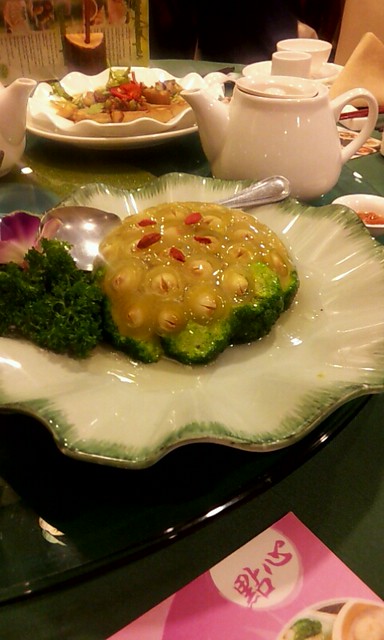
This dish is lotus seeds wrapped in strips of winter melon arranged on a bed of broccoli.
  • lotus【名】《植物》ハス、蓮 (definition from Eijiro on the Web)
  • winter melon《植物》冬瓜 (definition from Eijiro on the Web)
You might say it looks like an alien brain, but actually it had a very mild and pleasant flavor.

It was a vegetarian restaurant, and the menu was overwhelming. There were too many dishes to choose from.
In other words, there were so many dishes that I couldn't choose. At least, it was really difficult to choose. I will have to go again to try different dishes.

I'm too busy in Tokyo to travel as much as I'd like, but every time I go abroad I feel it's refreshing to get a change of perspective. There are so many places that I'd like to visit that I can't see them all in one year. Maybe not even in five years is enough.
  • change of perspective《a ~》観点の変化[を変えること](definition from Eijiro on the Web)
Maybe you feel the same about traveling. If so, English is a really useful skill. It's too useful not to work on improving it now. If you aren't doing so already, I hope you'll start coming to a class to improve your English.

フォロワー