ラベル 完了時制 の投稿を表示しています。 すべての投稿を表示

2009/06/30

完了時制 -- When do I use them? (part 4)

One common pattern for using past perfect uses a "when" phrase. Look back at the last post on past perfect tense from last week:
http://upgradeenglish.blogspot.com/2009/06/when-do-i-use-them-part-3.html
In this case, "when" is a conjunction connecting what looks like two sentences. One style is like this. In the "when" clause, use past tense. It's talking about "past1". In the main clause, use past perfect. It's talking about "past2". For example:
× When I got home tonight, it didn't start raining. <- it sounds like I expected that arriving at home would cause the rain to start... strange...
○ When I got home tonight, it hadn't started raining yet.
× When I opened the bag of eggplants, they spoiled. <- it sounds like they were fine until I opened the bag... strange...
○ When I opened the bag of eggplants, they had already spoiled.
Another style is like this. Use "when" with past perfect to show one action is complete, and that something happened after that. You could also use "after" instead of when. The main clause says what happened after the past perfect verb was completed. Notice that the past tense/past tense version is also OK in this case.
○ When they had finished the work, they took a break.
○ When they finished the work, they took a break.
○ After he had read the book, he wrote a review of it on amazon.com.
○ After he read the book, he wrote a review of it on amazon.com.
When I took this photo, I had already cut the cucumbers and put the red peppers in the container, but I hadn't yet added the vinegar, salt, or sesame oil. I finished adding those things, and then I put the mixture in the refrigerator. After it had been been in the refrigerator for about 20 minutes, I took it out and served it.
  • 酢 (す) (n) vinegar; (P);
  • 黄瓜 (きゅうり) (oK) (n) cucumber;
  • 胡麻油 (ごまあぶら) (n) sesame oil;
Take a look at the other posts on past perfect for review.
http://upgradeenglish.blogspot.com/2009/06/series-on-using-past-perfect.html
http://upgradeenglish.blogspot.com/2009/06/when-do-i-use-them.html
http://upgradeenglish.blogspot.com/2009/06/when-do-i-use-them-part-2.html
http://upgradeenglish.blogspot.com/2009/06/when-do-i-use-them-part-3.html
I might write more on past perfect tomorrow. Take care!

2009/06/26

完了時制 -- When do I use them? (part 3)

I've been talking about past perfect (and other perfect tenses) for a few days now. Here's the list of posts:
http://upgradeenglish.blogspot.com/2009/06/series-on-using-past-perfect.html
http://upgradeenglish.blogspot.com/2009/06/when-do-i-use-them.html
http://upgradeenglish.blogspot.com/2009/06/when-do-i-use-them-part-2.html
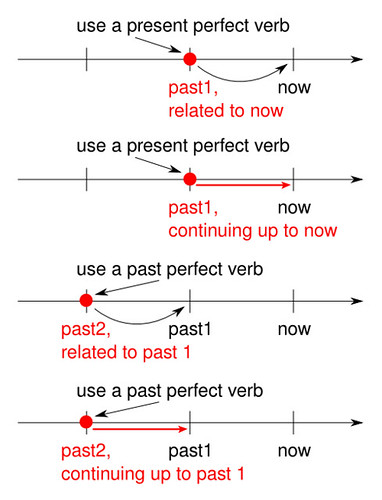
I mentioned that you can use past perfect to talk about something that was related to another past time. Like I said about present perfect a while back, you can also use past perfect to talk about something that continued up to a past time.

So, just like I can say:
  • I have lived in Japan since 2001.
I can also say:
  • I moved to Japan after I had lived in Taiwan for four and a half years.
Maybe it's more common to use past perfect continuous, though, like this:
  • I had been living in Taiwan for about five months when I first experienced an earthquake. <- true!
  • I had been taking a shower for about five minutes when the whole place starting shaking because of an earthquake, the second one I had ever experienced. <- also true! Notice the past perfect in the second half of the sentence.
One day when I was an elementary school student, my mom took me to the mall. In one shop, there was a red jacket with zippers on it, just like in the "Beat It" video!

I had wanted to have a jacket like that ever since seeing the video. For whatever reason, my mom wouldn't buy me the jacket. His albums "Thriller" and "Bad" still sound good to me.

Rest in peace, Michael Jackson.
  • rest in peace〔魂などが〕安らかに眠る、〔霊などが〕休まる◆【略】R.I.P. ・May he rest in peace. : 彼の冥福を祈る。・May his spirit rest in peace. : 彼の魂が安らかに眠らんことを。

2009/06/25

完了時制 -- When do I use them? (part 2)


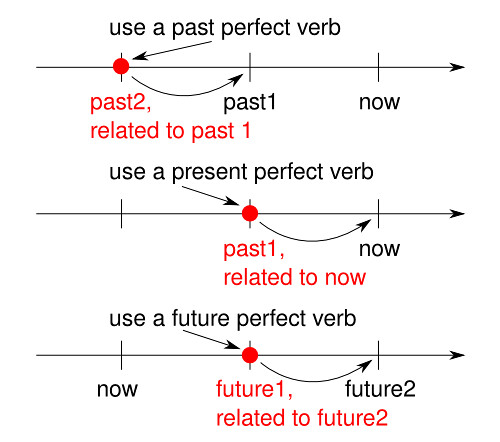
Here's the updated picture from yesterday. Notice how the relationship between one time and a time after it is the same in every case.

That's why past perfect tense is called "past perfect": it's related to some point in the past. Present perfect is related to now. Future perfect is related to some time in the future.

If you can understand this point, then all of the perfect tenses become easier to use, not just past perfect.

You were supposed to add something to yesterday's diagram. I hope you have done it.

I finished this diagram a few minutes ago. I did that because I had told you I would do so. Check your diagram with this one.

I also asked you about these sentences in yesterday's post:
I took my rain suit with me because I had expected it to rain. <- take, past1; expect, past2
I haven't figured out how to make my backpack lighter. <- figure out, past1, related to now
Today I tried a new Indian restaurant. I hadn't been there before. The vegetable curry was nice, but somehow I missed the Nepalese guy at the other restaurant who always tells me things like "today too much hot".
× Today too much hot.
○ It's too hot today (to go out).
○ It's really hot today. <- more natural
By the time this series is over, you will have improved your understanding of perfect tenses. More tomorrow!

2009/06/24

完了時制 -- When do I use them?


One thing that is useful to realize is that perfect tenses (完了時制) generally work by the same logic.
  • logic 論理{ろんり}、論理学{ろんりがく}、論法{ろんぽう}、ロジック、道理{どうり}、理詰め{りづめ}、理屈{りくつ}I see the logic in all that. : その理屈は分かります。It's your logic. : それはあなたの考えだ。(definition from 英辞郎 on the web)
Look at the diagram on the right. When we use a perfect tense, it means that an event has a relationship to some time after the event happens. Can you add something to the diagram to show which time the verb with the perfect tense is related to? I'll update the diagram tomorrow.

I had planned to put an interesting photo with today's post, but I didn't manage to take any good pictures today. <- past perfect

Instead, I have made this diagram. <- present perfect

I hope you will have solved the question about the diagram by tomorrow night. <- future perfect

It was really hot today, wasn't it? I took my rain suit with me because I had expected it to rain. However, it just made my backpack heavier, which made me sweatier. I hope nobody noticed. I haven't figured out how to make my backpack lighter. It's tough having to carry around a portable office all of the time.
  • sweaty 汗の出る、汗にまみれた、汗が出るほどの、汗まみれの、汗のような、汗臭い I'm all sweaty. : 汗びっしょりだ。
Can you match the perfect tense sentences in the paragraph above to the diagram? More tomorrow...

フォロワー