2009/10/28

If there are no fish in my fish tank, is it still a "fish" tank?


Shark week on the Discovery channel is about to end. I hope the last shark program goes out with a bang. Some of the programs I have seen talked about great white sharks (ホオジロザメ). They are very mysterious and beautiful. I just hope I never see one while swimming in the sea.

Speaking of fish, a few weeks ago, we bought a fish tank. After seeing Finding Nemo one time too many, we couldn't resist not buying some clownfish (
カクレクマノミ). However because of my inexperience with fish keeping, the fish kicked the bucket. When it comes to salt water fish keeping, I feel like a fish out of water but I hope to get the hang of it.

Here are some more "fish" expressions and idioms. Can you think of any other ones?

idiom-- have bigger fish to fry/ have other fish to fry
meaning-- to have other things to do; to have more important things to do.
sample sentence-- I won't waste time on your question. I have bigger fish to fry.
From the ALC site-- have bigger fish to fry

ほかにもっと大切[大事{だいじ}]な仕事{しごと}がある

idiom-- There are plenty of other fish in the sea.
meaning-- There are other choices (to talk about people)
sample sentence-- When Takeshi broke up with Keiko, I told her not to worry. There are plenty of other fish in the sea.
From ALC Space--Why do you think he is the only nice-looking man in the world? Look around, there are plenty of other fish in the sea.
この世で格好いい人は彼だけじゃない。周りを見てごらんよ。格好いい人は他にもいる。

idiom-- go out with a bang
meaning-- finish successfully, finish in an exciting way.
sample sentence-- The Sopranos finale went out with a bang.
From the ALC space site-- T
im won't retire quietly. I assure you he will go out with a bang.

ティムはひっそりとは退職しないでしょう。きっと、賑々しく辞めていくと思います

「as to」と「as for」の違いは何?

There are two phrases with "as" that you might come across in a business email: "as to" and "as for".

Some sources, including the American Heritage Dictionary of Idioms, say they have the same meaning. I think they are often used differently, though.
  • "as to" <- to precede an answer to a question or reply to a comment.
  • "as for" <- to state the topic which the main sentence is related to
As to what I was up to over the weekend, I went to a performance at SuperDeluxe in Roppongi. <- "what I was up to" could be seen as a question
http://www.super-deluxe.com/
It's a good venue to see interesting music. I see a show there about once every two or three months.
  • 開催地 (かいさいち) (n) place where a meeting (conference, etc.) is held; venue; (definition from Edict)
The weather wasn't good, but as for the performance, it wasn't bad. It was improvised music on laptops by a trio called Fenn O'Berg. You can listen to some of their music here:
http://www.zero-inch.com/artist/Fenn_Oberg
As for this post, that's it. There will be another post tomorrow!

2009/10/23

「none」と「nothing」の違いは何ですか?

This is my favorite season. None of the other seasons are as good as autumn.

There's a difference between "none" and "nothing" that you should be careful about. If you just look at the Japanese definitions, it seems they're the same:
  • none 誰も[何も・一つも・どれも・どれ一つとして]~ない
  • nothing 何も~ない、少しも~ない、何物{なにもの}も~ない (definitions from Eijiro on the Web)
"None" is used to talk about the lack of something in group.

"Nothing" is used to talk about a total lack of anything.
  • 欠 (けつ) (n) lack; deficiency; vacancy;
  • 缺 (けつ) (oK) (n) lack; deficiency; vacancy; (definitions from Edict)
Look at some examples:
How much did you pay?
× None
○ Nothing
○ How much of the water is in the cup? None of it.
○ What is in the cup? Nothing.

○ How much did you read this week? Nothing.
○ How much of this book did you read this week? None of it.

○ Which of your coworkers speaks Spanish? None of them.
○ How many countries have put astronauts on Mars? None.

○ How much did you pay? Nothing.
○ How much money did you spend? None.
There's nothing I like more in autumn than mandarin oranges. I hope none of you have anything but a great weekend!

2009/10/22

「how」と「what」の違いは何?

The other day I read this:
× How fantastic party it is!!
How fantastic it was!!
What a fantastic party it was!!
There's a grammatical difference between "how" and "what" in exclamations. Here are the patterns you should use:
  • How __(adj)__!
  • What a __(adj)__ __(n)__!
Some friends of mine opened a flower shop in Aoyama.
http://www.illony.com/taniblog/
When I visited it, I saw these flowers.
× How interesting flowers!
What interesting flowers!
To be honest, I usually don't use these patterns, though. I usually say something like:
  • Wow! Those flowers are really interesting!
There are lots of other beautiful flowers and arrangements there. You should check it out!

2009/10/21

今まで通りのポストの上に猫を見たことがありますか?

I have seen black cats. I have seen striped cats. I have seen scary stray cats but I had never seen cats on a street post before until very recently.

I went to Ginza with my family on a sunny Sunday afternoon a few weeks ago. Ginza is a great place to visit on the weekends. The streets are closed off and are car-free (歩行者天国) . It's unusual to have streets closed off just for pedestrians in my hometown, San Francisco.

When I got to the main street, we saw an ojiisan reach into his paper shopping bag, take out kittens one after another and put them on top of the street sign. A lot of people gathered around and started taking pictures of the cats so naturally I did the same. When in Tokyo, do as the Tokyoites do.

The cats were the stars of the afternoon. The next time you have a free afternoon on a Sunday, why don't you go to Ginza? You can walk on the street and make car noises.

Let's take a look at some common "cat" idioms.

a stray cat: 野良猫

When the cat's away, the mice will play: Without supervision, people will do as they please, especially in disregarding or breaking rules. For example, As soon as their parents left, the children invited all their friends over

From the ALC Space website:
When the cat's away, the mice will play.
猫がいないとネズミが暴れる。/鬼の居ぬ間に洗濯。


let the cat out of the bag: to reveal a secret or a surprise (sometimes by accident).

From the ALC Space website:
I'm going to storm into the police station and let the cat out of the bag.
警察に駆け込んで全部ぶちまけてやる.

2009/10/20

この雑誌は英語の使い方に注意した方が良い。

I saw this magazine on the newsstand the other day.
  • newsstand 【名】〈米〉ニューススタンド◆駅・路上などで本・新聞を売る露店(小さな売店)
The caption above the five portraits on the cover says:
× NEW HABITS FOR MANAGING YOUR TIME AND IDEA
It should say:
NEW HABITS FOR MANAGING YOUR TIME AND IDEAS
"Idea" is a countable noun. If you don't use the plural in this case, it sounds like you have only one idea. That's certainly not what this magazine means.

However, if you use "idea" as a singular noun, since it is countable, you must use something like "a" or "the" in front of it.

If a restaurant makes a mistake with their English usage, that's one thing.
  • That's one thing. あれは許せるけど、... <- not so sure about this translation, but...
A magazine, on the other hand, has a close relationship to language. How could they not ask a native speaker to check their English usage, especially on the cover?
  • かと言って (かといって) (exp) (uk) having said that; on the other hand; (definition from Edict)
  • その反面 (そのはんめん) (n) on the other hand; (definition from Edict)
If I were the editor, I'd be really embarrassed.

2009/10/14

人間の第一の友

Do you know the discovery channel? Have you ever seen one of their programs? If you have and are like me then you would agree that one of the most exciting programs are about sharks. And guess what? Shark week is coming to the discovery channel! To celebrate the coming of shark week, I thought it would be a good idea to do some posts about animals. It would be hard to find someone who isn't fond of animals. First up this week, let's take a look at some "animal" idioms. Here are some common dog idioms.

Last week, typhoon Melor passed through the Kanto region. It was raining cats and dogs. In fact, it rained so hard some of my classes were cancelled.
Meaning: Use it's raining cats and dogs to describe heavy rain.

I broke my wife's favorite vase and have been in the dog house since.
Meaning: You have done something which has made someone angry.

When your boss is in a bad mood it is best to let sleeping dogs lie.
Meaning: Leave something/someone alone if it might cause trouble.

The proverb "Barking dogs seldom bite" suggests that people who say they are going to do something bad to us usually do nothing.

Last but not least, are you a dog person or a cat person? Do you prefer dogs or cats?
Use last but not least to emphasize that while it is listed last on the list, it is just as important as the other things mentioned (earlier) on that list.

Some samples from ALC space website:

As far as symphony is concerned, he is said to be fond of Gustav Mahler.
交響曲ではグスタフ・マーラーが好きなのだそう。

Father has been in the dog house since he lost his wedding ring.
パパは結婚指輪をなくしてから、すっかり頭が上がらない。

Last but not least
大事{だいじ}なことを言い忘れていたが
Last but not least, allow me to add some suggestions to further improve the magazine which will be facing the 21st century very soon.
最後に、間近に迫った21世紀に向け、本誌の一層の向上をはかるためにいくつかの提案をさせていただきたいと思います。

You know what they say. Let sleeping dogs lie.
よく言うでしょ、「触らぬ神にたたりなし」ってね.

Let sleeping dogs lie.
眠っている犬を起こすな。/寝た子を起こすな。/触らぬ神にたたりなし。/事を荒立てるな。/やぶをつついてヘビを出すな.

接続詞の使い方

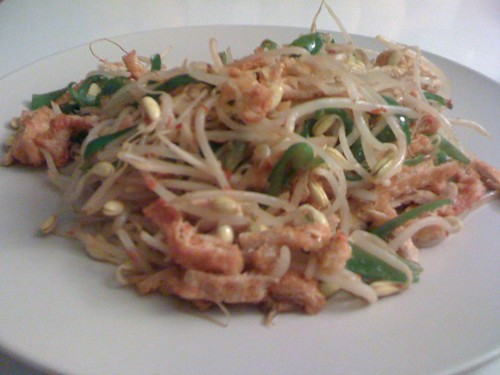
This was a successful dish. I made it a little more than a week ago. Since I've been busy showing you signs with mistakes, I didn't post it on the blog.

I was talking with someone last week. She told me about Thai curry in Thailand and the same dish at a Thai restaurant in Japan. She told me:
× It was good but not the one we ate in Thailand.
○ It was good, but not as good as the one we ate in Thailand.
○ It was good, but it wasn't as good as the one we ate in Thailand.
I feel the first sentence has a mistake because the two things connected by the conjunction aren't the same type of thing: "good" is an adjective, but "the one" is a pronoun.

In the second sentence, we just connect "good" with "not as good", both of which are adjectives. In the third sentence, we connect one sentence with another sentence.

This dish in my photo has slices of fried tofu, green pepper (remember this post?), and bean sprouts. <- noun, noun, and noun

I stir-fried everything and added a spicy Chinese sauce. <- verb and verb

Using grammar well is sometimes hard. What do you think about cooking delicious dishes: hard or easy? <- adjective and adjective

フォロワー