ラベル 単語 の投稿を表示しています。 すべての投稿を表示

2012/07/17

「暑い日」を英語で


I was preparing some teaching materials today, and I came across a sentence that described today's weather pretty well.
  • It's a scorcher today. 今日は焼け付くように暑い。(example from Eijiro on the Web)
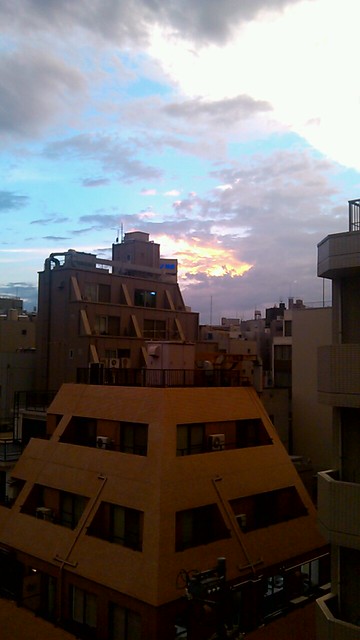
It may have been hot, but the sunset was a beautiful one. The sky went golden. I enjoyed looking at it for about five minutes until I went back inside because it was still too hot.

The three-day weekend was a scorcher, too. I went running on Sunday afternoon, not expecting it to be so hot. 45 minutes later, I was dripping wet.
  • enjoy the three-day weekend 3連休を楽しむ (definition from Eijiro on the Web)
What advice do you have for sweltering heat?
  • sweltering heat うだる[地獄の]ような暑さ (definition from Eijiro on the Web)
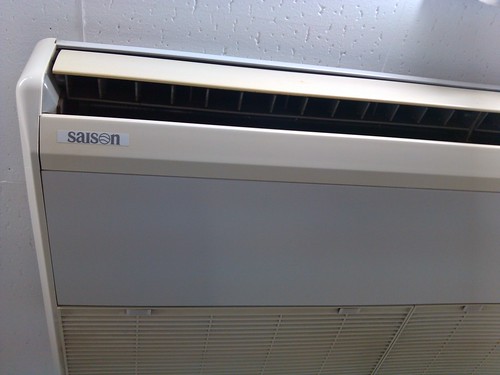
I wish there was a better alternative, but the most practical thing I know to do right now is to sit directly under the air conditioner vent. Watch out for heat stroke!
  • heat stroke 熱射病 (definition from Eijiro on the Web)

2012/04/04

「rent, lend, borrow」の違い


The other day somebody came to class and realized she had forgotten her pen. She asked me:
× Can you borrow a pen?
○ Can I borrow a pen? Can you lend me a pen?
  • borrow 借りる
  • lend 貸す
"Borrow" and "lend" have a direction. The subject of "borrow" is receiving something. The subject of "lend" is giving something.

I was talking about a book with someone. It sounded like an interesting book. The person I was talking to sensed my interest in the book and said:
× I can rent it to you.
○ I can lend it to you.
  • rent 賃借[賃貸]する
If you rent something, it means you are a business person. You are earning money by allowing someone to use something that you own. I know that the pronunciation of these two is a little similar. You have to be really careful about "r" and "l".

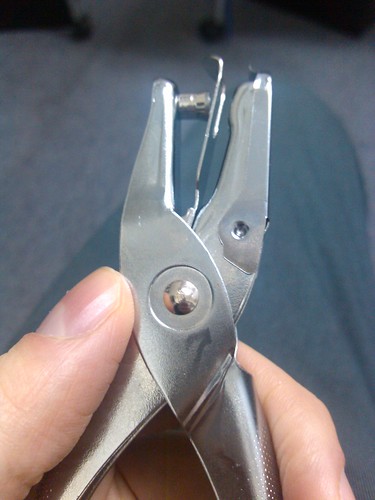
One student has been collecting notes from class in her notebook. She always punches holes in her paper using the rings in her binder. I had been meaning to get a hole punch, but every time I go to the 100 yen shop or office supply store, I always seem to forget what I wanted to buy.
  • hole punch 穴あけ器 (definition from Eijiro on the Web)
This week, though, my memory was working well, and I remembered to get the hole punch.

If you ever visit me at my classroom, I'd be happy to lend you a pen or my hole punch. I'll even lend you a sympathetic ear.
  • lend a sympathetic ear 親身になって耳を貸す、同情して話を聞く、じっくり話を聞く (definition from Eijiro on the Web)

2012/02/03

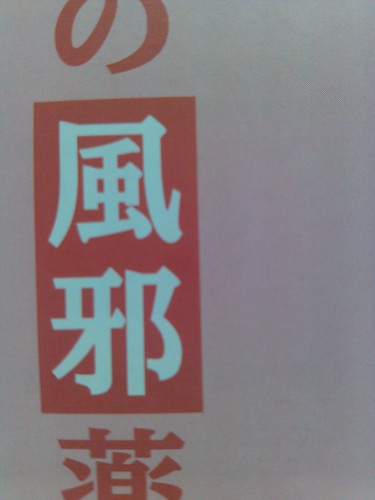
風邪の話


Sorry for the long silence on the blog since the last post. Last week was really busy, and I think I'll write about it in my next post. This week I had the worst cold I've had in a long time.

I started to come down with this cold on Sunday. The symptoms were typical. By Sunday night, I was suffering from chills and body aches.

  • come down with a cold 風邪{かぜ}で倒れる[ダウンする](definition from Eijiro on the Web)
  • symptom 症状
  • chills 悪寒 (definition from Eijiro on the Web)
  • body aches 体の痛み (definition from Eijiro on the Web)

When I woke up on Monday morning, I felt like death warmed up.

  • feel like death warmed up ひどく疲れている、ひどく具合が悪い (definition from Eijiro on the Web)

Still, somehow by late Monday evening I had recovered a lot, I thought, so Tuesday I went ahead with teaching.

  • go ahead with 〔計画{けいかく}・仕事{しごと}などを〕進める、推進{すいしん}する、強行{きょうこう}する (definition from Eijiro on the Web)

That might have been a mistake. I got a runny nose, and I couldn't stop sneezing. When I got home, I found out that I was running a fever. I started coughing. I really hope I didn't pass my cold to my student on Tuesday evening.


  • runny nose 鼻水の垂れている鼻
  • sneeze くしゃみをする
  • run a fever 熱を出す
  • cough 咳をする
  • (definitions from Eijiro on the Web)


Wednesday I finally went to the doctor to get some medicine, which seemed to help with my fever. I was still coughing, though, and the runny nose turned to a stuffed-up nose. The staff at the clinic told me they had seen many patients with colds. This is one trend that I don't want to take part in, though.

  • have a stuffed-up nose 鼻が詰まっている (definition from Eijiro on the Web)
  • take part in ~に参加{さんか}[出場{しゅつじょう}]する (definition from Eijiro on the Web)

Finally today I feel back to about 75% of my usual self, with a normal body temperature and no runny nose.

  • body temperature 体温 (definition from Eijiro on the Web)

If you are one of those people suffering from a cold, I hope you get well soon!

  • Get well soon. 早く元気になってくださいね。/お大事に。◆【場面】見舞いなどで病人の早期回復を願う。(definition from Eijiro on the Web)

2011/12/27

「yule」とは


You might have heard in an English song or movie something about "Yule" when they are talking about Christmas. If you check Eijiro on the Web, you'll find:

  • yule【名】キリスト降誕祭、クリスマスの季節 (definition from Eijiro on the Web)

Maybe a lot of people think they are synonymous, but it's not really true.

  • synonymous【形】同意語の、同義の、同義語の、同義的な、類義語の (definition from Eijiro on the Web)

If you check Wikipedia, you'll find out that it's actually a pagan holiday!
http://ja.wikipedia.org/wiki/%E3%83%A6%E3%83%BC%E3%83%AB
Christmas was two days ago, but Yule runs until January 6, I think. Traditionally, it was celebrated for 12 days. If you've got a Christmas tree, then you are celebrating Yule!

I suppose most Japanese associate Christmas with romantic dates and cake, but from the point of view of nature, now the days are getting longer.

  • associate ~ with ~と…を結び付ける、…で~を連想する (definition from Eijiro on the Web)

The meaning of Yule is related to the winter solstice and the days starting to get longer. I wish the longer days would bring about warm weather sooner. It's pretty cold outside today! Until the warm weather shows up, I think I may just sit here underneath the heater.

  • underneath【名】下部、底 (definition from Eijiro on the Web)

2011/11/22

「within walking distance」といろいろな単語の説明


I wanted to see if Otemachi is within walking distance of our classroom. Our classroom is really close to Kanda Station, Shin-nihonbashi, and Mitsukoshi-mae Stations, but looking at the map, Otemachi looked really close, too.
  • within walking distance of ~から歩いて行ける距離[範囲]で (definition from Eijiro on the Web)
  • It's within walking distance. 歩いて行ける距離です。(definition from Eijiro on the Web)
I thought it probably was close enough to walk from, so I took a walk to confirm my hypothesis.
  • confirm the hypothesis that 〔that以下〕という仮説{かせつ}を裏付ける{うらづける}(definition from Eijiro on the Web)
After checking the map, I hit the door and started down the street towards Otemachi Station. A lot of people were just getting off work and heading towards various stations.
  • hit the door 出発する (casual)
  • head towards ~の方へ向かう (definition from Eijiro on the Web)
When I got to Otemachi, I snapped this shot of exit A5, the one closest to our classroom. An office worker was going down into the station, and a member of the station staff was coming up the stairs.
  • snap a shot of ~の写真を撮る (definition from Eijiro on the Web)
I started my stopwatch and turned around towards our classroom. I took a reasonable pace. I passed some construction workers carrying their equipment back to their van. One older man in down jacket seemed to be in a hurry and passed me.
  • in a hurry 急いで、慌てて (definition from Eijiro on the Web)
The sidewalks were full of commuters, but after eight minutes and 10 seconds, I arrived in front of our building.
  • commuter【名】通勤者{つうきん しゃ}、通学者{つうがく しゃ} (definition from Eijiro on the Web)
What do you think? Is eight minutes within walking distance? Regardless, there are three other closer stations nearby, within three to five minutes. I hope you will walk over and say hello.

2011/10/07

「much」の使い方


OK, who keeps letting people put up nonsense English in Yaechika? I found this one:
× Much the Autumn
○ ???
This one is hard to guess. I wonder what they meant?
  • Bountiful Autumn 
  • bountiful【形】〔物が〕豊富{ほうふ}な; 〔人が〕気前{きまえ}の良い; 〔人が〕慈悲深い、恩寵{おんちょう}の豊かな (definition from Eijiro on the Web)
  • It's very much autumn now!
  • It's much like autumn.
  • Will you buy much this autumn?
Maybe they are making a pronunciation mistake!
Match the Autumn 秋に会う <- is this Japanese OK?
Don't say this though:
× I bought much at Yaechiku.
○ I bought a lot at Yaechiku.
Only use "much" for negative sentences and questions. In a positive sentence, you should use "lots" or "a lot".

I keep finding mistakes at Yaechika. I'm going to search at Kanda Station more. I feel like I might find a lot of mistakes there, too. Do you think I will have much success finding them there? I think it's going to be a bountiful autumn. Wish me luck!

2011/10/05

Tully'sは英語の使い方に注意した方が良い


I hadn't been to Yaechika in a while. I can always find English mistakes, there, and this time was no exception.
  • no exception《be ~》例外{れいがい}でない (definition from Eijiro on the Web)
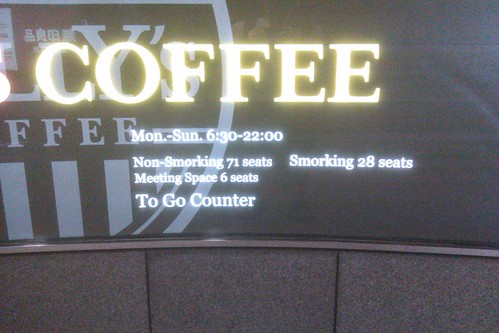
Just when you come down the stairs on the Yaesu Avenue northeast entrance, there's a new Tully's. They have a gorgeous new sign, which says:
× Non-Smorking 71 Seats; Smorking 28 Seats
○ 71 non-smoking seats, 28 smoking seats
What do you suppose "smorking" is? I looked it up, and the Urban Dictionary had this funny definition:
  • smork - someone who is so smitten, they are acting like a absolute dork. Slightly embarrassing, usually someone who is not an obviously smitten person, hence the lame name Smork. "You are acting like such a smork, you're definitely smorko over him" <- my note: "smork" is not common English. Don't expect many to know this.
  • smitten【形】〈英俗〉ぞっこんほれ込んだ (definition from Eijiro on the Web)
  • dork【名】〈俗〉ばか、あほ、とんま、愚か者、のろま (definition from Eijiro on the Web)
So I suppose it's nice of Tully's to provide special seats for those who have fallen head over heels for someone.
  • ぞっこんほれ込みなさい。 Fall head over heels. (definition from Eijiro on the Web)
The sign also says:
× To Go Counter
to-go counter
When you use a phrase as an adjective, you should connect the words with a hyphen.

Because of that, I would also say:

× Meeting Space 6 seats
6-seat meeting space

Good luck everybody, smorks included. Even I can be a mistake-making dork sometimes.

2011/08/23

「success」の使い方


I haven't put up any pictures of food I've cooked lately. One reason is that I haven't been cooking so much lately. I've been too busy.

I cooked these fried noodles the other day. Besides onions, carrots, and fried tofu, I used some spicy oil with sesame seeds. The noodles were just ordinary buckwheat noodles. You might want to ask me:
× Did you success?
○ Did you succeed?
○ Were they a success?
○ Were they successful?
Notice that "success" is a noun. The verb is "succeed", and the adjective is "successful".
  • (definitions from Eijiro on the Web)
  • success 成功(者){せいこう(しゃ)}、合格{ごうかく}
  • succeed【自動】成功{せいこう}する
  • successful【形】〔結果{けっか}が〕上出来{じょうでき}な、上首尾{じょうしゅび}の、成功{せいこう}した
Yeah! These noodles were a big success, I thought. However, it could have been just because I was really hungry at the time.

One thing that I haven't been successful at is posting on this blog twice a week. Let's see if I have more success this week.

2011/08/16

水関係言葉


I was pouring sweat this afternoon. I needed to go several places, and with the heat, my body's natural reaction was to drench my tshirt.
  • pour sweat 全身{ぜんしん}に大汗{おおあせ}をかく、汗だくになる (definition from Eijiro on the Web)
  • drench 水浸{みずびた}しにする、びしょぬれにする (definition from Eijiro on the Web)
I changed out of my wet tshirt when I got back to the office.  I stuck my head in the sink and splashed it with cool water, then I felt much better.
  • splash〔液体{えきたい}を〕散らす、飛ばす(definition from Eijiro on the Web)
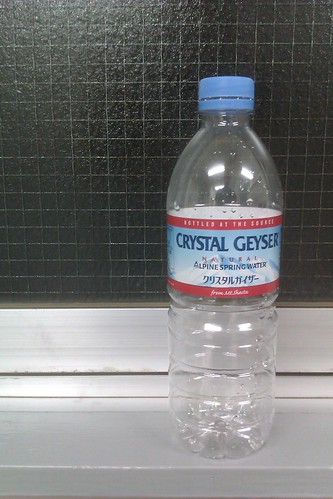
This bottle of water wasn't enough to quench my thirst. I felt more satisfied after a bit more water and then a cup of coffee.
  • quench thirst 渇きを癒やす(definition from Eijiro on the Web)
The soil for the plants wasn't moist at all, so I poured water in the pots. I wonder if they actually prefer the heat when we're out of the office to the cool air-conditioned air when we're in the office.
  • moist【形】湿った、湿気{しっけ}のある、ぬれた、涙ぐんだ、じっとりしている(definition from Eijiro on the Web)
  • pour~を注ぐ、液体{えきたい}をつぐ、光を放射{ほうしゃ}する、弾丸{だんがん}を浴びせる、殺到{さっとう}する(definition from Eijiro on the Web)
It will feel good to rinse off in the shower when I get home.
  • rinse off ゆすぎ落とす、洗い流す(definition from Eijiro on the Web)

2011/07/29

このリースを作った人は英語の使い方に注意した方が良い。


I found this wreath on a door the other day. It says:
× Country Home, Sweat Heart
○ Country Home, Sweet Heart
  • sweat (noun) 汗◆【類】perspiration (definition from Eijiro on the Web)
  • sweet (adj) 思いやりのある (definition from Eijiro on the Web)
If your heart is sweating, you had better see a doctor.

If your heart is sweet, I'd like to meet you! Why don't you come visit one of my classes?

I suppose this person is fantasizing, but an office in Tokyo is about as far from a country home as you can get.
  • fantasize (definition from Eijiro on the Web)
    【自動】空想{くうそう}[夢想{むそう}]する[にふける]
    【他動】~を夢に描く
  • country home 田舎の家 (definition from Eijiro on the Web)
  • Both countries are about as far away as you can get from each other. 両国はもうこれ以上遠くなりようがないほど離れている。(example from Eijiro on the Web)
I'm waiting for all of you sweethearts in my city office.
  • sweetheart 親切な人 (example from Eijiro on the Web)

2011/07/26

「fall apart」の使い方


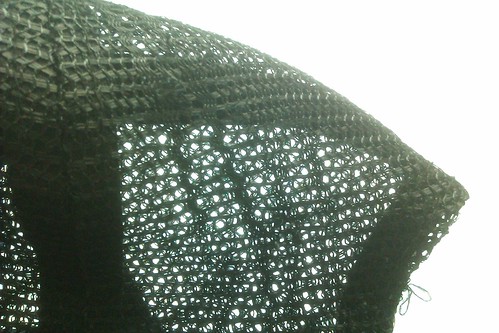
It might be hard to tell what that is a photo of. It's my two-year-old cap. I've used it and washed it too many times, so now it's falling apart.

The definition for "fall apart" in this sentence from Eijiro on the Web is ボロボロになる. There are a lot of other meanings, like in my sentence below. Take a look at the other definitions of "fall apart":

http://eow.alc.co.jp/fall+apart/UTF-8/

The mesh is coming undone, and I'm afraid the whole back is close to unraveling.
  • come undone ほどける、失敗する、破滅する (definition from Eijiro on the Web)
  • unravel 【自動】解ける、ほどける、ほぐれる、明らかになる、ほころびる、解体{かいたい}する、分解{ぶんかい}する 【他動】~をほどく、ほぐす、~を解く、解明{かいめい}する、〔計画{けいかく}を〕つぶす (definition from Eijiro on the Web)
At least I have other caps to wear as backups to this one.

At the same time, it seems that Japan's old nuclear plans are falling apart. China's plan to sell high-speed rail to the rest of the world seems to be coming undone, too. The American economy is unraveling. I wonder what backups to use in these situations? Dark days, huh?
  • dark days 失意の時代、不遇の時代 (definition from Eijiro on the Web)

2011/07/19

「oops!」の使い方・私は日本語の使い方に注意した方が良い(part 5)。

Over the holiday weekend, I moved our website to a new hosting company.
over the weekend 週末{しゅうまつ}に~
holiday weekend 祭日{さいじつ}と重なる週末{しゅうまつ}(definition from Eijiro on the Web)
The internet is a complex system. Have you ever thought about how it works? Basically, you type an address into your browser. The address you use is an easier one, though. For example, when you type the address for this blog, "upgradeenglish.blogspot.com", there is a special computer (called a "name server") out on the internet that converts this address to something called an IP address. For upgradeenglish.blogspot.com, the IP address is 74.125.153.132.
convert コンバート, コンヴァート, 転換 (definition from jmdict)
Basically the computer at that IP address gives you the web page that you have requested.

When I moved our website to a new hosting company, the IP address changed, even though the name you use, upgradeenglish.com, didn't change. It takes some time for all the name servers to know the new IP address.

On Sunday night when I looked at the webpage, I saw this page which said "oops!".
oops 【間投】
    ウープス、おっと!、しまった!◆へま・失敗をしたとき
    ・Oops, I did it again. : やばい、またやっちゃった。
    ・Oops, I hadn't thought of that! : しまった、それを忘れてた。◆【場面】計画などに見落としがあった。
    うわっ!◆驚いたとき
Use "oops" by itself, often followed by a "!" to acknowledge a mistake.
You may learn a lot to acknowledge your mistakes and this will help your effort for self improvement. もっと自分の間違いを素直に認めるようにすれば、内面的な成長の役に立つはずです。◆【出典】Hiragana Times, 1993年12月号(株式会社ヤック企) (sample from Eijiro on the Web)
As a result, some of you may have seen a broken webpage on the weekend or had trouble sending me email. If you did, I'm sorry about that! Everything seems to be working fine now, though.

I also recently found out I had a Japanese spelling mistake on the website. I wrote "ブログ" as "ブロッグ". Oops! If you find any mistakes, please let me know!

2011/07/08

「street」の使い方

Our new classroom is on Bank of Japan Street (日銀通り). We use "on __ street" to talk about the location.
Bank of Japan - 日本銀行、日銀 (definition from Eijiro on the Web)
British people say "in Bank of Japan Street", but I think for Americans "in the street" has a different meaning.

Don't play in the street! It's dangerous!
in the street (definitions from Eijiro on the Web)
    1. 通りで、街頭{がいとう}で
    2. ブラブラして、住む所がなくて、あぶれて
    3.〔株の取引{とりひき}が〕時間後売買{じかんご ばいばい}の
It really is just up the street from the Bank of Japan; it's only about 400 meters away.
up the street - 通りを向こうへ、この先に (definition from Eijiro on the Web)
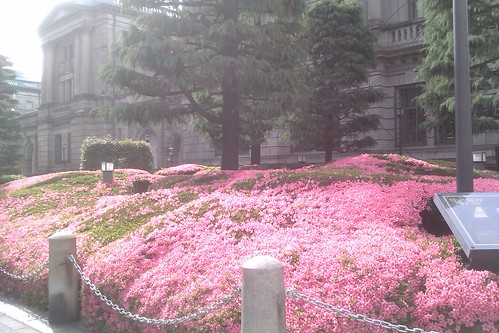
Back in May, the azaleas they have in front of the building were blooming beautifully.
azalea -《植物》ツツジ (definition from Eijiro on the Web)
Across the street, there's a Family Mart. It's very convenient, and the manager is a helpful guy. One evening he spent some time giving me advice on how to throw out our cardboard boxes from moving. As it turns out, though, I really did have to put them in the street for the garbage collector.

One street over is Main Street (中央通り), where Mitsukoshi-mae (三越前) Shin-Nihonbashi (新日本橋) Stations are located. Kanda (神田) Station is just a couple of streets up from our building.
one street over - 次の道
Come by and pay us a visit! Here's the details of our location.
pay someone a visit - (人)を訪ねる[訪問する・見舞う](definition from Eijiro on the Web)

2011/06/14

変な英語の使い方


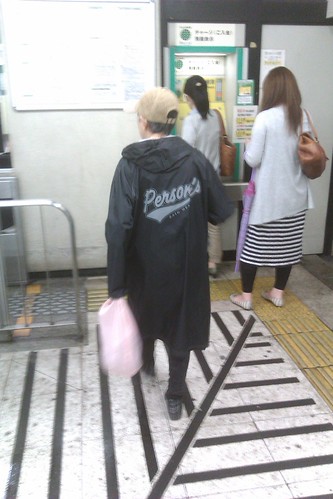
This person's jacket says "Person's". I thought that was funny. It's a good thing that it didn't say "Dog's" or something like that. At least the English grammar is basically correct though.

You know, I always wonder what some clothing makers are thinking. If you see a jacket that says "Person's", what do you think? Does that word really make you want to buy it? Would you feel cooler if you had "Person's" written large across your back?

Personally, I'd never choose a jacket that said 人間の on the back. One student told me that sometimes I'm more like a robot, so maybe I should have a jacket that says "Robot's". Another student told me "you're like a strange animal!" Does it mean I need one that says "Strange Animal's"? Would that be a cool jacket?

Sometimes fashion is mysterious.

mysterious 【形】神秘{しんぴ}の、はっきりしない、神秘的{しんぴてき}な、秘密{ひみつ}の、不可解{ふかかい}な、いわくのある、えたいの知れない、謎めいた (definition from Eijiro on the Web)

2011/05/24

このドイツ人は日本語の使い方に注意した方が良い。


One of my stops in Europe was Berlin. It was a great city! The food was delicious and affordable, and the people were very friendly. There was so much art activity going on, as well.

affordable【形】手頃な[良心的な・手の届く・無理なく買える]価格

While I was walking around East Berlin, I found this guy. Check out his tshirt! I wonder if he has any idea what it means. Maybe he does and thinks its funny or cool, but maybe he doesn't.

The point is that you shouldn't wear foreign words on your clothing or bags unless you know the meaning. I still chuckle when I remember the 65 or 70-year-old woman I saw in a night market in Taiwan wearing a tshirt that said "porn star".

pornstar【名】ポルノ女優、AV女優 (definition from Eijiro on the Web)

Make sure you aren't accidentally expressing something you don't mean!

2011/05/21

「先々週」は英語でどう言う?


Sorry for the long break between posts. The week before last I was attending a conference at the National University of Ireland.

the week before last - 先々週

It has a really old campus, full of buildings like the one in this picture.

After the conference, I visited people in Europe. The Monday before last I flew from Dublin to Berlin, and three days later I went to Amsterdam. It was a pleasant trip, filled with wonderful people, nice food, and stimulating music.

I've been back in Tokyo for a week, but it has been a little difficult because of jetlag.

I hope my sleep schedule will be back to normal next week, but it will be fine by the week after next for sure.

the week after next - さらい週

2011/03/22

「tell、talk、speak、say」の違い (part 4)

I haven't said anything on this blog since the earthquake. Google says that this site has readers in Fukushima, Miyagi, and other places hit by the quake. I think I have only met one of you, but I want to say to all of you that we have been so concerned. I feel so sorry for the whole region. At first, I wanted to say that I hope our readers and their friends and families are OK. Then I thought that saying that would be strange. I want everyone to be OK. I want all of the suffering to end.

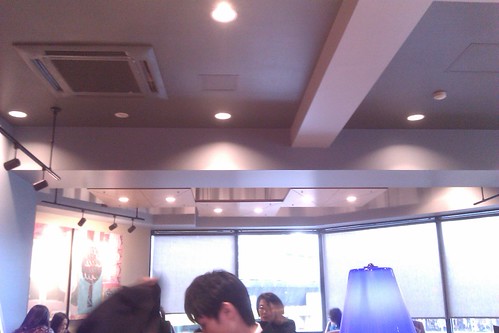
During the earthquake, I was sitting in Starbucks and trying to study Japanese. The building started to shake. I was watching the things hanging from the ceiling (in the photo above) begin to sway. The swaying got more and more violent.

× I can tell that I was afraid. <- see this post for more about "tell"
◯ I can say that I was afraid.

I cannot imagine how terrifying it must have been for those who were closer to the epicenter.

● epicenter 震源 しんげん 震源地 しんげんち 震央 しんおう (definition from jmdict)

"Say" is similar to "tell", except that it doesn't need a target. It just needs to be followed by content.

× After the earthquake, my parents and I said. <- no content!
◯ After the earthquake, my parents and I talked. <- casual
◯ After the earthquake, my parents and I spoke. <- a bit more formal

× They told that they were really worried.
◯ They told me that they were really worried.
◯ They said that they were really worried.

I'm also worried about the situation, especially with the nuclear power plant in Fukushima, but NHK says that engineers there are making progress with the help of fire fighters. I also frequently look at various websites where data on radiation monitoring has been posted. They say the radiation in Tokyo is just slightly higher than normal, so I don't feel so nervous.

I hope that in a couple of weeks I will be able to say that the worst part of the crisis has past. However, this being such a huge disaster, who can say when Japan will have recovered from it? I can only say that it will be a long time from now.

2011/03/10

「tell、talk、speak、say」の違い (part 3)

These days I've had to take care of a lot of business. Notice how "speak" is used.

× As a result, I have had to talk Japanese a lot. <- don't use "talk" for a language
◯ As a result, I have had to speak Japanese a lot.

× I told a government officer yesterday. <- "tell" needs some content
△ I talked to a government officer yesterday. <- this is OK, but it's a little bit too light. My conversation was kind of serious.
◯ I spoke to a government officer yesterday. <- best

× I was filling out a form, and he spoke to me about some points to be careful about. <- "about" doesn't feel direct enough, and using "about" twice feels strange here
◯ I was filling out a form, and he told me some points to be careful about.

× Can you speak what this is a photo of? <- the action of speaking isn't important; the content is...
◯ Can you tell me what this is a photo of?

More in the next post...

2011/03/09

「tell、talk、speak、say」の違い (part 2)

I was talking about the difference between these words in my last post. You might want to read it to catch up with this series.

We usually don't use a noun directly after "talk". Instead, we put a preposition after it.

◯ I talked with my friend yesterday. <- "with" feels more like a discussion

◯ I talked to my friend yesterday. <- "to" sounds like brief contact, or sometimes one-way contact

◯ We talked about the difference between English schools. <- use "about" to describe the content

When you want to emphasize the act of speech, don't use "talk". Use "speak" instead.

× I talked some Chinese yesterday.

◯ I spoke some Chinese yesterday.

When I got in the elevator two nights ago, a woman I didn't know started talking to me suddenly. I couldn't hear what she was saying at first because I was listening to music on my headphones. I could tell that she had been drinking (see the last post for more about "tell") because of the strong smell of alcohol. We talked about the snow that fell that morning, and then I told her "good night" when she got off the elevator on her floor.

I told you that I'd tell you what the photo in the last post was of. It's a lamp as seen between someone's fingers. This photo is of a meal I cooked last month, I think. I like to talk about what I cook, but this post is already too long. More in the next post.

2011/03/08

「tell、talk、speak、say」の違い (part 1)

Sometimes people tell me that these words are confusing, so I want to talk about them over a few posts. However, first I want to tell you that I'm sorry it has been so long since my last post.

First, let me tell you about "tell". "Tell" has several meanings. The most common one uses a person as an object, like the "tell" in this sentence and the one above it, and then it is followed by some content that is told. The other day someone I know wrote:

× He told he's a college student. <- "he's a college student" is the content
◯ He told me that he's a college student. <- "tell" needs a person as an object

◯ He said that he's college student. <- or you can use "said" instead

Sometimes we use "tell" with an object like "story" or "joke" or another word that describes the content of what you are saying.

◯ I can't tell a lie; I've been working on an important secret project. I'll tell the story of my recent business later.

Another really common meaning for "tell" is to say that someone can understand something based on what you perceive.

tell ~ apart ~を見分ける、~を区別する (definition from Eijiro on the Web)
● tell ~ from ~と…を識別する・How can you tell the flu from a cold? : インフルエンザと風邪は、どうやって見分けることができますか。 (definition and example from Eijiro on the Web)

Can you tell what that is a photo of? I'll tell you in the next post I make.

フォロワー