ラベル よくある間違い の投稿を表示しています。 すべての投稿を表示

2012/04/04

「rent, lend, borrow」の違い


The other day somebody came to class and realized she had forgotten her pen. She asked me:
× Can you borrow a pen?
○ Can I borrow a pen? Can you lend me a pen?
  • borrow 借りる
  • lend 貸す
"Borrow" and "lend" have a direction. The subject of "borrow" is receiving something. The subject of "lend" is giving something.

I was talking about a book with someone. It sounded like an interesting book. The person I was talking to sensed my interest in the book and said:
× I can rent it to you.
○ I can lend it to you.
  • rent 賃借[賃貸]する
If you rent something, it means you are a business person. You are earning money by allowing someone to use something that you own. I know that the pronunciation of these two is a little similar. You have to be really careful about "r" and "l".

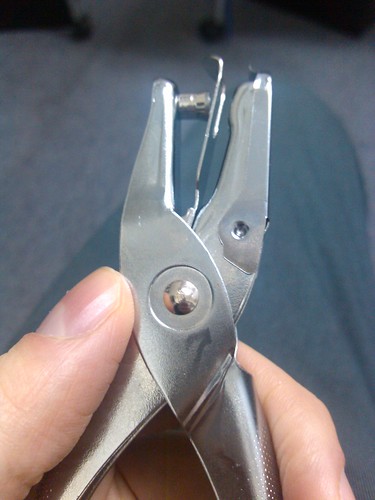
One student has been collecting notes from class in her notebook. She always punches holes in her paper using the rings in her binder. I had been meaning to get a hole punch, but every time I go to the 100 yen shop or office supply store, I always seem to forget what I wanted to buy.
  • hole punch 穴あけ器 (definition from Eijiro on the Web)
This week, though, my memory was working well, and I remembered to get the hole punch.

If you ever visit me at my classroom, I'd be happy to lend you a pen or my hole punch. I'll even lend you a sympathetic ear.
  • lend a sympathetic ear 親身になって耳を貸す、同情して話を聞く、じっくり話を聞く (definition from Eijiro on the Web)

2012/03/28

成田空港は英語の使い方に注意した方が良い。「the」の使い方


I haven't posted in a while because I took a trip to the US. It was interesting to visit, especially because it had been a while.
It's been a while since
~して以来ずいぶん日がたつ。/久しぶりに~する。/~するなんて久しぶりだ。/ずいぶん長い間~していなかった。/最近[ここしばらく]~していない。(definition from Eijiro on the Web)

On the way back, I was waiting for the Narita Express when I noticed this sign.
  • This is the terminal 1 of Narita Airport.
  • This is terminal 1 of Narita Airport.
  • This is Terminal 1 of Narita Airport. <- treating it as a proper noun might be best

Some people think "the" is tricky, but actually there are not so many special cases, and only a few rules. One of the rules is this:

Don't use "the" in the case of a name with a title.

You don't say the Mr. Bell (usually), nor do you say the Queen Elizabeth; you say Mr. Bell or Queen Elizabeth. In the same way, we don't say the Mount Fuji; it's Mount Fuji.

Numbered buildings, platforms, and terminals are the same.
  • The train you want is at platform 3.
  • His office is in building 5. <- one building in a complex of buildings

If the building my classroom is in were a giant space station or complex of some sort, I could say that my classroom is on level 6. However, our building is a rather small one between Shin-nihonbashi Station, Mitsukoshi-mae Station, and Kanda Station. As a result, I can just say that our classroom is on the sixth floor. Make an appointment with me and come by for a visit!

2011/12/22

英語の間違いについてどう考えたらいいですか?


I've been thinking about this for weeks now. I think a lot of people have the wrong idea about making mistakes.

You know I have a series of posts called ○○さんは英語の使い方に注意した方が良い. Some people might have the misunderstanding that I am trying to bully someone or denigrate someone.

  • denigrate【他動】〔人の性格や評判を〕傷つける、中傷する、侮辱する、悪くいう; 〔人や物の価値を〕過小評価する、見くびる (definition from Eijiro on the Web)

That couldn't be farther from the truth. 

  • That couldn't be farther from the truth. これほど事実から程遠いものはありません。 (definition from Eijiro on the Web)

The reality is that mistakes are learning opportunities. I don't think any mistake I've posted on my blog has any real consequence for anyone beyond making someone blush (maybe the author, if I am lucky enough for them to read my post).

  • blush with embarrassment 恥ずかしさのあまり赤面する (definition from Eijiro on the Web)

I post these mistakes so that you all can learn from them. These aren't private mistakes, either, but things which appear in public. If someone doesn't mind putting this English in public, it's fair game.

  • fair game for discussion 議論の格好の話題 (definition from Eijiro on the Web)

What's more, in truth I admire these people. They are using English to communicate, even if there are mistakes. Learning a language and using it helps to bring people together.

  • admire【他動】~を称賛[敬服]する(definition from Eijiro on the Web)

It's true that sometimes mistakes have serious consequences. For example, if safety instructions are written wrongly and someone gets injured, that's serious.

There appears to be a case where a health supplement dealer faced a possible death sentence for a mistranslation of "hemp oil" for "hash oil" (hemp oil is a nutritional supplement, while hash oil is a strong drug which is illegal in most parts of the world).


  • hemp 【名】麻、麻布、麻の繊維
  • hash = hashish【名】〈俗〉ハシシ、ハシーシュ◆大麻に含まれる樹脂(幻覚物質)を乾燥させた作った麻薬
  • (definitions from Eijiro on the Web)


However, the mistakes that I have posted are nothing like this. Everyone should think of them as learning opportunities rather than be afraid of them because they are zero-risk.

Especially in an English class, there is zero risk. That means you should never be afraid to make mistakes, but think of them as lucky chances to learn something.

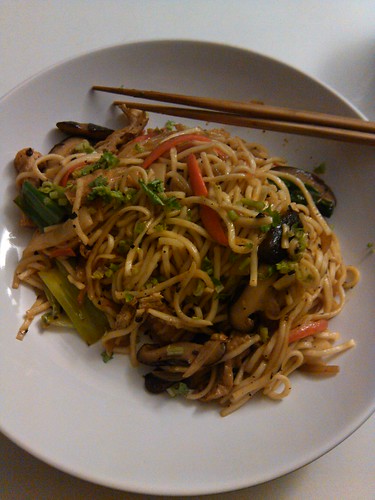
It's like these fried noodles that I cooked tonight. One of the ingredients was green onions. I chopped the onions into four centimeter pieces. I had intended to slice them further into strips, but I was hungry and forgot. Fortunately, the noodles still tasted delicious.

That's a perfect example of a zero-risk mistake. The lesson for me is to pay more attention when cooking, or maybe to eat a snack before cooking so that I won't be in such a hurry.

Please don't fear your mistakes, and take advantage of all of the learning opportunities you can.

2011/10/05

Tully'sは英語の使い方に注意した方が良い


I hadn't been to Yaechika in a while. I can always find English mistakes, there, and this time was no exception.
  • no exception《be ~》例外{れいがい}でない (definition from Eijiro on the Web)
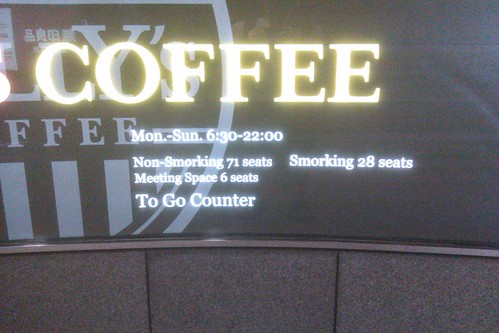
Just when you come down the stairs on the Yaesu Avenue northeast entrance, there's a new Tully's. They have a gorgeous new sign, which says:
× Non-Smorking 71 Seats; Smorking 28 Seats
○ 71 non-smoking seats, 28 smoking seats
What do you suppose "smorking" is? I looked it up, and the Urban Dictionary had this funny definition:
  • smork - someone who is so smitten, they are acting like a absolute dork. Slightly embarrassing, usually someone who is not an obviously smitten person, hence the lame name Smork. "You are acting like such a smork, you're definitely smorko over him" <- my note: "smork" is not common English. Don't expect many to know this.
  • smitten【形】〈英俗〉ぞっこんほれ込んだ (definition from Eijiro on the Web)
  • dork【名】〈俗〉ばか、あほ、とんま、愚か者、のろま (definition from Eijiro on the Web)
So I suppose it's nice of Tully's to provide special seats for those who have fallen head over heels for someone.
  • ぞっこんほれ込みなさい。 Fall head over heels. (definition from Eijiro on the Web)
The sign also says:
× To Go Counter
to-go counter
When you use a phrase as an adjective, you should connect the words with a hyphen.

Because of that, I would also say:

× Meeting Space 6 seats
6-seat meeting space

Good luck everybody, smorks included. Even I can be a mistake-making dork sometimes.

2011/09/02

「just」と「only」の使い方


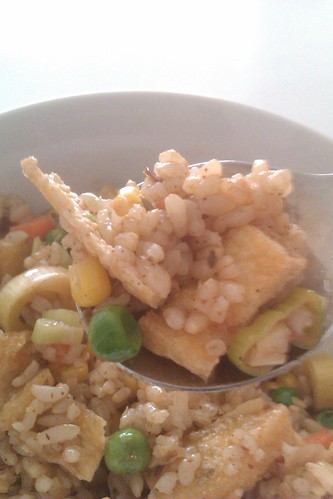
The other day for lunch I cooked this fried rice. I used Indian spices in it, though, to make it more exciting. I also used a Chinese cooking ingredient, chili pepper flakes soaked in oil. I had never used that ingredient to make fried rice before.

× I just only imagined that it would be good.
○ I just imagined that it would be good.
○ I only imagined that it would be good.

Usually we do not use "just" or "only" together. Basically, they have the same meaning, so we have to choose one of them.

One exception is "only just [verb]".
  • only just 辛うじて、たった今~したばかり、やっと、今しがた (definition from Eijiro on the Web)
I only just had enough time to make this fried rice before I had to leave the apartment. It's lucky that fried rice is not only easy to make but also delicious. I'd say it's just a perfect dish.

2011/07/13

「here you are」と「here we go」の違い

Someone asked me to explain the difference between "here you are" and "here we go", so here we go.
  • here we go = let's start, we're starting
First, it will be useful to look at the definitions of these two phrases given by Eijiro on the Web. Here you are:
  • Here we go.  1.(さあ)行くよ。/さあ始めるよ。2. せーの。/それっ。◆複数の人たちが力を合わせて物を動かすとき。
  • Here you are! さあどうぞこちらです。はいどうぞ!
We use "here we go" sometimes for encouragement, but sometimes as a complaint. As a complaint, we often add "again".
A: Let me tell you why what you did bothers me.
B: Oh no. Here we go again. <- it sounds like this person has heard this complaint before
"Here you are" is said when we want to offer something. It can also be used with "there" instead of "here", when the possession of something has passed from the giver (using "here") to the recipient (using "there").
  • recipient【名】受領者、容器、受取人、受け手、受信者、受益者
So, there you are! That's the difference.

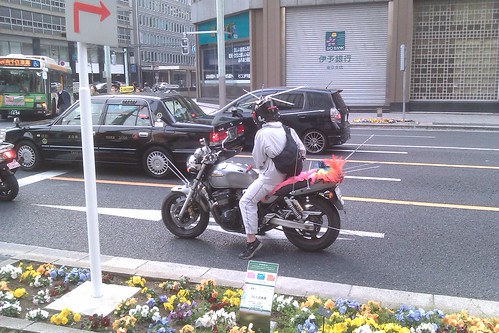
Oh! I haven't given you a photograph with this post. I should add something! Now, you may be thinking "oh, here we go again, another of Nick's strange photos!". Anyway, here you are, a picture of a guy on a motorcycle at Nihonbashi who loves antennas.
  • antenna 【名】1.  〈米〉アンテナ、空中線{くうちゅうせん}◆【略】ANT◆【同】〈英〉aerial; 2.〔昆虫などの〕触角{しょっかく}(definition from Eijiro on the Web)
Please let me know if you have more questions that I can answer in posts!

2011/04/26

「cherry blossom」の使い方


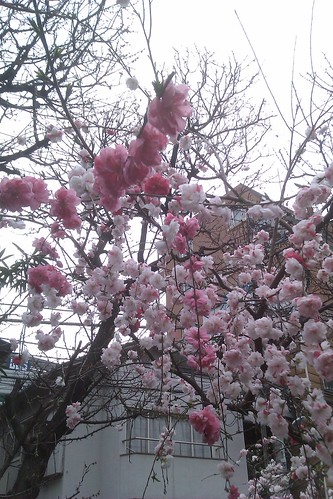
The cherry blossoms were really nice while they lasted. The season is over now, but there is one phrase that I hear every year that people should be careful about.

× The cherry blossom trees were really nice this year.
◯ The blossoms on the cherry trees were really nice this year.

It always happens that someone tells me: "but, there is no fruit with the cherry blossoms!"

Checking Wikipedia, we can find that flowering cherry trees are called Prunus serrulata. The fruit comes from a type called Prunus avium.

● flowering【名】開花{かいか}、開花期{かいかき}、花の形をしたもの、花飾りをつけること、花飾り (definition from Eijiro on the Web)

2011/04/19

この店とカシオも英語の使い方に注意した方が良い。「color」の使い方について


As I passed by this shop, the English on the sign caught my eye.

● catch someone's eye 〔思いがけない物などが〕(人)の目に留まる[触れる]、(人)の目を引く[捕らえる・奪う]、(人)の注意{ちゅうい}を引く◆複数形eyesが用いられることもある。(definition from Eijiro on the Web)

It says:

× G-Shock in white colour
◯ G-Shock in white

Usually, when we talk about the color of something, we don't use the word "color" after the name of the color. For instance,

× I have a black color bag.
◯ I have a black bag.

We use the word "color" in the question, though.

What color is your bag?

Retail shops use English mostly because it looks cool, I've been told. Just the presence of the Roman alphabet makes something look cool, so whether it is correct or not is not important. That's the excuse I've heard.

Roman alphabet ローマ字 (definition from Eijiro on the Web)

Maybe it's just because I teach English, but I think the coolest thing would be correct English. That is especially true when it comes to an international company like Casio.

2011/02/23

「every」の使い方について

Last month there was an interesting set of performances in at SuperDeluxe in Roppongi. Some musicians visiting Tokyo from Norway played noise music with some musicians living in Tokyo.

I couldn't make it to both nights, unfortunately, but I did catch the Sunday performance. That's where I took this picture of Jim O'Rourke on guitar and  Lasse Marhaug on electronics. The superb drummer, Paal Nilssen-Love, can't be seen because of the large speaker cabinet on the left.

× Does the guitarist do that every his concert?

◯ Does the guitarist do that at every concert?

◯ Does the guitarist do that at every one of his concerts?

Nope. I have seen him play several times, and that was the first time I had seen him play the guitar like that.

"Every" has to be followed by a noun. You can't put a possessive pronoun between "every" and the noun you want to use.

This is something that I want to teach to every one of my students.

2011/02/10

「doubt」と「suspect」の違い

There was a good question this week about the difference between "doubt" and "suspect". When I check my Japanese dictionary for 疑う, I see that both of these are listed. That's not so helpful, so let me explain.

"Doubt" has a negative meaning which is similar to "don't think". "Suspect" also has a negative meaning, but means "think". The key difference is the "not" hidden inside "doubt".

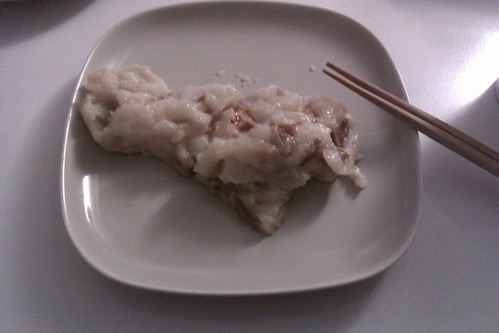
Over the Lunar New Year holiday, I cooked radish cakes. It looked good in the photo, but when I was trying to take it out of the pan, it broke. This piece you see on my plate is the result. Ugly, isn't it?


Lunar New Year 旧正月、春節、小正月◆中国・台湾・海外華僑の旧正月ならばChinese New Yearが良い。韓国・北朝鮮ではLunar New Year(中国の属国、植民地の歴史観から)(definition from Eijiro on the Web)


Actually, though, when I was cooking it, I thought I would have trouble. That's because even after steaming it for 90 minutes, when I stuck a chopstick in it, the chopstick didn't come out clean. At that point:

I doubted that it would turn out correctly. = I suspected that it wouldn't turn out correctly.

It's OK, though, because my second try was much better. The Lunar New Year holiday may be over, but I'm going to try again this weekend.

2011/01/31

「raise」と「rise」の違い、part 2

It has taken me all of January to catch up with topics from 2010. The last thing I need to do is revisit my post last year about "raise" and "rise", which several people said still confused them.

Let's try to clear things up.

● Let's clear up a couple of things. いくつかのことをはっりさせましょう。(example from Eijiro on the Web)

"Raise" is a verb that usually requires an object: a transitive verb. You can make a sentence in passive voice with it.

transitive verb 他動 たどう (definition from jmdict)

"Rise" is a verb that isn't used with an object: an intransitive verb. You can't make a sentence in passive voice with it.

intransitive verb 自動詞 じどうし (definition from jmdict)

Radish cakes (or turnip cakes) are a traditional dish at Chinese New Year. One Chinese name for them means something like "rising height every year" or "growing taller every year".

In other words, your height rises every year (notice, no object). That's the auspicious meaning of the dish.

auspicious 吉祥、愛でたい (definition from jmdict)

I tried to make them this weekend, and while it looks pretty good in this photo, the texture was actually pretty wrong.

From the photo in my next post, you will see that I have to raise my skill level at making radish cakes (notice "skill level" is the object).

2010/12/15

副詞と形容詞の使い方について・誰かが英語の使い方に注意した方が良い。

I can't say who has to be careful, since it isn't clear to me from my photo. Does it say the train company in the bottom right corner?

Anyway, the sign says:
× Smoothly and Speedy
Smoothly and Speedily (better)
Smooth and Speedy (best)
When you want to use two words that describe something and connect them with a conjunction, they need to be of the same type.
  • conjunction - 接続詞
The problem here is that "smoothly" is an adverb and "speedy" is an adjective. The hint here is that "ly" usually signifies an adverb, while "y" alone is usually an adjective.

I hope your holiday journeys are smooth and speedy. 

2010/12/07

私は日本語の使い方に注意した方が良い。(part 4) スペルミスについて

Someone kindly pointed out to me that the headline of my last blog post had a spelling mistake.
  • spelling mistake スペルミス
  • ×  レソトラン
  • ◯ レストラン
Spelling correctly is tough in any language. English spelling is particularly tricky since spelling sometimes seems not to match pronunciation.
  • pronunciation 発音
Fortunately, when typing Japanese, the input method will check it. Unfortunately, I just directly converted hiragana into katakana without letting the input method check it. That was my mistake.

Anyway, I am always grateful when someone shows me where I've gone wrong.

While I am talking about recent feedback, someone else said that I hadn't posted any pictures of what I have been cooking. 
  • × Here are two currys that I made the other day: chick pea curry and spinach curry. 
  • ◯ Here are two curries that I made the other day: chick pea curry and spinach curry.
It's a common mistake to forget to change "y" to "ies" when making a plural noun.

2010/11/17

「claim」と「complain」の違い

I've been told:
× You always claim about wrong English.
◯ You always complain about wrong English.
claim
  1. 〔証拠なしに~が本当であると〕主張{しゅちょう}する、言い張る、断言する
  2. 〔当然のこととして~を〕要求{ようきゅう}[請求{せいきゅう}]する、求める
  3. 〔~の所有権を〕主張{しゅちょう}する
  4. 〔命を〕奪う
  5. 〈主に英〉〔賞品などを〕獲得する
  6. 〈主に英〉〔人の注意を〕引く
complain 【自動】
  1. 不満{ふまん}[苦情{くじょう}・不平{ふへい}]を言う[漏らす]、文句{もんく}を言う、愚痴{ぐち}を言う[こぼす]
  2. 〔病状{びょうじょう}や痛みを〕訴える、言う
  3. 〔苦情{くじょう}でも言うかのように〕うめく、きしみ音を出す
  4. 〔正式{せいしき}な機関{きかん}に〕苦情{くじょう}を申し立てる、訴え出る、クレームを付ける
  5. 〔コンピュータやソフトウェアが〕エラーを出す、言うことを聞かない
Well, I cannot claim that my Japanese is perfect, and I don't expect Japanese to have perfect English, either. However, if you are a big business and try to use English, you should make the effort to let a native speaker check your English for mistakes.

"Complain" is used when talking about something you are not happy about. That means that English doesn't have the word クレーマ. In English, you'd have to say "someone who made a complaint".
  • complaint 文句 (definition from jmdict)
I can't claim it is good, but I was awake the other day at 5 am. I can't complain about being up at that time, either, because I was able to see the reflection of the sunrise on the office towers around Tokyo Station. It was beautiful, I thought.

「appeal」と「claim」の違い

Today's content might be controversial. Get ready. I want to talk about "appeal" and "claim".

  • controversy 論, 繋争, 争論, 論争 (definition from jmdict)
These words are often confused by Japanese, mostly because they have been adopted into Japanese with meanings which are slightly different from their English meanings.

Someone told me:
× Chinese appeal their country is a developed one.
◯ Chinese claim their country is a developed one.
We can say:
× Chinese claim about Japanese policy.
◯ Chinese complain about Japanese policy.

× Taiwanese claim to the world to recognize them as a country.
◯ Taiwanese appeal to the world to recognize them as a country.
◯ Taiwanese claim they are an independent country, but China disagrees.
Here are the definitions of "appeal" and "claim" from Eijiro on the Web; check their site for the examples:

appeal
  1. 注意{ちゅうい}を喚起{かんき}する
  2. 援助{えんじょ}を求める、懇願{こんがん}する、訴える、要請{ようせい}する、頼む
  3. 気に入る、興味{きょうみ}をそそる、魅力{みりょく}がある
  4. 上訴{じょうそ}する、抗告{こうこく}する
  5. 抗議{こうぎ}する
claim
  1. 〔証拠なしに~が本当であると〕主張{しゅちょう}する、言い張る、断言する
  2. 〔当然のこととして~を〕要求{ようきゅう}[請求{せいきゅう}]する、求める
  3. 〔~の所有権を〕主張{しゅちょう}する
  4. 〔命を〕奪う
  5. 〈主に英〉〔賞品などを〕獲得する
  6. 〈主に英〉〔人の注意を〕引く
I talked about "appeal" back in January. Check this post:
http://upgradeenglish.blogspot.com/2010/01/appeal.html
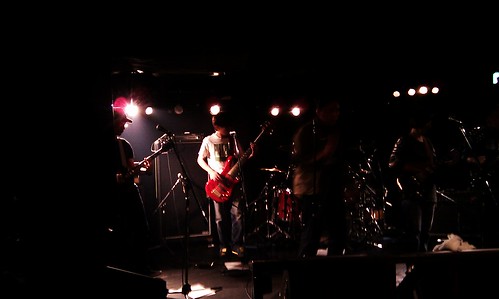
I took this photo last night at a performance of my friend's band. The name of the band is ギロチン工場. I'd like to appeal to you to catch one of their performances if you are into noise rock. I cannot claim that this is a good photo, but it's the best my phone could do.

Somehow I've never talked about "claim", though! OK, there's the next post.

2010/11/11

復習:「so」と「such」の違いについて

Somebody the other day said:
× Soooooooooo cute kid!!!
Such a cuuuuuuuuuuuute kid!
Sooooooooooo cute!
Remember, the pattern is:
  • so + (adj)
  • such + (adj) + (n)
This was the subject of my post back on July 16 of last year:
http://upgradeenglish.blogspot.com/2009/07/more-about-so.html
In May of last year I talked about going to a Ryoji Ikeda exhibition:
http://upgradeenglish.blogspot.com/2009/05/ive-been-taking-it-easy-today-check-out.html
This past Friday, I had the chance to see him perform live.
× It was soooooooo good performance!
◯ It was such a gooooooood performance!
◯ The performance was sooooooooo goooooood!
He performed with Carsten Nicolai as well. That concert was probably the best one I've been to in five years. The visuals were so well-designed! I had such a good time.

Here's some more information on Ryoji Ikeda. You should check out his work:
http://ja.wikipedia.org/wiki/池田亮司

2010/10/29

「there」の使い方

Back in September, I went to Naeba. Along the road, there were some beautiful cosmos. I stopped and snapped this photo.
  • snap photos of ~の写真{しゃしん}を撮る ) (definition from Eijiro on the Web)
Last week, someone asked me:
× Is cosmos in America?
Are there cosmos in America?
When you are talking about the existence of an item or category of items, use "there".
  • existence 実在, 有無, 存亡, 存在, 存廃, 生命, 実存, 生存, 存立 (definitions from jmdict)
Use it with a "be" verb.

Wikipedia says that cosmos are native to the Americas, so yes, there are cosmos in America.
http://en.wikipedia.org/wiki/Cosmos_(plant)
It also says there are 20 to 26 different species of cosmos.
× I wonder what kind there are in this photo?
◯ I wonder what kind these in the photo are?
Don't use "there" when you are talking about specific ones, like in the sentence above. Maybe these are cosmos bipinnatus, from looking at the photos in Wikipedia. After tomorrow's typhoon, there might not be any more cosmos left until the next time they are in season.

2010/08/04

この店は、英語の助けが必要だ。

This shop really needs help with their English (I'm not sure, but I might need help with my Japanese in today's headline).
× Suit Get! Fair
"Get a Suit" Sale!
First, for fairness, let me compliment them on their use of "suit" and not "suits". Good job! The explanation of "suits" can be found at this old post, which happens to be about the same shop:
http://upgradeenglish.blogspot.com/2010/07/blog-post.html
Remember English word order. In almost every case, the subject comes before the verb. That means their suit is getting something, but suits don't usually get anything, except:
First, my suit got stained.
Then my suit got torn.
After that, it got repaired by a tailor.
When it was too old, it got thrown away.
Their next mistake is using "get" with an exclamation point in the middle of the phrase. I talked about this punctuation mistake, which is so common in Japan, in this old post:
Finally, Japanese retailers love to talk about "fairs" and "festas", but really, if you are selling stuff, what's wrong with sticking with "sale"? If I am looking for a good deal, I don't go to a "fair" -- I go to a sale.

  • fair カーニバル (definition from Eijiro on the Web)... I know there are other definitions, but I promise you that the feeling is like The World's Fair: http://ja.wikipedia.org/wiki/国際博覧会
  • 祝祭 [しゅくさい] (n) festivals feasts <- do you say this in Japanese? A festival, like a fair, sounds like a really big gathering in a town, not an event at a shop.
  • stick with 【句動】~にくっついて離れない、~とずっと一緒{いっしょ}にいる、~のそばを離れない、~を手放{てばな}さない、~を堅持{けんじ}する、~を続ける、~にあくまでも忠実{ちゅうじつ}である、~にこだわる、~の一点張りで通す (defintion from Eijiro on the Web)
  • a good deal 安い買い物 (defintion from Eijiro on the Web)
With luck, their sale will work anyway, and they will make enough money to be able to hire someone to help them with their English in the future.

2010/07/22

この店は英語の使い方に注意した方が良い。スペルミスしないで。

I was out walking around on the holiday. Hot, wasn't it?
× I passed a suits shop. <- don't use a plural noun as an adjective
◯ I passed a suit shop.
It's no wonder this shop needs to advertise suits. Who wants to buy a suit when it's 35 degrees outside?

However, this shop needs help. Not only does their graphic design leave a LOT to be desired, it's spelled wrong!
× Laday's suit (wrong spelling, shouldn't be singular)
Ladies' suits (so-so?)
◯ Women's suits (better, maybe)
  • leave ~ to be desired どこか物足りない、不十分な点がある◆【直訳】何か望まれるものを残している The results left a lot to be desired. : あまり望ましくない結果が出た。(definition from Eijiro on the Web)
I wrote about apostrophes a few months ago. Now's a good time to review:
http://upgradeenglish.blogspot.com/2010/03/part-1.html
× You won't catch me wearing a suits in this weather. <-「suits」は日本語英語
◯ You won't catch me wearing a suit in this weather.
In fact, you'd be lucky to catch me in a suit in any weather. Take care in the heat!

2010/07/14

Uniqloは英語の使い方に注意した方が良い。

On Sunday, I stopped by Uniqlo in Ginza. It was crowded everywhere in Ginza, and Uniqlo may have been doing better business than anywhere else.
  • crowded 稠密 過密 濃密 満員 (definition from jmdict)
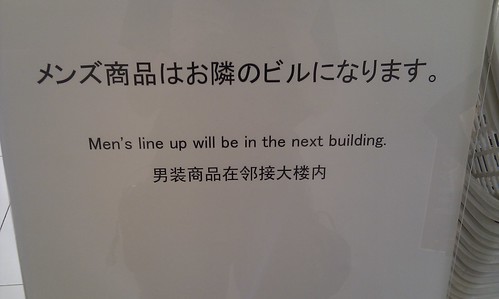
Of course, since I was in Ginza, I was doing something glamourous: shopping for underwear. While looking around, I found this sign:
× Men's line up will be in the next building.
◯ The men's line-up (lineup) is in the next building.
  • glamour 魅力 蠱惑 グラマー (definition from jmdict)
  • lineup ラインナップ 布陣 (definition from jmdict)
The first problem they have is the missing "the". "The" is necessary because we know which "men's line-up" -- it's the Uniqlo men's line-up. When your audience knows which one you mean, use "the".
  • audience 会集 観客 会見 会衆 看客 入り 引見 オーディエンス 聴衆 傍聴人 聞き手 (definition from jmdict)
The second problem Uniqlo has is "line-up". "Line up" is a phrasal verb, which means to get in line or to queue. It's possible to turn many phrasal verbs like this into nouns by adding a hyphen. Some of the more common ones have even become nouns without hyphens, like "lineup".

For me, the third problem is the biggest one. When you use "will", it generally has one of two meanings:
a) you have just decided on some future action
b) you are making a prediction about the future
  • prediction 予言 予断 予測 予知 予報 予想 (definition from jmdict)
If they have made a sign, they can't be deciding right now. It's also strange for Uniqlo to make a prediction about something like the location of their men's section.

There's a special case, which is probably which caused them to make this mistake. Some native speakers have conversations like this:
A: Excuse me, where's the toilet?
B: Oh, it will be just down the hall and on your right.
Native speakers do this, and probably most people don't feel it's strange. However, it's definitely only for conversations, and I don't recommend it to any of you. You and Bさん should say "it is just down the hall on your right."

If you have any connections at Uniqlo, you should let them know. If they are trying to become an international company, they should avoid making English mistakes, especially at their flagship store.
  • flagship store 主力店舗 (definition from Eijiro on the Web)

フォロワー