ラベル 食物 の投稿を表示しています。 すべての投稿を表示

2011/02/17

忍耐は美徳である。Patience is a virtue.

You may have seen my not-so-successful radish cake the other day. I tried again, and this time it worked out pretty well.

work out well うまくいく (definition from Eijiro on the Web)

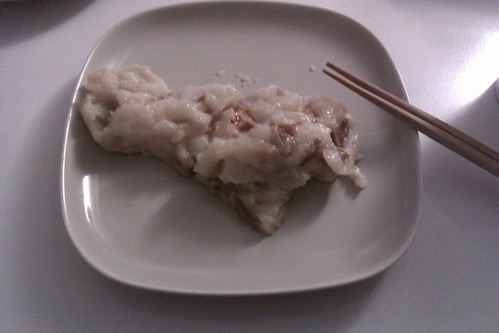
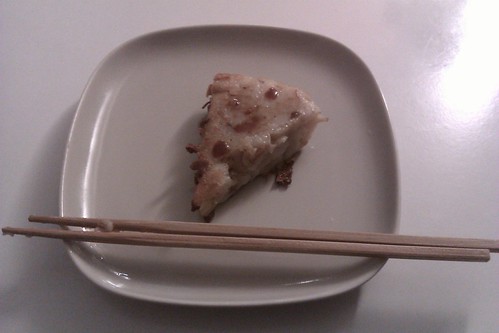
Rather than cook the radish cake in a wok on the stove, I used the rice cooker. That was not only easier to use, but it also turned out better. Here's a slice of it, with a bit of soy sauce on top.

wok 【名】《料理》中華鍋◆取っ手が片手持ち型は北京鍋、両手持ちは広東鍋。鉄、アルミ、チタン製がある。アルミ・チタンは軽くて熱廻りが均一だが、価格は鉄の10倍。北京鍋の取っ手に持つのに熱くない木製のもある(木取っ手の押えねじが緩みやすいのでしっかり増し締めすること)。プレスで型打ちするのと、手打ちのがある(手打ちは多数の円形模様がある、熱廻りが均一)。(definition from Eijiro on the Web)

Cooking is really satisfying. You can finish the whole activity within a couple of hours and enjoy the result right away. I guess it's not quite instant gratification, but it's much closer to it than long-term activities like learning a foreign language or computer programming.

instant gratification すぐに得られる喜び (definition from Eijiro on the Web)

That's important for us students of language to remember; since the results from study don't always come immediately, we've got to be patient. However, when you look back one year or more, you should be able to see the difference.

Be patient. 我慢してください。 (definition from Eijiro on the Web)

As for my radish cake, it tasted good, and I enjoyed it, but I'm not a dim sum chef yet. Maybe some day. I'll patiently work on it.

dim sum 《中華料理》点心 (definition from Eijiro on the Web)

2011/02/10

「doubt」と「suspect」の違い

There was a good question this week about the difference between "doubt" and "suspect". When I check my Japanese dictionary for 疑う, I see that both of these are listed. That's not so helpful, so let me explain.

"Doubt" has a negative meaning which is similar to "don't think". "Suspect" also has a negative meaning, but means "think". The key difference is the "not" hidden inside "doubt".

Over the Lunar New Year holiday, I cooked radish cakes. It looked good in the photo, but when I was trying to take it out of the pan, it broke. This piece you see on my plate is the result. Ugly, isn't it?


Lunar New Year 旧正月、春節、小正月◆中国・台湾・海外華僑の旧正月ならばChinese New Yearが良い。韓国・北朝鮮ではLunar New Year(中国の属国、植民地の歴史観から)(definition from Eijiro on the Web)


Actually, though, when I was cooking it, I thought I would have trouble. That's because even after steaming it for 90 minutes, when I stuck a chopstick in it, the chopstick didn't come out clean. At that point:

I doubted that it would turn out correctly. = I suspected that it wouldn't turn out correctly.

It's OK, though, because my second try was much better. The Lunar New Year holiday may be over, but I'm going to try again this weekend.

2011/01/31

「raise」と「rise」の違い、part 2

It has taken me all of January to catch up with topics from 2010. The last thing I need to do is revisit my post last year about "raise" and "rise", which several people said still confused them.

Let's try to clear things up.

● Let's clear up a couple of things. いくつかのことをはっりさせましょう。(example from Eijiro on the Web)

"Raise" is a verb that usually requires an object: a transitive verb. You can make a sentence in passive voice with it.

transitive verb 他動 たどう (definition from jmdict)

"Rise" is a verb that isn't used with an object: an intransitive verb. You can't make a sentence in passive voice with it.

intransitive verb 自動詞 じどうし (definition from jmdict)

Radish cakes (or turnip cakes) are a traditional dish at Chinese New Year. One Chinese name for them means something like "rising height every year" or "growing taller every year".

In other words, your height rises every year (notice, no object). That's the auspicious meaning of the dish.

auspicious 吉祥、愛でたい (definition from jmdict)

I tried to make them this weekend, and while it looks pretty good in this photo, the texture was actually pretty wrong.

From the photo in my next post, you will see that I have to raise my skill level at making radish cakes (notice "skill level" is the object).

2010/08/25

シンガポールには、良い食物がいっぱいある!

Singapore is a great place to eat Indian food. Though the majority of the population in Chinese, there's a large number of Indians as well.
  • the majority of the population 人口の大半 (definition from Eijiro on the Web)
This restaurant has an interesting concept. It's a kind of charity.
  • charity 施し,慈善,博愛,善根,仁恵,仁愛,慈悲,篤志 (definition from jmdict)
There are no prices on the menu. People just pay what they feel they can or should pay. Someone who is down on their luck can pay 50 yen. Another person who isn't having trouble making ends meet might pay 500 yen. Both of them could eat the same meal.
  • down on one's luck 運が傾いて、つきに見放されて (definition from Eijiro on the Web)
  • make ends meet 生活の収支を合わせる、収入の範囲内でやりくりする[やっていく] (definition from Eijiro on the Web)
My host felt that 200 yen was appropriate. That sounds great for people in Tokyo, right?

So, what's in the photo? On the plate, there's rice mixed with lentil curry. Next to the plate, there are three vegetable curries, each of which had a very different flavor. This was a south Indian meal.
  • lentil レンズ豆
Because of all of the great food I ate in Singapore, I gained 2 kgs!
  • gain weight 重さ[重量・体重・目方]が増える[増加する]、太る◆【反】lose weight

2010/05/30

「s」の発音と「sh」の発音はどう違う?

I'm in trouble now.

After three posts of trying to satisfy people with a photo of myself, now I appear to be a narcissist.
  • narcissist ナルシシスト
The problem with saying this word correctly in English is not using katakana-style pronunciation. In Japanese, it's like this: narushishisuto.
  • pronunciation - 発音
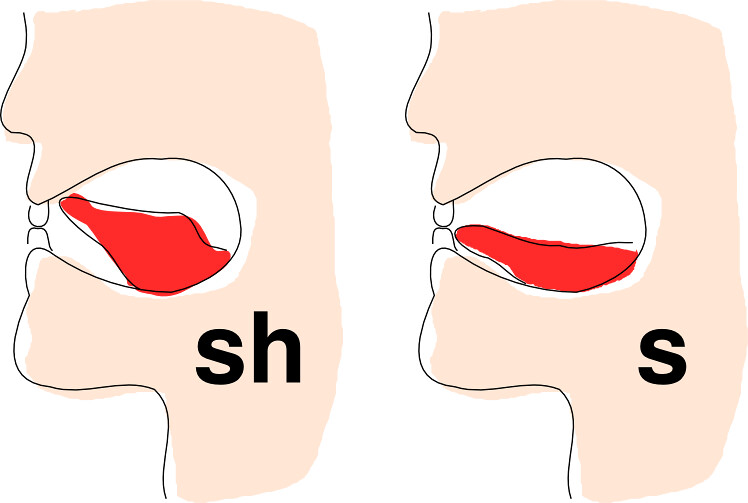
However, in English, the "sh" should be a "s". In your mouth, this is what should be happening.

When you say this, be careful to say the "cissist" part with "s" sounds, not "sh" sounds.

Some other cases where this same pronunciation matter comes up are: sister, policy, pronunciation, and symbol. Take care with any word containing "s".

So, to further demonstrate my narcissitic tendency, here's a photo of something I cooked recently! It's fried tofu and celery stir-fried in black-bean sauce (be careful about the "s" sound at the beginning of the name of this vegetable).
  • tendency - 偏向, 帰趨, テンデンシー, 風潮, 気運, 傾き, 動向, 傾向, 勢運, 勢い, 趨向,趨勢
If you have any good vegetarian recipes, I'd like to hear them. Send me email!

2010/05/18

「マクロビ」とは...+スペルに注意しましょう

You probably know that I'm a vegetarian. Because of that, eating out in Tokyo is hard. Everywhere, dishes usually contain at least bonita soup base, if not bits of ham, soup stock made from chicken, or something else.
  • bonita soup base = だし
  •  soup stock 出汁 だし (from jmdict)
One type of place that I can often find something to eat at is macrobiotic restaurants.

Eijiro on the Web says this:
  • macrobiotic

    【形】
    1. マクロビオティックの、長寿食{ちょうじゅ しょく}の、健康食{けんこう しょく}の、 自然食{しぜんしょく}
    2. 長寿{ちょう じゅ}の、長命{ちょうめい}の、寿命{じゅ みょう}を延ばす
  • macrobiotic diet

    長寿食{ちょうじゅ しょく}
There's more on macrobiotic diets here:
http://en.wikipedia.org/wiki/Macrobiotic
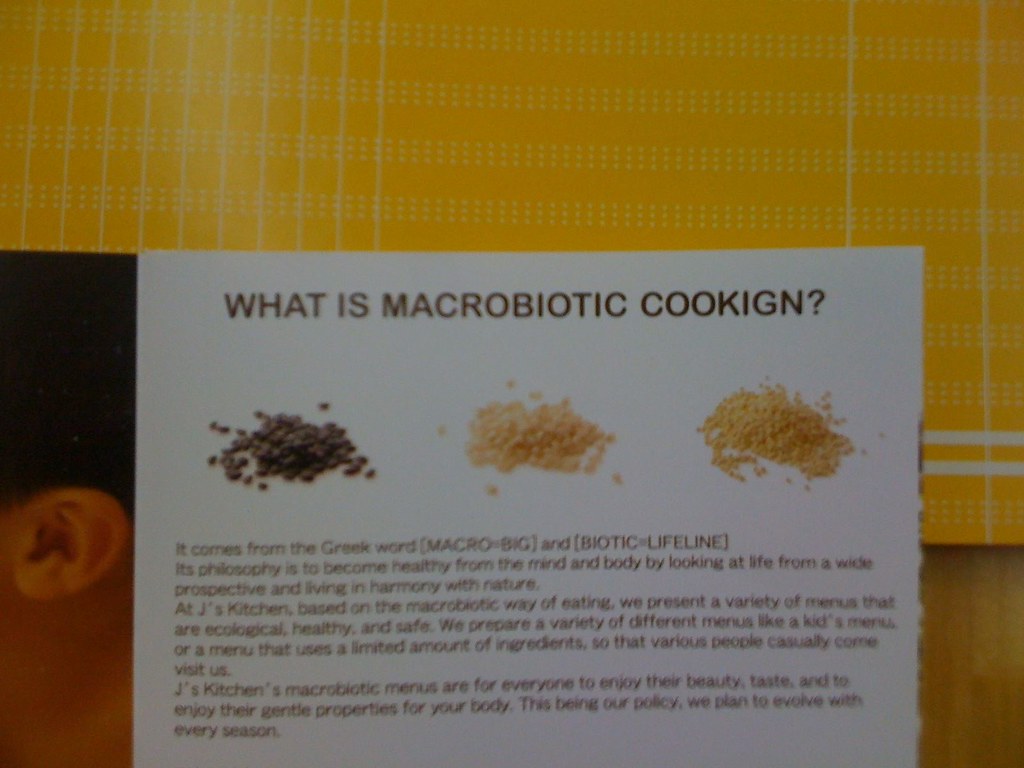
It's a shame that this restaurant in Tokyo made the effort to make this English brochure, but then didn't check the spelling in the headline well enough.
× What is macrobiotic cookign?
◯ What is macrobiotic cooking?
A simple spell-checker would have caught this mistake. Don't do the same thing in your writing!

2010/04/19

「worth, worthy, worthwhile」の違いは何?

"Why have you put another picture of a banana here, Nick?" you may be asking.

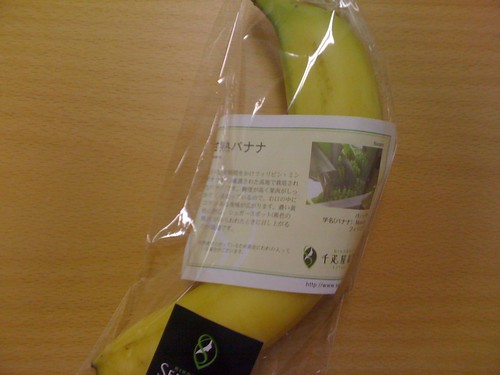
I know someone who hates bananas. I asked her if she had ever eaten a Sembikiya banana. I had never eaten one, but theoretically, they should have some of the best bananas in Japan.
  • theoretically 理論上{りろんじょ う}は、名目上{めいもく じょう}は、理論的{りろんてき}に言えば (definition from Eijiro on the Web)
I asked her if she would be willing to try a Sembikiya banana. She said yes, so today we ate Sembikiya bananas as an experiment.

Bravely, she ate one quarter of a banana without making too many strange faces. She didn't want any more, though.

Of course it tasted pretty good, since it's from Sembikiya. I prefer green bananas, and these were slightly green. I was happy about that.

However, I didn't think it was worth it. <- "worth" is a preposition! I learned something!
  • It wasn't quite worth it, was it? (definition from Eijiro on the Web)
    そんな価値はなかったね?
They aren't worth 210円 each, though. <- see? "210円" is a noun, and "worth" is a preposition...

Doing the experiment was worthwhile, though. <- "worthwhile" is an adjective
  • worthwhile 【形】やりがいのある、値打ちのある、価値{かち}のある、無駄{むだ}ではない (definition from Eijiro on the Web)
The experiment was worthy to try. <- Maybe this is ok, but... I never say "worthy"...
  • worthy ~に値する、~するに足りる (definition from Eijiro on the Web)
The experiment was worth trying. <- Ah... this is much more natural for me.

2010/02/22

賞味期限にご注意、「rot 」と「go bad」の違い

This dish that I just cooked looks pretty delicious, right? I thought so, too, until I took a bite. In fact, it was a failure.

The dish is Chinese-style braised tofu with green onions and green peppers. It looked great, and I was really excited about eating it. I tore into it, but I was quickly disappointed.
× The tofu had rotted.
◯ The tofu had already gone sour. <- it really was sour
◯ The tofu had already gone bad. <- "go bad" is the general way to say 腐る
  • tear into something ~に取り掛かる (definition from Eijiro on the Web) <- not sure about this... I'm saying that I started eating it quickly and enthusiastically...
  • go sour 酸っぱくなる、味が変わる
  • 腐る (くさる) (v5r) to rot; to go bad; (P); (definition from Edict)
In most cases, you should use "go bad". Use "rot" for when things have really changed a lot, close to decomposed. When you think of "rot", think of zombies.
decompose 【自動】
  1. 腐敗{ふは い}[腐食{ふしょく}]する
  2. 〔物質が〕分解{ぶんかい}する
【他動】
  1. 腐 敗{ふはい}[腐食{ふしょく}]させる
  2. 〔物 質を〕分解{ぶんかい}する
You had better be careful about expiration dates. I thought I was, too, but it was too close. The package said it was good until the 22nd, but it was clearly past the expiration date.
  • expiration date 有効{ゆうこう}[使用{しよう}・消費{しょうひ}・賞味{しょうみ}]期限{きげん}(definition from Eijiro on the Web)
This day is also past its expiration date. Time to go to bed...

2010/01/28

「manner」と「manners」の違いは何?

Someone advised me the other day:
Nick, you always put the chopsticks on top of your bowl before you take a picture.
× That's not a good manner.
○ That's not good manners.
When you mean "the way something is done", use "manner". However, when you mean something like "etiquette", use "manners".
  • (definitions from Edict)
  • 風 (ふう) (adj-na,n,n-suf) (1) method; manner; way; style; (2) appearance; air; (3) tendency;
  • 方法 (ほうほう) (n) method; process; manner; way; means; technique; (P);
  • 作法 (さほう) (n) manners; etiquette; propriety; (P);
  • 習慣 (しゅうかん) (n,adj-no) custom; habit; manners; (P);
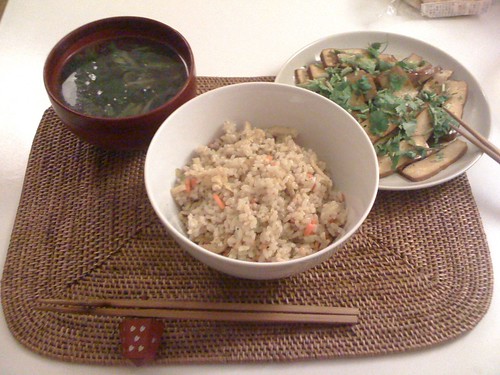
This person was talking about the manner in which I place my chopsticks. Take a look at today's photo. I'm using a chopstick rest for the chopsticks.
  • 箸置 (はしおき) (n) chopstick rest;
Compare that to a recent photo of my noodles:
http://upgradeenglish.blogspot.com/2010/01/appeal.html
Do you approve of my manners now?

The other thing to notice in today's photo is that it's not noodles! Maybe you thought I only cook noodles, but it's not true! The menu for tonight's meal was fried brown rice, which was flavored with garam masala and Sri Lankan pickles. I ate that with dried tofu and cilantro, plus a bowl of spinach, onion, and garlic soup.

As a foreigner here, it's easy to have bad manners sometimes. If you catch me doing something in a manner which I should not, let me know!

2009/12/01

「in the case of」の使い方

I've talked about "in case" and "in case of", so today I want to talk about "in the case of". Here's the definition from Eijiro on the Web:
  • in the case of ~の場合{ばあい}は、~について言えば、~ついては、~にしてみれば
"Of" is a preposition, so you have to follow it with a noun, like this:
  • in the case of __(n)__, (sentence).
You can also reverse the order, putting the "in the case of" phrase at the end. In that case, don't use a comma.

Someone gave me some nice vegetables on the weekend. Having recently tasted a lot of Southeast and South Asian dishes, I had those flavors on my mind. However, this is Japan, and my vegetables were Japanese ones.
× I have to be honest -- I love Asian food, but in case of Japanese food, I find the flavors are often a bit too weak for me. <- what's the emergency?
× I have to be honest -- I love Asian food, but in Japanese food's case, I find the flavors are often a bit too weak for me. <- Japanese food is not a person, so apostrophe "s" cannot be used
○ I have to be honest -- I love Asian food, but in the case of Japanese food, I find the flavors are often a bit too weak for me.
Maybe it's because I'm a vegetarian that a lot of Japanese food has a weak flavor for me.

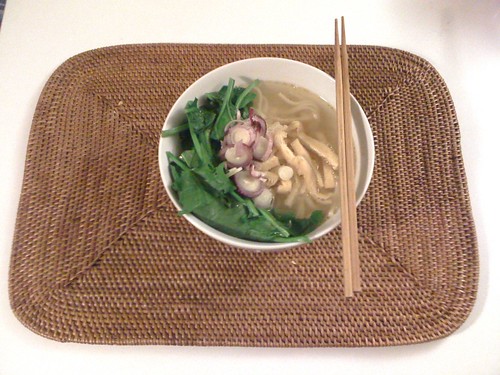
Anyway, in order to make my noodles, I used a whole Japanese citron, a lot of Japanese powdered chili pepper, red scallions, and some fresh spinach. The soup also had seaweed bullion and sweet cooking rice wine.
  • 長葱 (ながねぎ) (n) scallion; shallot; green onion; spring onion;
  • 柚子 (ゆず) (n) (uk) Japanese citron (Citrus junos, Citrus ichangensis x Citrus reticulata var. austera); yuzu;
  • みりん sweet cooking rice wine
It didn't taste so much like Southeast Asian food, but it was pretty yummy.

2009/10/31

「made by」「made from」「made of」「made with」の違いは何?

People seem to be confused about these phrases. Here's my advice.
  • made of - use this when the material hasn't been processed heavily
  • made from - use this when the material has been processed a lot
  • made with - use this when there are multiple ingredients or constituent parts
  • made by - use this to describe the method
× This curry was made of beans.
○ This curry was made with beans. <- there are a lot of ingredients in it!

× I made it from frying onions and ginger and then adding a masala paste that I bought at an import grocery store. <- onions are a processed ingredient, BUT...
○ I made it by frying onions and ginger and then adding a masala paste that I bought at an import grocery store. <- this is talking about the method

× The masala paste was made by spices, peppers, and garlic.
○ The masala paste was made from spices, peppers, and garlic. <- the ingredients in the paste have been processed a lot

2009/10/07

「meal」と「meat」の違い

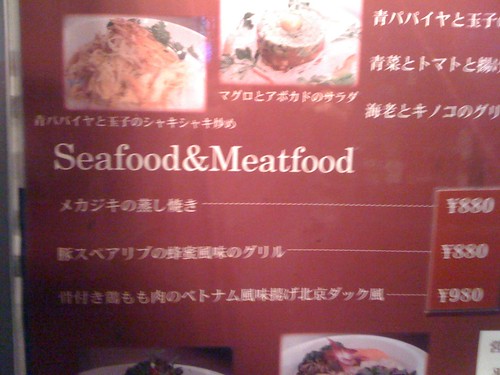
I'm sorry for the blurry photo; this is the same sign I was talking about yesterday. This part of the sign says:
× Seafood&Meatfood
While I admire the creativity the sign-maker is showing, "meatfood" is not an English word.
  • 憧れる (あこがれる) (v1,vi) to long for; to yearn after; to admire; to be attracted by; (P);
  • 創造力 (そうぞうりょく) (n) creative power; (P); creativity
I wish I could give you a good reason why we say "seafood" but not "meatfood", but I just can't think of one.

The sign should read:
Seafood & Meat
× As a vegetarian, I don't eat any seafood, or any meal either.
○ As a vegetarian, I don't eat any seafood, or any meat either.
  • 食事 (しょくじ) (n) (1) meal;
  • 肉 (にく) (n) (2) meat;
For my meals, it's vegetables only. I hope you enjoy your next meal!

2009/10/05

「サラダ」は英語じゃない

I don't know why it is that when going to Ebisu I can find lots of English mistakes. Take a look at this photo:
Sarada&Vegetabele
Here are the comments from your picky native English-speaking friend. The most common mistake here is "sarada". Neither "sarada" nor "salada" is English. It's supposed to be "salad". Notice that the English doesn't end with ダ, but ends with "d". Be careful when pronouncing this word!
  • サラダ (n) salad
Also, on the menu, if there are several kinds of salads, you should use a plural noun, not a singular one.

After that, if you're going to put English on a sign, at least use a spell-check! It's so easy! "Vegetabele" should be "vegetable".

Finally, there's the issue of spaces. If you are going to use "&", which is called an ampersand, you need a space on either side of it.
  • アンド (n) ampersand sign; and; (P);
Here's what the sign should have said:
Salads & Vegetables
You know, one of my favorite vegetarian restaurants has a lot of English mistakes on its menu. Still, I didn't try this restaurant; I went down the street to an Italian restaurant I usually eat at. I had olives, a salad, gorgonzola risotto, and tomato, basil, and mozarella gnocchi. It was delicious!

I hope you all had a nice weekend.

2009/09/12

「パプリカ」は英語で何?

This week I feel like talking about food.

One common mistake I hear is:
× I hate to eat pi~man. <- ピーマン is not English!
So I tell people that's not English, so they say:
× Oh! I mean I hate paprika.
"Paprika" is English, but it's a dried spice made from peppers, not the peppers themselves. Wikipedia says some European countries say "paprika" meaning the peppers, but as far as I know, English-speaking countries don't say that.
http://en.wikipedia.org/wiki/Paprika
  • as far as I know 私の知る限りでは、私の知っている範囲では (definition from Eijiro on the Web)
So what should you say?
○ I hate peppers!
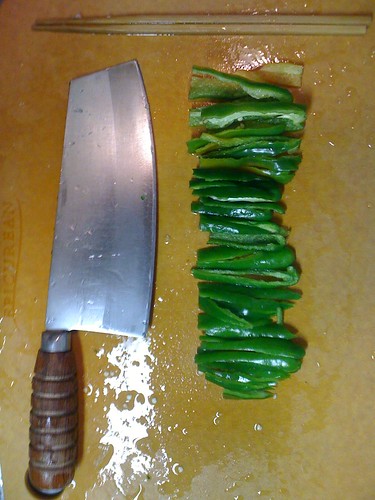
I don't hate peppers, though. I love them! These are slices of bell pepper. There are green bell peppers, red peppers, yellow peppers. There are lots of other kinds of peppers, like jalapeno peppers, chili peppers, and so on.

I read that Australians and New Zealanders call them "capisicum". I had never heard that until today, though.

After slicing these bell peppers, I diced them and stir-fried them with chili peppers, green onion, garlic, ginger, fake mince meat, soy sauce, vinegar, sesame oil, and a little salt. I put that mixture on top of a bowl of noodles. Yummy!

2009/07/07

「taste」の正しい使い方

Here's some more about food. I often hear people use "taste" as a noun, like this.
× Tea is good taste.
× Tea has a good taste.
However, as a noun, "taste" usually has this meaning:
have good taste (~の)センスがある、(~の)趣味{しゅみ}が良い
She has good taste.
If you look in the dictionary, probably you will find that it says "taste" as a noun means 味, but it's really not so common, and I don't recommend it for you. If you are talking about the flavor of something (spelled "flavour" in British English), you should use "taste" as a verb.
  • 味 (あじ) flavor; flavour
So, what the people above really want to say is:
○ Tea tastes good.
○ The flavor of tea is nice.
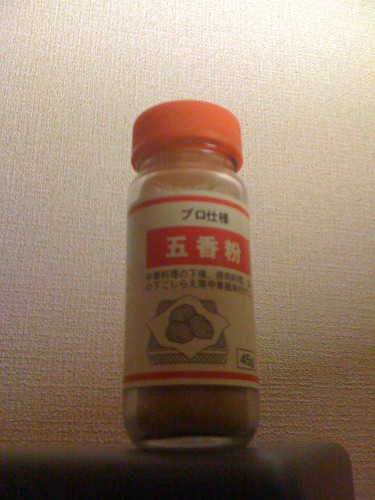
I really like the flavor of this spice. It tastes good to me, and reminds me of Taiwan. Some people don't like it because it contains anise.
  • 八角 (はっかく) (n) (1) octagon; (2) star anise (spice);
I didn't used to like anise, either, but it grew on me.
grow on someone
〔~に対する不安{ふあん}・好意{こうい}・関心{かんしん}などが〕だんだん大きくなってくる、募ってくる
・Once you live in a place, it grows on you. : 住めば都。
・The idea grew on him. : 彼はその考えに取り付かれていた。
・I didn't like English at first, but it has grown on me. : 最初は英語が嫌いだったけど、だんだん好きになってきた。
(definition from 英辞郎 on the web)
I used a big spoonful of this in the soup I made last night. I also used in the tofu and chives dish that I made back on June 22. Those dishes tasted good, I think. If you have recommendations on ways to use spices to make tofu taste better or special, I'd like to hear them.

2009/07/06

「menu」の正しい使い方

Sometimes I hear the word "menu" misused. Sometimes a menu is a document with many items on it. Those items include drinks, side dishes, main dishes, appetizers, desserts, soups, and other things.
menu メニュー、献立表{こんだてひょう}; 料理{りょうり}、食事

お菜 (おかず) (n) (1) (uk) accompaniment for rice dishes; side dish;
前菜 (ぜんさい) (n) relishes; hors d'oeuvres; smorgasbord; appetizer;
Other times, "menu" just means the list of dishes at a meal.
Watch out for mistakes like these:
× I would like to have this menu. <- strange... it sounds like you are ordering every item which is listed
○ I would like to have this item.
○ I would like to have this dish.
× What menu did you choose? <- strange... it sounds like the restaurant had different lists of dishes, maybe depending on the customer
〜 Which menu items did you choose? <- so-so
○ Which dishes did you choose? <- better
× There wasn't this menu last time I was here. <- strange...
○ The menu is different from last time. <- better, it means that several dishes have changed.
○ This item wasn't on the menu last time I was here. <- better, it means that there is one new item.

× You can get any menu. <- strange... it sounds like there is a choice about which list you choose from...
○ You can get anything on the menu.
In this sentence, the double possessive is strange:
× Your today's menu looks good.
○ Your menu for today looks good.
Remember this sentence. It's a common one.
What's on the menu? <- you saw "on the menu" above; it's a common phrase.
  • onthe menu《be ~》メニューにある[載っている]、計画{けいかく}[予定{よてい}]されている
My menu for this evening included this stir-fried zucchini with ginger and red peppers, root-vegetable soup with shredded tofu and egg noodles, and my favorite dark chocolate for dessert. I will have some almond tofu in a little bit, after finishing this post.
根菜 (こんさい) (n) root vegetable;

I hope you had a healthy and delicious dinner. What was your menu?

2009/07/02

I'm a happy vegetarian this evening.


Besides some nice conversations, maybe the best thing that happened today was trying a new, delicious, and cheap vegetarian meal.

I mentioned finding it back in June:
http://upgradeenglish.blogspot.com/2009/06/if-you-are-sure-something-will-happen.html
At Shiodome City Center, there's a branch of this restaurant:
http://quina.jp/index.html
  • branch - 支店
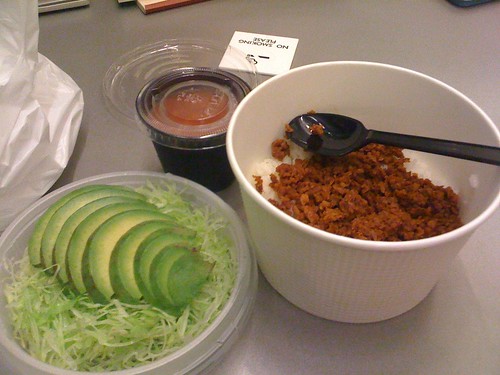
They have a vegan taco rice. It's typical Japanese rice covered with fake taco meat made from soybeans.
  • ビーガン (n) vegan; 絶対菜食主義者 (ぜったいさいしょくしゅぎしゃ) (n) vegan;
  • soybean 《植物》大豆{だいず}◆マメ科、一年草。タンパク質が多い。豆腐、みその原料。
They give you a bunch of shredded lettuce and almost a whole avocado to put on top.
  • shredded lettuce みじん切りの[細く刻んだ]レタス
There's also salsa. She asked me if I wanted mild or hot. I had expected even the hot sauce to be mild, so I asked for hot. I was surprised when it actually was spicy! It was delicious. What a great dinner that was! On top of that, it was cheap: only 750 yen!

If you find a vegetarian dish in a restaurant you often go, please let me know. Back to English topics tomorrow...

2009/06/23

A series on using past perfect


The next series of posts I'm going to write is on past perfect tense. People already feel present perfect is difficult, so past perfect feels even tougher.
  • tough〔任務遂行・問題解決・交渉などが〕難しい、困難{こんなん}な、骨の折れる、厳しい、きつい It's tough to be a man. : 男はつらいよ。
For present perfect, please see the series of articles I did on it a while ago:
I'll start the series tomorrow.

The dinner which I cooked last night wasn't so successful. I tried to make fried noodles and a spicy soup to go with them. The spicy soup turned out alright, but the noodles were a disaster. The flavor was alright, but somehow the noodles all clumped together.
  • 塊まり (かたまり) (n) lump; mass; bundle; clump; clod; cluster; (used as a verb above)
I was especially disappointed because I had just made great fried noodles the night before. <- past perfect

What went wrong?

I should have taken a picture of my clump of noodles, but I was too disappointed and just ate them instead.

Here's a picture of the successful meal which I cooked on Saturday night: stir-fried greens with vegetarian pepper steak, fried tofu with chives in a five-spice sauce, fried noodles with XO sauce, and spicy cucumber salad. I was particularly pleased with the chives and tofu. I had been thinking about how to cook chives, and when I checked on the internet, I found someone cooking them with tofu and that five spice mixture. <- past perfect continuous

Anyway, watch for the start of the past perfect series tomorrow. Good night!

フォロワー