ラベル 熟語 の投稿を表示しています。 すべての投稿を表示

2011/02/22

さび付かないで = Don't get rusty!

A funny thing happened a few weeks back at Coredo Nihonbashi (コレド日本橋).

Coredo Nihonbashi is near our school. I had run over there in the afternoon for a quick lunch. When I had finished eating, I ran back to school. On the way, one of my gloves fell out of my pocket.

● run over to ~まで走っていく、~に駆け寄る (definition from Eijiro on the Web)

Later that evening, I was preparing to ride my bicycle home when I realized that one of my gloves was missing. I figured I must have dropped it at Coredo, so I went back there to find it. I looked all of the places that I had been and asked the staff in the restaurant if they had seen it. They said they hadn't.

● figure 計算する (definition from Eijiro on the Web)

Finally, I went looking for the security staff. I thought they must have a lost-and-found. I found the employee entrance, which was locked, and knocked on the door to get the attention of the guard. He came and opened the door and asked me what I wanted. I explained to him in Japanese the story of my glove. He understood, and let me come to the counter while he checked a kind of log of found items.

● lost and found 〈米〉遺失物取扱所、遺失物係

He seemed to have found it in the log, asked me to wait, and stepped away to a locker where those items could be found. Bringing back a plastic bag with my glove in it, he asked me if it was mine. I told him that it was and thanked him for keeping it for me. He then asked me to fill out a form, which I did.

I thanked him again and started to walk back to the door which I had entered from. Then he told me something that I couldn't quite understand. I asked him to repeat it, but somehow my Japanese wasn't good enough to make out what he meant. That's when something really funny happened.

● make out 理解する、分かる、判読する、認識する、~をようやく見分ける、見分ける、聞き分ける (definition from Eijiro on the Web)

"Th.. th... that... d... d... doooooooooor...* he struggled to tell me in English about the door, as if he couldn't make his mouth pronounce the words "... is locked," he continued, suddenly in perfectly pronounced English. He instantly sounded like a native speaker.

"Oh! You can speak English!" I said, surprised.

"Yes, I used to live in the US when I was a kid," he told me, again in perfectly pronounced native-speed English.

We talked for just a second, and then I left. It seems that he just hadn't spoken English for some time. He had just gotten rusty.

● be rusty〔練習不足により技術などが〕下手になった、鈍くなった、なまった (definition from Eijiro on the Web)

It seems that you don't really forget language that you have learned before. However, if you don't practice, it may not be right there at your disposal when you need it.

● at one's disposal (人)が自由に[好きなように・勝手に]使える[できる]、(人)の思う[意の]ままに (definition from Eijiro on the Web)

The moral of the story is: don't stop practicing English! Keep your skills sharp!

By the way, how is that headline? Is it strange?

2010/11/02

「go on」について

"Doesn't 'go on' mean continue?" somebody asked me. This person had read my post from a few days ago about "go to" and "go on".

http://upgradeenglish.blogspot.com/2010/10/ecocologo-togo-on.html

"Sure! 'Go on' has both meanings," I said.

"Go on" as a verb meaning "continue" can take an activity as an object.
  • I will go on posting pictures of English mistakes when I find them.
  • Even if you make mistakes, I hope you'll go on studying.
It doesn't always use an object, though. There was a typhoon on Saturday.
  • Someone told me that her daughter's school festival went on despite the typhoon.
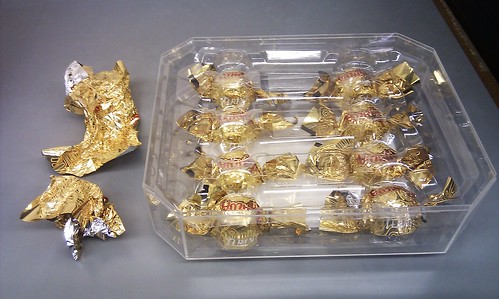
Right now, there's a box of chocolate sitting next to me. They're delicious, so I might go on eating them if I don't put the box away. I supposed I had better put them away.

2010/09/01

Sorry about last month!

Last month I couldn't manage to do as many blog posts as usual.
  • manage to  何とか~する (definition from Eijiro on the Web)
That's partly due to my trip to Singapore.
  •  due to ~が原因{げんいん}で、~に起因{きいん}して、~のせいで、~によって、~の理由{りゆう}から、~のおかげで、~のため、~の故に、~の結果{けっか}、~という要因{よういん}を背景{はいけい}として (definition from Eijiro on the Web)
It's also owing to my catching a cold on my return to Tokyo.
  • owing to ~のおかげで, ~のせいで (definition from Eijiro on the Web)
In the end, I think the heat had a role to play as well.
  • play a role in causing

    ~を引き起こす一因{いちいん}となる、〔疾患{しっかん}など〕の発現{はつげん}[発症{はっしょう}]にかかわる (definition from Eijiro on the Web)
Summer is hard for me, and I bet it is hard for many of you all, too.

Air conditioning is said by many to be no good for our health. However, sometimes I feel I need to be in a building like this one I saw in Singapore. Look at all of those air conditioners! I didn't go in; I wonder how freezing it is inside.

This month I'm going to do my best to bring you a lot of posts, though. Wish me luck!

2010/08/25

シンガポールには、良い食物がいっぱいある!

Singapore is a great place to eat Indian food. Though the majority of the population in Chinese, there's a large number of Indians as well.
  • the majority of the population 人口の大半 (definition from Eijiro on the Web)
This restaurant has an interesting concept. It's a kind of charity.
  • charity 施し,慈善,博愛,善根,仁恵,仁愛,慈悲,篤志 (definition from jmdict)
There are no prices on the menu. People just pay what they feel they can or should pay. Someone who is down on their luck can pay 50 yen. Another person who isn't having trouble making ends meet might pay 500 yen. Both of them could eat the same meal.
  • down on one's luck 運が傾いて、つきに見放されて (definition from Eijiro on the Web)
  • make ends meet 生活の収支を合わせる、収入の範囲内でやりくりする[やっていく] (definition from Eijiro on the Web)
My host felt that 200 yen was appropriate. That sounds great for people in Tokyo, right?

So, what's in the photo? On the plate, there's rice mixed with lentil curry. Next to the plate, there are three vegetable curries, each of which had a very different flavor. This was a south Indian meal.
  • lentil レンズ豆
Because of all of the great food I ate in Singapore, I gained 2 kgs!
  • gain weight 重さ[重量・体重・目方]が増える[増加する]、太る◆【反】lose weight

フォロワー