ラベル アドバイス の投稿を表示しています。 すべての投稿を表示

2011/02/22

さび付かないで = Don't get rusty!

A funny thing happened a few weeks back at Coredo Nihonbashi (コレド日本橋).

Coredo Nihonbashi is near our school. I had run over there in the afternoon for a quick lunch. When I had finished eating, I ran back to school. On the way, one of my gloves fell out of my pocket.

run over to ~まで走っていく、~に駆け寄る (definition from Eijiro on the Web)

Later that evening, I was preparing to ride my bicycle home when I realized that one of my gloves was missing. I figured I must have dropped it at Coredo, so I went back there to find it. I looked all of the places that I had been and asked the staff in the restaurant if they had seen it. They said they hadn't.

figure 計算する (definition from Eijiro on the Web)

Finally, I went looking for the security staff. I thought they must have a lost-and-found. I found the employee entrance, which was locked, and knocked on the door to get the attention of the guard. He came and opened the door and asked me what I wanted. I explained to him in Japanese the story of my glove. He understood, and let me come to the counter while he checked a kind of log of found items.

lost and found 〈米〉遺失物取扱所、遺失物係

He seemed to have found it in the log, asked me to wait, and stepped away to a locker where those items could be found. Bringing back a plastic bag with my glove in it, he asked me if it was mine. I told him that it was and thanked him for keeping it for me. He then asked me to fill out a form, which I did.

I thanked him again and started to walk back to the door which I had entered from. Then he told me something that I couldn't quite understand. I asked him to repeat it, but somehow my Japanese wasn't good enough to make out what he meant. That's when something really funny happened.

make out 理解する、分かる、判読する、認識する、~をようやく見分ける、見分ける、聞き分ける (definition from Eijiro on the Web)

"Th.. th... that... d... d... doooooooooor...* he struggled to tell me in English about the door, as if he couldn't make his mouth pronounce the words "... is locked," he continued, suddenly in perfectly pronounced English. He instantly sounded like a native speaker.

"Oh! You can speak English!" I said, surprised.

"Yes, I used to live in the US when I was a kid," he told me, again in perfectly pronounced native-speed English.

We talked for just a second, and then I left. It seems that he just hadn't spoken English for some time. He had just gotten rusty.

be rusty〔練習不足により技術などが〕下手になった、鈍くなった、なまった (definition from Eijiro on the Web)

It seems that you don't really forget language that you have learned before. However, if you don't practice, it may not be right there at your disposal when you need it.

at one's disposal (人)が自由に[好きなように・勝手に]使える[できる]、(人)の思う[意の]ままに (definition from Eijiro on the Web)

The moral of the story is: don't stop practicing English! Keep your skills sharp!

By the way, how is that headline? Is it strange?

2011/02/17

忍耐は美徳である。Patience is a virtue.

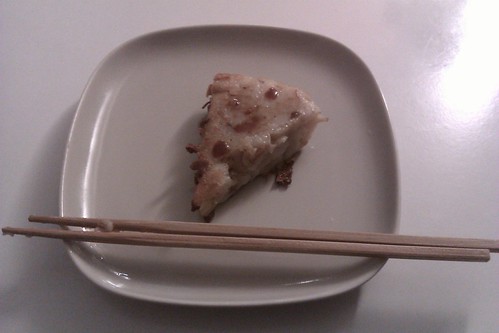
You may have seen my not-so-successful radish cake the other day. I tried again, and this time it worked out pretty well.

work out well うまくいく (definition from Eijiro on the Web)

Rather than cook the radish cake in a wok on the stove, I used the rice cooker. That was not only easier to use, but it also turned out better. Here's a slice of it, with a bit of soy sauce on top.

wok 【名】《料理》中華鍋◆取っ手が片手持ち型は北京鍋、両手持ちは広東鍋。鉄、アルミ、チタン製がある。アルミ・チタンは軽くて熱廻りが均一だが、価格は鉄の10倍。北京鍋の取っ手に持つのに熱くない木製のもある(木取っ手の押えねじが緩みやすいのでしっかり増し締めすること)。プレスで型打ちするのと、手打ちのがある(手打ちは多数の円形模様がある、熱廻りが均一)。(definition from Eijiro on the Web)

Cooking is really satisfying. You can finish the whole activity within a couple of hours and enjoy the result right away. I guess it's not quite instant gratification, but it's much closer to it than long-term activities like learning a foreign language or computer programming.

instant gratification すぐに得られる喜び (definition from Eijiro on the Web)

That's important for us students of language to remember; since the results from study don't always come immediately, we've got to be patient. However, when you look back one year or more, you should be able to see the difference.

Be patient. 我慢してください。 (definition from Eijiro on the Web)

As for my radish cake, it tasted good, and I enjoyed it, but I'm not a dim sum chef yet. Maybe some day. I'll patiently work on it.

dim sum 《中華料理》点心 (definition from Eijiro on the Web)

2009/09/18

ノイズについて一言

On the other side of those trees is the city. The traffic there creates a lot of noise.
  • 交通 (こうつう) (n,vs) communication; transportation; traffic;
However, thanks to the trees, the noise is reduced. No one would want to stay on the sidewalk next to the passing cars for very long.
  • 歩道 (ほどう) (n) footpath; walkway; sidewalk; (P);
However, you could easily spend all day among the flowers.
  • 中 (なか) (n) (1) inside; in; (2) among; within; (3) center (centre); middle; (4) during; while; (P);
Some people think that I'm being too picky when I complain about missing periods and letters that should be capitalized but aren't.
  • 粗捜し (あらさがし) (n,vs) finding fault; being picky;
Still, you should consider those small mistakes as noise. Once you add the word-choice mistake - "grass" instead of "flowers" - the noise increases. Look at the post from two days ago to see what I'm talking about:
http://upgradeenglish.blogspot.com/2009/09/blog-post_16.html
The more noise there is in your sentences, the more your English becomes like the sidewalk next to the traffic.
  • the more ~, the more ~すればするほどますます…
If there's too much noise in your sentences, many people don't want to take the time to communicate.
  • take the time to ~するために時間{じかん}を割く、時間{じかん}を取って~する、~の時間{じかん}を取る◆【語法】toの直後には動詞の原形が来る
Try to make your English like this field of flowers so that people feel communicating with you is a pleasure. I just wanted to say a bit about that.
  • 一言する speak a word

2009/05/22

business English advice

Ichiro Suzuki. Ayumi Hamasaki. Masayoshi Son. Do you know these people? I am sure you do. They are practically household names.

household name
どこの家庭{かてい}でも通じる名前{なまえ}、誰でもよく知っている名前{なまえ}、おなじみの名前{なまえ}、有名人{ゆうめいじん}

She immediately became a household name when she won the gold medal. :
あの人は金メダルを獲得して一躍有名人となった。

However when you meet a foreign business counterpart for the first time remember the following:
Most foreign business people are not used to hearing Japanese names, so speak a little (just a little) more slowly when you say your name. Secondly, it really helps to subtly repeat your name. For example,

Hello, nice to meet you.
My name is Satoshi Nakamura. (Remember to speak a little more slowly than usual)
Please call me Satoshi.

I hope you found my advice useful.

フォロワー