ラベル 文法 の投稿を表示しています。 すべての投稿を表示

2010/09/22

「difference」の使い方

I wrote about "difference" the other day. Take a look at that post for review:

http://upgradeenglish.blogspot.com/2010/09/differdifferentdifference.html

Over the weekend, I visited Niigata. The cooler weather was really pleasant.
× There's a big difference with Tokyo and towns in the mountains.
◯ There's a big difference between Tokyo and towns in the mountains.
When you use "difference", don't forget this pattern:
  • difference between _(n)_ and _(n)_
In Naeba, there wasn't a Seven Eleven or Family Mart, and there were far fewer vending machines. That was a bit inconvenient.
  • vending machine〔飲料{いんりょう}などの〕自動販売機{じどう はんばいき}(definition from Eijiro on the Web)
That's not the only thing, though. There's also a difference between the air in Tokyo and the air there. The air in the mountains was clean and had the wonderful smell of plants. The air in Tokyo is mostly fumes from buses, taxis, and smokers.
  • vehicle fumes 車両{しゃりょう}の噴煙{ふんえん}[排(出)ガス](definition from Eijiro on the Web)
Despite that, I think I prefer the convenience of the city. Still, it was nice to escape for a few days.

2010/07/28

過去完了形の使い方を復習しましょう

On Monday night, I cooked this fried rice and bean curry. I was planning on taking a picture of it before I started eating, but because I was hungry, I forgot.
It wasn't until I had eaten a lot that I remembered my intention.
Notice the past perfect in the sentence above. "Eating" was finished when I remembered. That "eating" action had an important result, which is that the food was gone before I could take a picture. Those are the two reasons to use past perfect tense.
  1. the action is finished before an important past time
  2. that action has a result that is important at the important past time
Last summer I wrote about past perfect. You can review the series I wrote here:
http://upgradeenglish.blogspot.com/2009/06/they-hadnt-expected-weekend-business-to.html
The curry tasted much better today. The flavor was deeper and more savory. However, I made such a big pot that I'll be eating bean curry again tomorrow.
If I hadn't made such a big pot, I wouldn't have to eat it again tomorrow.
  • savory 香ばしい・芳しい・セボリー (definition from jmdict)
There's past perfect again. This time, it's a "third conditional" sentence. I wrote about them last summer, too. Review here:
http://upgradeenglish.blogspot.com/2009/06/if-i-had-stayed-out-bit-longer-this.html

2009/06/23

A series on using past perfect


The next series of posts I'm going to write is on past perfect tense. People already feel present perfect is difficult, so past perfect feels even tougher.
  • tough〔任務遂行・問題解決・交渉などが〕難しい、困難{こんなん}な、骨の折れる、厳しい、きつい It's tough to be a man. : 男はつらいよ。
For present perfect, please see the series of articles I did on it a while ago:
I'll start the series tomorrow.

The dinner which I cooked last night wasn't so successful. I tried to make fried noodles and a spicy soup to go with them. The spicy soup turned out alright, but the noodles were a disaster. The flavor was alright, but somehow the noodles all clumped together.
  • 塊まり (かたまり) (n) lump; mass; bundle; clump; clod; cluster; (used as a verb above)
I was especially disappointed because I had just made great fried noodles the night before. <- past perfect

What went wrong?

I should have taken a picture of my clump of noodles, but I was too disappointed and just ate them instead.

Here's a picture of the successful meal which I cooked on Saturday night: stir-fried greens with vegetarian pepper steak, fried tofu with chives in a five-spice sauce, fried noodles with XO sauce, and spicy cucumber salad. I was particularly pleased with the chives and tofu. I had been thinking about how to cook chives, and when I checked on the internet, I found someone cooking them with tofu and that five spice mixture. <- past perfect continuous

Anyway, watch for the start of the past perfect series tomorrow. Good night!

2009/05/24

Have you ever been to this restaurant?


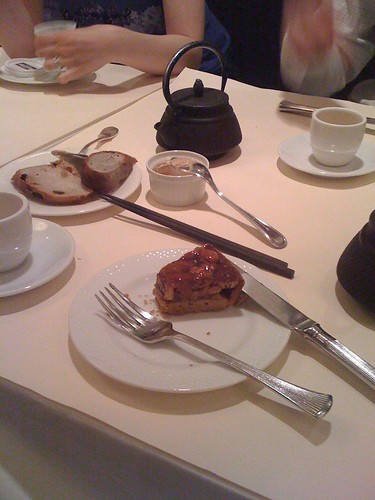
I have decided to report about the restaurant from last night since it was good. It's called Chaya, and it's on the seventh floor of Isetan.
http://www.chayam.jp/restaurant/shinjuku.html
Actually, I've been there many times. I used to like going to movies, and there's a nice theater near there. While their brown rice is good, my suggestion is to get bread. It's really delicious, and you can eat as much as you want! It also comes with a nice peanut spread.
come with ~を搭載している[備えている・装備している]、〔主語には〕~が付いて[付属して・同梱されて]いる
・Does coffee come with it? : コーヒーはセットになっていますか? (definition from 英辞郎 on the web)
For dessert, I had the nut tart. I have had other desserts there, but that one is my favorite.

So, you know I have been writing about present perfect tense. Here are the links to all of the posts I have written about it this week:
http://upgradeenglish.blogspot.com/2009/05/now-that-i-have-had-dinner-i-can-write.html
http://upgradeenglish.blogspot.com/2009/05/yesterday-i-started-series-of-posts-on.html
http://upgradeenglish.blogspot.com/2009/05/i-have-written-two-posts-on-present.html
http://upgradeenglish.blogspot.com/2009/05/i-havent-seen-one-of-my-friends-for.html
http://upgradeenglish.blogspot.com/2009/05/how-many-times-have-you-run-washing.html
For a review, you should be able to correct these real sentences from class:
× I have ever been to that museum.
× How long have you lived in Taipei? (I don't live there now)
× Pollen allergy from last week.
× Recently, there are some serious quality problems.
Here are the answers:
○ I have been to that museum. <- don't use "ever" in a positive sentence
○ How long did you live in Taipei? <- if you use present perfect, it sounds like I still live in Taipei
○ My pollen allergy has been giving me trouble since last week. <- use "since" not "from" with present perfect
○ Recently, there have been some serious quality problems. <- use present perfect with "recently"
I hope you have learned something about present perfect this week. Now there are other topics to talk about, so my series of present perfect posts has come to an end. If there is something that you haven't understood, please let me know!

2009/05/22

How many times have you run the washing machine this week? Have you ever felt the laundry never ends?


In case you haven't read the posts about present perfect tense from earlier in the week, here they are. I have written about it four times this week. After you have reviewed them, come back and read this post.
http://upgradeenglish.blogspot.com/2009/05/now-that-i-have-had-dinner-i-can-write.html
http://upgradeenglish.blogspot.com/2009/05/yesterday-i-started-series-of-posts-on.html
http://upgradeenglish.blogspot.com/2009/05/i-have-written-two-posts-on-present.html
http://upgradeenglish.blogspot.com/2009/05/i-havent-seen-one-of-my-friends-for.html
Sometimes we use present perfect which is sort of a combination of the two ways I mentioned earlier this week.
  • みたい (suf,adj-na) (col) -like; sort of; similar to; resembling; (P); (definition from Edict)
We can use present perfect to talk about something that is finished, but in the sentence we include a term that is unfinished.
  • I have eaten blowfish before.
  • How many times have you been to that restaurant (in your life)?
  • Since I moved to Chuo-ku, I've taken the train far less than I did before.
However, many Japanese want to use "ever" to mean 今まで. That's not OK in a positive sentence.
  • × I have ever...
  • × I've ever been abroad more than five times.
  • × I've ever eaten blowfish two times.
  • × I've ever talked to a stranger because I got lost.
It's good to think about time when using English, but actually present perfect tense already contains this meaning. Because of that, you don't need to use "ever" in these cases.
  • I've been abroad more than five times.
  • I've eaten blowfish two times.
  • I've talked to a stranger. It was because I got lost.
However, don't forget to use present perfect tense with "never".
  • × I never been to Beijing.
  • ○ I have never been to Beijing.
Save "ever" for questions:
  • Have you ever been to Beijing?
There are two restaurants that I have been to twice this week. I feel I've been eating out too much. It can't be good for my health, and it's certainly not good for my wallet either. How often have you felt like that? On top of that, I have done the laundry twice this week, but I haven't folded the clean clothes yet. This weekend, I hope. I also hope you all enjoy your weekend. See you in class!

2009/05/21

I haven't seen one of my friends for a long time.


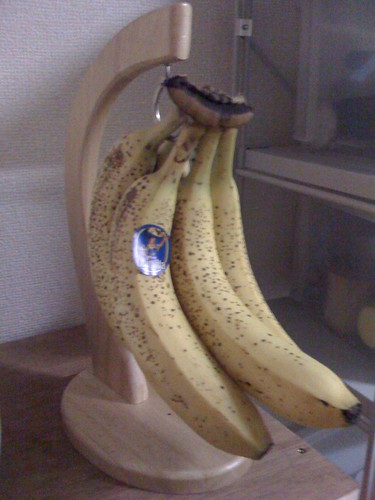
We bought a banana rack a few weeks ago. It works pretty well. Still, I have been disappointed that the bananas don't stay green longer. I really love slightly green bananas! I suppose I should buy fewer bananas each time so that I can enjoy them before they start to develop black spots.

This week, I have written a few times about present perfect tense. If you want to review, here are the posts:
http://upgradeenglish.blogspot.com/2009/05/now-that-i-have-had-dinner-i-can-write.html
http://upgradeenglish.blogspot.com/2009/05/yesterday-i-started-series-of-posts-on.html
http://upgradeenglish.blogspot.com/2009/05/i-have-written-two-posts-on-present.html
So, remember that one reason to use present perfect is to talk about an action which began in the past and has continued up to the present. The action is NOT FINISHED, or JUST FINISHED.
  • × How long here worked? <- a direct translation from Japanese?
  • ○ How long have you worked here?
When you talk about "how long" using present perfect, use "since" or "for", but not "from".
  • × I have worked here from last spring.
  • ○ I have worked here since last spring.
  • ○ I have worked here for about a year.
  • ○ I worked for my previous employer from 2006 to 2007. (雇い主 employer; definition from Edict)
A: Where did you grow up?
B: Tokyo.
A: Oh, so you must know the city well.
B: Sure, I've lived here my whole life.
Present perfect tense has this meaning of continuing from the past up to now. However, I think native speakers are more likely to use present perfect continuous in this situation, unless the action has been continuing for a really long time.
  • × I've listened to this mp3 nonstop lately. You should really download it.
  • I've been listening to this mp3 nonstop lately. You should really download it.
Another difference is that when using present perfect, the action is more likely finished. When using present perfect continuous, there's a greater chance that the action is still going on.
  • × Why haven't you replied to the email I sent? I have waited since last week!
  • ○ Why haven't you replied to the email I sent? I have been waiting since last week! <- and I am still waiting
  • I've been working on this report for days, and I'm still not finished. <- I'm still working on it.
I haven't seen one of my Taiwanese friends since January. She has been to Moscow recently, and I'm really looking forward to hearing about her trip. We are planning to have dinner on the weekend. If dinner is good, I'll recommend the restaurant to you.

I have already written part of tomorrow's post; it's more on present perfect tense. Look for that tomorrow. The press has announced that a case of swine flu has been found in Tokyo, so everyone take care!

Have you finished your laundry?


I have written two posts on present perfect this week. I wrote them on Monday and Tuesday. You might want to read them first.
http://upgradeenglish.blogspot.com/2009/05/now-that-i-have-had-dinner-i-can-write.html
http://upgradeenglish.blogspot.com/2009/05/yesterday-i-started-series-of-posts-on.html
Yesterday, I mentioned that one reason to use present perfect is to talk about something that happened before but is important now. On Monday night, I was in class at a company. This was part of our conversation:
A: Can you go home after class?
B: Yes, because I've already finished all of my work. In fact, I finished it before lunch.
It was a joke; she didn't really finish before lunch, but she had finished her work.

When the events aren't really important now, don't use present perfect tense.
  • ○ (at an accident) Has anyone been injured? (the accident just happened, and you wonder if you need to call an ambulance) <- present perfect
  • ○ (telling the story about the accident) I saw an accident today, but fortunately no one was injured. <- past
Sometimes the past events become important now because they directly relate to the current situation or conversation topic.
A: Can you really run from here to Yokohama?
B: Yes.
A: Really? Why?
B: Because I have run marathons several times.
Sometimes this is paired with a past event. The news is contrasted with a past event.
  • × I have been injured, but I'm well now. <- the injury isn't important now; being well is important
  • ○ I was injured, but I have recovered. I'm well now. <- use present perfect to point out the important news
I haven't done the laundry yet, so I should stop my post here. I don't want to stay up too late tonight. I haven't finished telling you everything I want to say about present perfect, though, so I will be writing about it again tomorrow.

2009/05/20

Have you gone to bed yet?


Yesterday, I started a series of posts on present perfect tense.

Last night in class, we were talking about two basic reasons to use present perfect tense:
  1. happened before, but it's important now. The action is FINISHED. (for example, news and experience)
  2. an action which began in the past and has continued up to the present. The action is NOT FINISHED, or JUST FINISHED.
As an example of number one:
  • I have eaten dinner, so I'm not hungry now.
And as an example of number two:
  • I have lived in Japan for more than three years.
Right away, you should be able to see one of the tricky things about present perfect; depending on the context, the action may or may not be finished. Still, the thing these two both have in common is that there is a strong connection between the past and now.

One of the most common mistakes in students' present perfect sentences is stating a past time in the sentence. We can't do that in present perfect sentences:
  • × I have been to Hong Kong eight and a half years ago. <- "eight and a half years ago" is a past time
  • ○ I have been to Hong Kong. I went there eight and a half years ago.
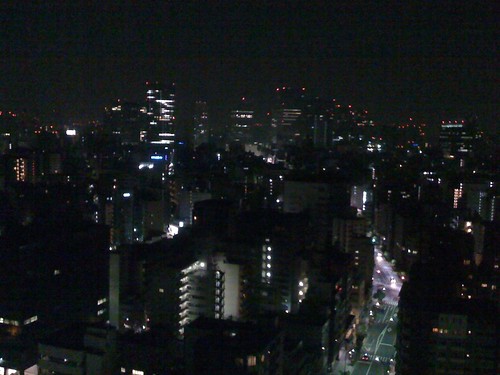
Most of the lights in the buildings around Tokyo Station have been turned off, so it's much darker now. It must mean most people have gone home. The two towers on either side of Tokyo Station turned off many of their lights at 10 pm. I suppose I should follow them. See you in class soon. Good night!

フォロワー