ラベル 食べ物 の投稿を表示しています。 すべての投稿を表示

2011/09/02

「just」と「only」の使い方


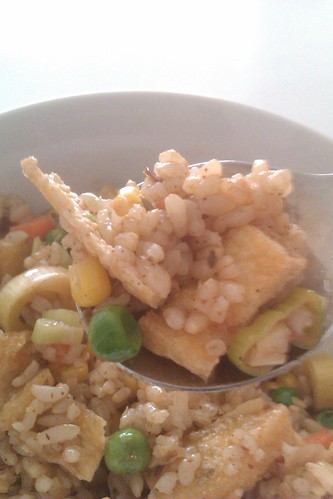
The other day for lunch I cooked this fried rice. I used Indian spices in it, though, to make it more exciting. I also used a Chinese cooking ingredient, chili pepper flakes soaked in oil. I had never used that ingredient to make fried rice before.

× I just only imagined that it would be good.
○ I just imagined that it would be good.
○ I only imagined that it would be good.

Usually we do not use "just" or "only" together. Basically, they have the same meaning, so we have to choose one of them.

One exception is "only just [verb]".
  • only just 辛うじて、たった今~したばかり、やっと、今しがた (definition from Eijiro on the Web)
I only just had enough time to make this fried rice before I had to leave the apartment. It's lucky that fried rice is not only easy to make but also delicious. I'd say it's just a perfect dish.

2010/12/07

私は日本語の使い方に注意した方が良い。(part 4) スペルミスについて

Someone kindly pointed out to me that the headline of my last blog post had a spelling mistake.
  • spelling mistake スペルミス
  • ×  レソトラン
  • ◯ レストラン
Spelling correctly is tough in any language. English spelling is particularly tricky since spelling sometimes seems not to match pronunciation.
  • pronunciation 発音
Fortunately, when typing Japanese, the input method will check it. Unfortunately, I just directly converted hiragana into katakana without letting the input method check it. That was my mistake.

Anyway, I am always grateful when someone shows me where I've gone wrong.

While I am talking about recent feedback, someone else said that I hadn't posted any pictures of what I have been cooking. 
  • × Here are two currys that I made the other day: chick pea curry and spinach curry. 
  • ◯ Here are two curries that I made the other day: chick pea curry and spinach curry.
It's a common mistake to forget to change "y" to "ies" when making a plural noun.

2010/09/29

森永は英語の使い方に注意した方が良い。

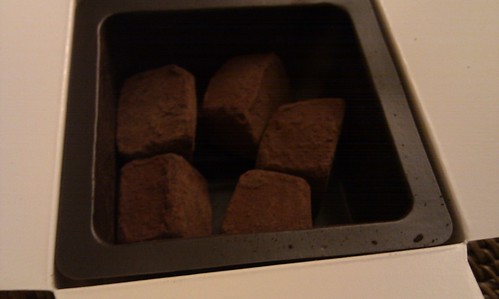
Someone gave me a snack from Morinaga. It's called "Nudear", and it's a kind of chocolate cookie or round brownie.
  •  brownie 【名】
  1. ブラウニー◆チョコレート入りケーキ。味が濃くナッツが入っている。(definition from Eijiro on the Web)
Here's a page with the commercial for Nudear.
http://www.morinaga.co.jp/cm/nudear.html
When you open the box, there's an explanation of the name on the inside. It says:
  • ありのままの私 (×nude) を大切に(dear)
The problem is that ありのままの私 doesn't mean "nude" in regular spoken English. It means "just as I am".
  • You always accept me just as I am.
  • I woke up late, so I had to go to work just as I was, without a shower or even my suit.
They should check out Billy Joel's old hit, "Just the Way You Are".
http://www.youtube.com/watch?v=ounJsqomcv8
If I went to work nude, wow! People would be so shocked! Here's the most common meaning of "nude":
  • nude (adj) 裸の、むきだしの、衣類{いるい}をつけていない、裸体{らたい}の、ヌードが登場{とうじょう}する (definition from Eijiro on the Web)
Morinaga is a big company! They make great almond pudding.
  • almond pudding (or almond tofu, almond jelly) - 杏仁豆腐
Any company of their stature ought to be able to afford to check marketing material with a native speaker, rather than teach everyone wrong English.
  • of this stature
    これほど(素晴{すば}らしい)才能{さいのう}を持つ (definition from Eijiro on the Web)
If you know anyone working there, you can suggest that they check my blog.

2010/09/07

「differ、different、difference」の違いは何?

I'm out! 
  • be out of something ~がなくなって、~を切らしていて、~が切れて、~を失って
    We're out of sugar. : 砂糖を切らしている。(definition and example from Eijiro on the Web)
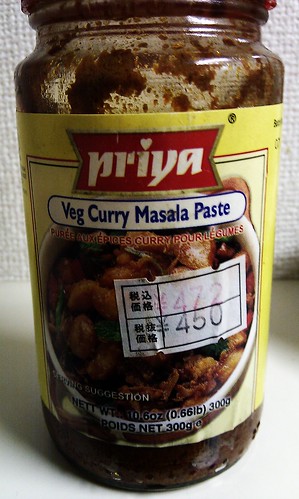
This is a really delicious paste that I picked up in Okubo at a small import food shop. It has a strong flavor and can turn a dish red. I've made curry and soup with it. I'm still not an expert on Indian food, but I think the flavor is South Indian.
× It is different to Japanese curry roux.
◯ It is different from Japanese curry roux. <- "Different" is an adjective.
  •  curry roux 《料理》カレーのルー (definition from Eijiro on the Web) <- note, the pronunciation of "roux" is the same as in Japanese
× There is difference from Japanese curry roux.
◯ There is a difference between Japanese curry roux and this masala paste. <- "difference" is a noun, so "a" is necessary

◯ Japanese curry roux differs from this curry paste. <- too formal! Don't say this! "Differ" is a verb. 
However, now I have to get another jar of it, so that means a trip to Okubo.

Here's the website of the company that makes it.
http://www.priyafoods.com/india/masalapastes.htm
There are some different pastes on that site; maybe this time I'll look for the biryani paste, too!

2010/08/05

「~によって」は英語でどう言う?「depend on」の使い方

A few weeks ago, somebody was telling me about Japanese pickles. They told me:
× The flavor is different by each prefecture.
◯ The flavor is different in each prefecture.
◯ The flavor differs according to the prefecture.
◯ The flavor depends on the prefecture.
  • depend on ~によって決まる、~次第{しだい}である
That last pattern is really useful! Take a look:
  • _(n/noun phrase)_ depends on _(n/noun phrase)_
You probably know I like chocolate by reading my blog, which has posts like this one:
This is some dark chocolate that I was eating the other day. It's a bit sweeter than I like, but the flavor was really rich.
  • rich flavor 《a ~》豊かな風味 (definition from Eijiro on the Web)
Dark chocolate is one of my favorite things to eat. I should learn more about why dark chocolates can taste so different. What factors does the flavor depend on?
  • factor 因子, ファクター, 因 (definition from jmdict)
If I were a rich man, I'd sample a different kind of dark chocolate every day. Right now, the kinds of chocolate I eat depend on what people give me. I seldom have the time to wander around the basement of a department store sampling chocolate. Some day...

2010/01/09

「アピールする」と「appeal」の違いは何?

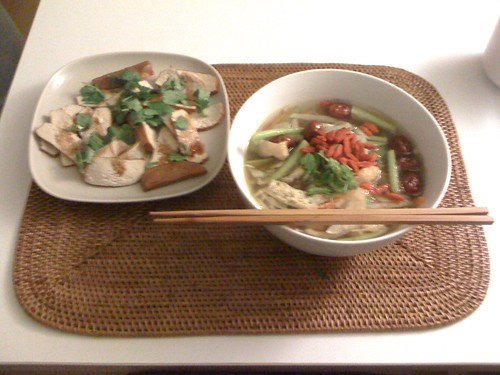
Wow! What a busy day it was! I got home tonight around 11:15pm, and immediately I started to make dinner. This is a picture of what I made.

It's one of my favorite soups: the one with the five spice powder. The difference this time is that it's full of turnip greens and dried jujubes. The side dish is a kind of half-dried bean curd from Taiwan with cilantro and a soy-sauce-based sauce.
  • turnip greens
    《植物》カブラ菜
  • jujube《植物》ナツメ (definition from Eijiro on the Web)
  • 豆乾 dried bean curd (this is Chinese, not Japanese... I know. I don't know how to say this in Japanese).
You might be saying, "ニック、何時も自分の料理をアピールしている。"
× You are always appealing the food you make.
○ You are always promoting the food you make.

この共同プロジェクトはビーチ・リゾートの魅力をアピールして観光客を呼び戻すことを目指しています。
The joint project aims to revive tourist numbers by promoting the beach resorts' attractions. (example from Eijiro on the Web)

promote〔商品などを〕販売促進{はんばい そくしん}する、宣伝{せんでん}する (definition from Eijiro on the Web)
I thought these dishes might be appealing for you. That's why I want to show off.
  • appealing【形】人の心を動かす(ような)、魅力的{みりょくてき}な、おいしそうな、訴求力{そきゅう りょく}がある、目立つ{めだつ}、華々{はなばな}しい
I hope you all can eat something delicious this weekend. Talk to you soon!

2009/09/11

「コストパ」は英語で何?

Here are the answers to yesterday's question:
These days I try to cook:
× a) as possible as I can
× b) as can as much
○ c) as much as possible
× d) possibly as much
○ e) as much as I can.
Even though I try to cook as much as possible, lunch is a meal I can rarely cook.

Today, I tried a relatively new vegetarian restaurant in Higashi-Nihonbashi. The interior was pleasant, and I particularly liked the natural lighting.

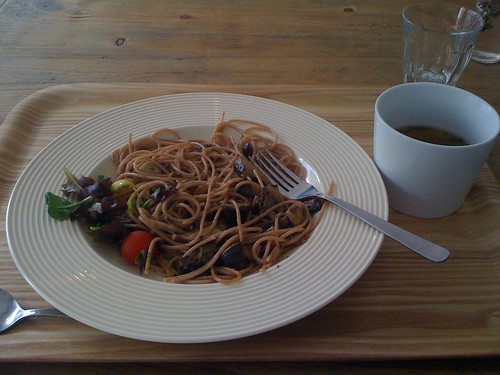
I had a mushroom pasta with a tiny salad and a cup of vegetable soup. The meal cost ¥1000. The flavor was not so bad, but to be honest, the pasta was a bit saltier than I like, and the soup was a bit more watery than what I make at home. The salad was also much too small.
  • コストパ、コスト・パフォーマンス cost performance // price vs performance (definition from Eijiro on the Web)
I'm not sure I've ever heard a native speaker use this in a conversation, especially about food. We're more likely to say something like:
  • It wasn't a very good value.
  • It wasn't worth it.
  • I didn't get my money's worth.
I'll try it again another time. If it's better, I'll give you the details on how to visit yourself.

2009/09/10

出来るだけ

In this photo, you can see the dinner I made last night. I talked about it in my post yesterday:
http://upgradeenglish.blogspot.com/2009/09/lotlots.html
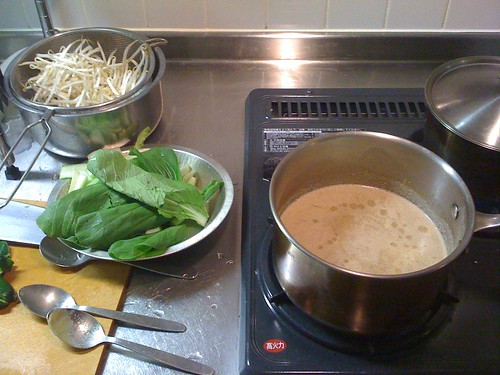
The bowl in front is the sesame sauce noodles. The small bowl on the right in the back is filled with cucumber pickles. The plate on the left is stir-fried Chinese cabbage, also known as bok choi, with fake duck meat.
  • 青梗菜 (ちんげんさい) (n) qinggengcai (spinach-like green vegetable originating in China); pak choi; bok choi; bok choy;
Cooking at home saves money, and the food is generally better for my health. It's also fun!

Which of these is right?
These days I try to cook:
a) as possible as I can, b) as can as much, c) as much as possible, d) possibly as much, e) as much as I can.
Check back for the answer!

2009/09/08

「lot」と「lots」の違いは何ですか?

This question came up in class the other day: what's the difference between "lot" and "lots"?

The basic answer is that "lot" is a singular noun, while "lots" is a plural noun. That means you should use "a" in front of "lot", but don't do that with "lots".

The meaning is the same, though. Personally, I'm likely to use them like this:
  • a lot of __(uncountable noun)__
  • lots of __(countable noun)__
However, either way is OK.

This, though, is definitely wrong:
× a lots of __(n)__
I was missing Taiwanese food. In particular, I wanted to eat sesame sauce noodles. To feed my craving for sesame sauce noodles, I made some tonight for my late-night dinner.
  • craving for ~に対する欲求、~への[~に対する]憧{あこが}れ、~への渇望{かつぼう}
The pot is filled with a lot of sesame sauce soup which I can pour over noodles. On the side you can see there are lots of bean sprouts to put on top of the noodles.
  • 萌やし (もやし) (n) bean sprouts;
I think it turned out pretty well, but I will use a lot more sesame paste in the sauce next time. Next time I'll show you the finished noodles!

2009/05/19

Now that I have had dinner, I can write tonight's post.


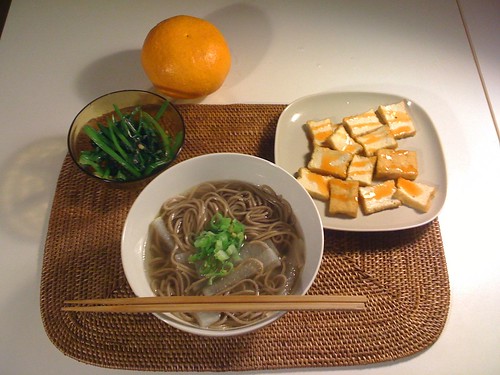
I have just finished dinner. What was on tonight's menu? I had buckwheat noodles with turnip and green onion, spinach stir-fried with garlic and ginger in vegetarian oyster sauce, fried bean curd topped with Thai chili sauce, and some kind of citrus fruit. I'm not sure what the fruit is called. At any rate, I'm full now.
  • buckwheat noodles そば
  • radish 大根
  • green onion 葱
  • spinach 法蓮草
  • ginger 生姜
  • garlic 蒜
  • bean curd 豆腐
Look at the headline for today's post and the paragraph above. Do you see the present perfect tense?
  • present perfect tense 現在完了時制
Why have I used present perfect tense? The reason in the first case was that finishing dinner happened in the past, but it is important now. The reason it is important is that I can now write this post. I can't write a post on an empty stomach.

In the first paragraph, I'm announcing news. Notice the pattern. The first sentence uses present perfect to announce the news. The second and third sentence use simple past to talk about the details. The final sentence uses simple present to talk about the results now. This is a really common pattern that you can find in the newspaper often.

It seems to be really hard for even advanced students to use present perfect correctly. Since I have seen so many students struggling with present perfect recently, I think I'm going to talk about present perfect for a few days. Keep reading. I hope that even if you have felt present perfect is difficult, you will become much better at it after the next few posts I write.

2009/05/02

Dinner turned out like this.


I made baked pesto penne with cherry tomatoes and デコポン. Since penne is Italian, I wasn't sure how to pronounce it. In English, we stress the first syllable, "pen", like something you write with. The second syllable is just like ね in Japanese. So it's like this, PEN-nay.

I realized I have no idea how to say デコポン in English, other than a funny kind of orange.
  • デコポン (n) Citrus reticulata Shiranui; type of citrus fruit (sweet orange with a lump at the top); (definition from Edict)
Wikipedia has a page on it, and guess what, the English is "dekopon", since it's a Japanese hybrid:
The pasta turned out great, and the fruit was super. I wish I could cook like this all of the time.
  • うまく行く (うまくいく) (v5k-s) to go smoothly; to turn out well; to do the trick; to have peaceful relations; (P); (definition from Edict)
You can see, Japanese isn't the only language with loan words. English has plenty of them, too.

I hope you all are having a nice holiday.

フォロワー