ラベル 間違い の投稿を表示しています。 すべての投稿を表示

2011/01/25

私は英語の使い方に注意した方が良い。

Before I get on to this year's important topics, there's still a bit of catching up to do regarding last year's posts. 

I'm writing this post while I have a cup of tea and cookies at a cafe near our classrooms.

I am encouraged by the progress of my students. Back on December 14, I was writing about the difference between "raise" and "rise". In that post, I made an English mistake!

A few of you had not only the sharp eyes to catch my mistake, but also the confidence to bring it to my attention.

・sharp eye 鋭い[刺すような]目[視線](definition from Eijiro on the Web)
・bring ~ to someone's attention ~を(人)に気付かせる、~に(人)の目[注意]を向けさせる、(人)を~に注目させる (definition from Eijiro on the Web)

Here's my mistake:
× If you want to ask me a question, you don't have to raise you hand; just send me email!
◯ If you want to ask me a question, you don't have to raise your hand; just send me email!

There's no explanation for the mistake; it's just a silly mistake that I should have caught. Thanks again to everyone who pointed it out.

2010/10/20

Panasonicは英語の使い方に注意した方が良い。

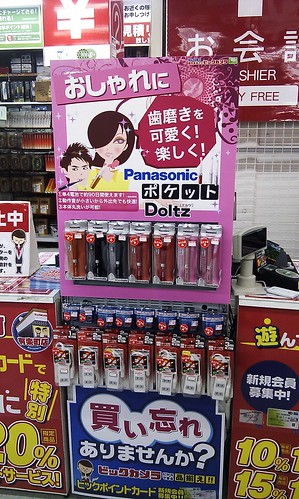
I was at Bic Camera the other day to pick up some things that I needed. When I was standing in line at the cash register, I noticed this display. If I understand correctly, it's for a stylish new toothbrush!
  •  So if I understand you correctly, ... では、君の言うことを私が正しく理解しているとすれば... (definition from Eijiro on the Web)
Maybe the world needs stylish toothbrushes, though I'm fine with a 100 yen tooth brush. I think it's a mostly useless product. What's worse, the amazingly horrible name they've chosen is "Doltz".

As far as I can tell, it doesn't have any meaning in German, French, Spanish, or Russian. That basically leaves English. The "z" can be interpreted as a really casual way to express "s", like a plural noun. In English, a "dolt" is an "idiot", a "fool", a "stupid person". Here's the definition according to Eijiro on the Web:
  • dolt 【名】〈俗・軽蔑的〉ばか、間抜け
This is a mistake that really lacks a good excuse. Junk World has a good excuse; they're just a small second-hand retailer. Panasonic, though, is a big international company! I'm not sure if you are dolt if you buy one, but they've got to be dolts for not asking one of the native English speakers on their staff if this name was a good choice or not.

2010/09/29

森永は英語の使い方に注意した方が良い。

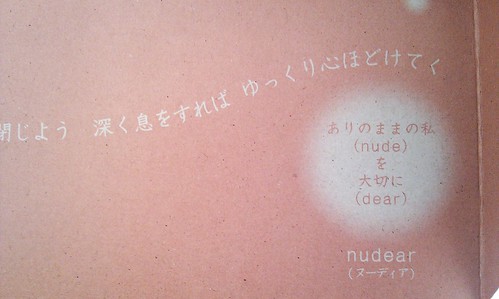
Someone gave me a snack from Morinaga. It's called "Nudear", and it's a kind of chocolate cookie or round brownie.
  •  brownie 【名】
  1. ブラウニー◆チョコレート入りケーキ。味が濃くナッツが入っている。(definition from Eijiro on the Web)
Here's a page with the commercial for Nudear.
http://www.morinaga.co.jp/cm/nudear.html
When you open the box, there's an explanation of the name on the inside. It says:
  • ありのままの私 (×nude) を大切に(dear)
The problem is that ありのままの私 doesn't mean "nude" in regular spoken English. It means "just as I am".
  • You always accept me just as I am.
  • I woke up late, so I had to go to work just as I was, without a shower or even my suit.
They should check out Billy Joel's old hit, "Just the Way You Are".
http://www.youtube.com/watch?v=ounJsqomcv8
If I went to work nude, wow! People would be so shocked! Here's the most common meaning of "nude":
  • nude (adj) 裸の、むきだしの、衣類{いるい}をつけていない、裸体{らたい}の、ヌードが登場{とうじょう}する (definition from Eijiro on the Web)
Morinaga is a big company! They make great almond pudding.
  • almond pudding (or almond tofu, almond jelly) - 杏仁豆腐
Any company of their stature ought to be able to afford to check marketing material with a native speaker, rather than teach everyone wrong English.
  • of this stature
    これほど(素晴{すば}らしい)才能{さいのう}を持つ (definition from Eijiro on the Web)
If you know anyone working there, you can suggest that they check my blog.

2009/05/25

This is one reason that I cut my own hair.

This morning I gave myself a haircut with the pair of clippers I have.
  • バリカン (n) barber's clippers; (from Edict)
Since I just shave my head, it's easy, and I save money and time. However, there's another reason. Look at the photo.

Here's another case of someone with good intentions but bad execution.
  • genuinely good intentions 純粋な善意 (from 英辞郎 on the web)
  • bad execution 不出来 (from 英辞郎 on the web)
We can guess they intend to get English-speaking customers, so they have written:
× spoken English
I understand what they mean. Probably they want to say something like this:
○ English is spoken here.
○ We speak English, too!
○ Don't speak Japanese? Don't worry! We speak English!
This isn't a big mistake, I suppose. Check out the difference between spoken English and written English:
  • 口語英語 (n) spoken English; (from Edict)
  • written English 書き言葉の英語、文語英語 (from 英辞郎 on the web)
Remember the sign about beer from the other day? I wouldn't worry so much if there's an article mistake when I'm trying to order beer. A communication error in this case won't be so serious.

However, if I want to keep it long on top, and the stylist takes a lot off the top, we're going to have a problem.
  • keep it long on top = allow the hair on the top of one's head to remain long; 上の方の髪は長い方がいい。
  • take a lot off the top = cut the hair on the top of one's head very short; 上の髪を短く切って下さい。
So, if I need to speak English with my barber, the barber's English really has to be OK. Maybe they really can speak English here, but they should have gotten one of their clients who is a native English speaker to check the text for their sign before they made it.
  • 床屋 (n) barber; (P); (from Edict)
And as always, if you catch a mistake in any of the Japanese here (and I bet there are plenty of mistakes!), please let us know.

2009/04/06

When talking about changed plans, don't use "would".

Today someone wanted to tell me that though they had made plans for this afternoon, those plans had changed. They decided not to go where they had planned to go. She said:

× I would go there, but I didn't.
○ I was going to go there, but I didn't.

"Would" is frequently used to describe hypothetical situations, not past situations. You can use "would have" to indicate the past. In that case:
  • I would have gone there if I hadn't changed my plans.
However, I think in this case "was going to" is the best choice.

Use "would" to talk about past habits, though:
  • When I was a college student, I would drink beer for breakfast.

2009/04/04

"Both of ok" is not ok!

I often hear this phrase. Please don't use it. Instead, say "both are ok" or "either is ok".

How to use "patrol"

We were having a discussion today about this article:

http://edition.cnn.com/2009/WORLD/asiapcf/03/14/japan.pirates/

Somebody said "The Self Defense Force can patrol pirates". The mistake is that the verb "patrol" should be used with a place, like this:
  • Police patrol rich neighborhoods often.
  • Police don't patrol my neighborhood often enough, so it's not safe.
  • It seems my boss is always patrolling our office, so I can't relax.
So, to correct the sentence above:
  • The Self Defense Force can patrol the coast to catch pirates.

フォロワー