ラベル 日本橋 の投稿を表示しています。 すべての投稿を表示

2011/07/13

「here you are」と「here we go」の違い

Someone asked me to explain the difference between "here you are" and "here we go", so here we go.
  • here we go = let's start, we're starting
First, it will be useful to look at the definitions of these two phrases given by Eijiro on the Web. Here you are:
  • Here we go.  1.(さあ)行くよ。/さあ始めるよ。2. せーの。/それっ。◆複数の人たちが力を合わせて物を動かすとき。
  • Here you are! さあどうぞこちらです。はいどうぞ!
We use "here we go" sometimes for encouragement, but sometimes as a complaint. As a complaint, we often add "again".
A: Let me tell you why what you did bothers me.
B: Oh no. Here we go again. <- it sounds like this person has heard this complaint before
"Here you are" is said when we want to offer something. It can also be used with "there" instead of "here", when the possession of something has passed from the giver (using "here") to the recipient (using "there").
  • recipient【名】受領者、容器、受取人、受け手、受信者、受益者
So, there you are! That's the difference.

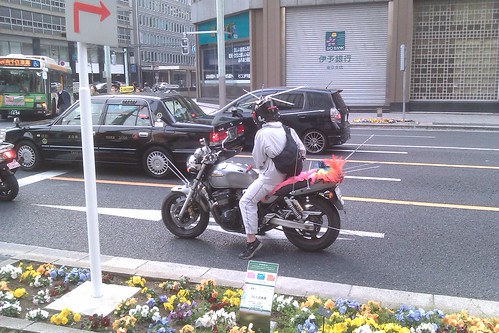
Oh! I haven't given you a photograph with this post. I should add something! Now, you may be thinking "oh, here we go again, another of Nick's strange photos!". Anyway, here you are, a picture of a guy on a motorcycle at Nihonbashi who loves antennas.
  • antenna 【名】1.  〈米〉アンテナ、空中線{くうちゅうせん}◆【略】ANT◆【同】〈英〉aerial; 2.〔昆虫などの〕触角{しょっかく}(definition from Eijiro on the Web)
Please let me know if you have more questions that I can answer in posts!

2009/05/10

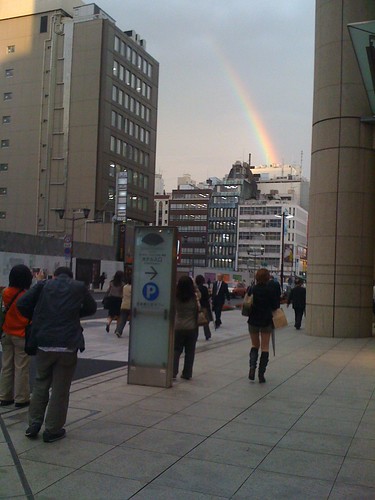
We don't see a whole lot of rainbows in Tokyo.


The other day I was talking about "all", "every", and "whole". When we were discussing it in class, two idioms using "whole" came to mind (definitions from Edict).
  • 胸に浮かぶ (むねにうかぶ) (exp,vi,v5b) to come to mind; to pop into one's head;
  • 頭に浮かぶ (あたまにうかぶ) (exp,vi,v5b) to come to mind; to pop into one's head;
  • 思い当る (おもいあたる) (v5r,vi) to come to mind; to recall; to think of;
Those two idioms are "a whole lot of __(n)__" and "the whole lot of __(n)__".
  • a whole lot of __(n)__ = many __(n)__ <- stronger than "a lot of"
  • the whole lot of __(n)__ = all of the __(n)__ <- a casual idiom
For example:
  • Today, there were a whole lot of people at Nihonbashi because of a festival.
  • Because of that, when I went into Family Mart to get a rice ball filled with sour plum, the whole lot of them were gone.
The difference between these two meanings shows us why you should be careful about articles like "a" and "the".

On Friday afternoon, when I came out of my Japanese lesson, I saw a whole lot of people on the corner. The whole lot of them were holding their cell phones up into the air. I didn't understand why until I looked at the sky. They were all taking pictures of a beautiful rainbow!

I'm looking forward to seeing the whole lot of you in class soon.

フォロワー