2012/09/18

「work」と「walk」の発音の違い


I sometimes find people confused about the difference in pronunciation between "walk" and "work".

"Work" sounds like "perk", "lurk", and "jerk". Your mouth is open about as much as when you say "え", but the sound is not "eh", but "er", like in "bird". You need a strong "r" sound, which means curling your tongue. There's more about "r" sounds in this blog post.
"Walk" sounds like "talk". The "a" is like "ah" (あ).

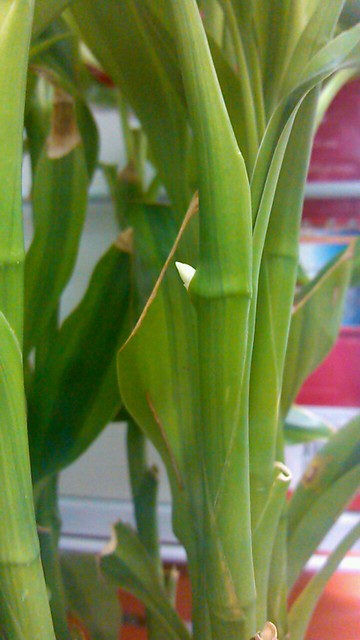
I have been working on this lucky bamboo plant for a while. We took some cuttings from the plant, and now they are growing quite well, as you can see in the photo above.

I've also been working on some spider plants.
  • spider plant オリヅルラン (definition from Eijiro on the Web)
You can see a very healthy one when you walk out of the elevator in our building. Come by and pay us a visit sometime!

2012/09/12

「want」と「won't」の違い

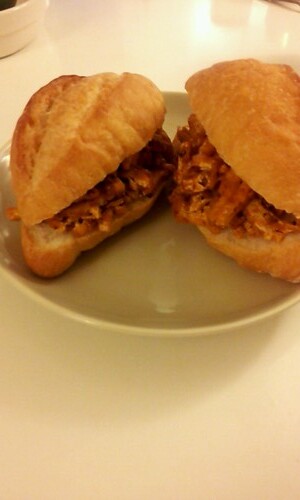
A tiny bit of nostalgia for my youth led to me making BBQ sandwiches. These sandwiches are full of mock BBQ chicken, made from strips of fried tofu and homemade Texas-style barbecue sauce.
  • nostalgia 【名】懐旧、懐古の情、ノスタルジア・郷愁、望郷の念 (definition from Eijiro on the Web)

× Somehow I won't to eat BBQ sauce these days.
○ Somehow I want to eat BBQ sauce these days.

I think it's because of the really good BBQ tempe that I had at this vegetarian restaurant in NYC back when I visited in March:

http://nymag.com/listings/restaurant/bliss/

× I want live in NYC again, I think...
○ I won't live in NYC again, I think...

... but that is a great restaurant!

In the sentences above, people who are listening sometimes get confused between the two. That's dangerous, because the meanings are very different. However, it should be simple to tell which is being used. There are two reasons.

The first is the difference in pronunciation:
want ~ taunt, flaunt, font. This is an "ah" sound in American English.
won't ~ This is an "oh" sound in American English.

The second difference is in grammar. "Won't" is an auxiliary verb, so it's never followed by "to". "Want" is a regular verb, so when a verb comes after it, you have to use "to" first.

I won't use the same recipe for barbecue sauce next time. This one was good, but not as rich or deep as I had wanted to eat.

2012/09/07

「clear」と「clean」の違い・「room」と「apartment」の違い


Two weekends ago I found that USB cables had been breeding in a box in my apartment, and that their population had really increased!
  • breed〔動物が〕子を産む、繁殖する (definition from Eijiro on the Web)
× I was clearing my room at that time.
○ I was cleaning my apartment at that time.

"Clear" means to get rid of everything, so that the space is empty. If a room is dangerous, the police might tell everyone to "clear the room!" They mean for everyone to get out of the room. 

"Clean" is a better choice when you are organizing things. I did clear the box of USB cables, though. The cables for some peripherals that I'd thrown away long ago were still in this box. Almost all of them got thrown out.

The other thing is that "room" means just one room in your apartment, which is one unit in your apartment building. My building has a lot of units, and my apartment has a few rooms, including the bathroom and the kitchen.

I always want my house to be more organized, and part of that is cleaning up clutter like these USB cables. 
  • clutter【名】散乱物、がらくたの山 (definition from Eijiro on the Web)
 I recommend you spend some time this weekend cleaning up clutter at your home.

2012/09/04

「チャックが全開だ」は英語でどう言う?


The other day I arrived at the office after teaching a lesson outside in the morning. I hadn't used the restroom since leaving home, so when I got to the office, I was kind of in a hurry to go to the restroom.

I put down my bag and started walking to the restroom. Thinking ahead, I looked down at my pants, and then I realized it. My fly was down.
  • fly チャック (also "zipper")
Since I hadn't been to the restroom since leaving home, it meant my zipper had been open for a few hours. No wonder it was a little bit cooler when I was riding my bicycle! I stopped and snapped this photo before going to the restroom.
  • no wonder 驚くに値しない、~も不思議ではない、道理で~なわけだ、無理もない、~も無理はない、なるほど~なわけだ、~も当然である (definition from Eijiro on the Web)
It seems that when I was a kid in Texas, in some cases someone might lean over to you and tell you, "hey, if you don't close the barn doors, the cows are going to get out!"

If you notice someone with their fly down, I recommend that you tell them. They will probably thank you for it. I would have been grateful for someone to have mentioned it to me. In fact, all of you should check your flies now.

2012/08/22

Tabikouboは英語の使い方に注意した方が良い。「heartful」は本当の英語でどう言う?


I was riding my bicycle up Chuo Avenue a few afternoons ago when I saw this bus. I read the side of the bus and had to stop to take a photo.
× We presents heartful trip
○ We provide heartfelt trips.
"Heartful" is not real English. It's a made-up word.
  • made-up【形】こしらえた、でっち上げた、フィクションの、架空の (definition from Eijiro on the Web)
It's true that we add the suffix "-ful" to mean "full of ~". However, "heartful" is not a commonly accepted case, unlike words like "hateful", "grateful", and "disgraceful" (like the English on this bus).

On the other hand, "heartfelt" is a real word that is relatively common.
  • heartfelt【形】〔感謝・同情・謝罪などの言葉・行動などが〕心からの (definition from Eijiro on the Web)
On top of that, this is still a weird sentence. The tour company doesn't have anything to do with whether I am traveling sincerely or not. Maybe they mean something like:
We provide you with heartfelt service on your trip.
That makes more sense. They are sincere, which makes my trip happier.

They also forgot the period at the end of the sentence. Make sure you don't do that.

This blog is just my heartfelt advice on how you can improve your English. I hope you'll come and study with us, too.

2012/08/07

「オリンピック競技」は英語で何て言う?


I started running a little over a month ago. Every time I put on my shoes...
× I feel like I'm in an Olympic game.
○ I feel like I'm in an Olympic event.
We say "the Olympic Games" when we are talking about the sum of all of the events. It's also important to remember that one sport might have several events, like tennis has singles and doubles, soccer has men's and women's, and so on. "Games" often have points, but not all of them do, particularly races.
× I may feel like an Olympic player when I put on my shoes, but...
○ I may feel like an Olympic athlete when I put on my shoes, but...
"Players" is generally used for participants in games with points. An athlete is someone "a trained to compete in sports or exercises", according to dictionary.com.
  • athlete 【名】運動[スポーツ]選手、スポーツマン、スポーツ愛好家、競技者 (definition from Eijiro on the Web)
Like I was saying, the truth is far from my imagination. I watched part of the women's marathon. When I calculated their speeds and compared them with mine, it was clear that I have a lot of practice to do to get anywhere close. That gave me more admiration for the Olympians.
  • Olympian オリンピック選手 (definition from Eijiro on the Web)
  • admiration 【名】称賛、感心、感嘆 (definition from Eijiro on the Web)
I suppose I should use my running shoes tonight, then.

2012/07/31

「thus」の使い方


Someone I know asked me how to use "thus", thus I am writing this post.

See? "Thus" is basically the same as "so". It sounds formal, maybe even old-fashioned.
thus【副】それ故に、従って、だから (definition from Eijiro on the Web)
Last night I was up late cooking that tofu dish that I posted about the other day. I think I'm finally used to cooking it, and I can manage to cook it without the tofu sticking to the pan when I fry it. The photo above is the fried tofu before it has been simmered in spices.

Actually, "thus" has two other meanings. One means "in that way", like:
  • Cooked thus, the tofu becomes firmer.
  • thus このようにして、こんなふうに、上に述べたように (definition from Eijiro on the Web)
Another relatively common usage is "thus far", which means "up to now", like:
  • Thus far, I've cooked this tofu about eight or nine times.
  • thus far ここまでは、これまで、今までのところは、今までは (definition from Eijiro on the Web)
I've been practicing it, thus my skill is improving. To be honest, though, I almost never use "thus" in this way. I'd probably just say "so", thus I don't really recommend using "thus".

2012/07/24

「every time」と「all the time」の違い

I had been concerned about our Dracaena sanderiana, aka lucky bamboo. There were no new shoots coming out of the stalk. However, today I noticed this small white shoot had appeared at the top of one of the stalks. I was relieved.
× I had been checking the stalks every time.
○ I had been checking the stalks all the time.
"Every time" means all of the occurrences of something. In the example above, exactly what is occurring is not clear. That's why we should use "all the time" instead, which can mean "very frequently" or "constantly".
  • all the time その間ずっと、四六時中、年がら年中、ひっきりなしに、のべつ幕なしに (definition from Eijiro on the Web)
  • every time 毎回~するたびに (definition from Eijiro on the Web)
  • constantly 【副】絶えず、しきりに、絶え間なく、常に、四六時中、やむことなく、いつも (definition from Eijiro on the Web)
Every time I looked at the stalks, I couldn't see any shoots, so I had been worried. <- this is OK because it is clear what happens each time

It seem I'm reading about China and other countries arguing about territory in the Pacific all the time. Every time I read such an article, it makes me nervous. One of the reasons is that people are competing for energy resources. With that and the safety and waste issues with nuclear power, it would be great if countries would devote their efforts to better solar energy instead. I would be much happier knowing that every time I use electricity it was coming from a solar panel rather than something that puts us at risk all the time.

フォロワー