ラベル よくある間違い、間違えやすい英文 の投稿を表示しています。 すべての投稿を表示

2009/12/01

「in someone's case」の使い方

At a very large weekend market in the suburbs of Bangkok, there were some women trying to raise money for a charity.
  • 金を調える (かねをととのえる) (exp) to raise money; (definition from Edict)
  • 慈善 (じぜん) (n,adj-no) charity; philanthropy; (P); (definition from Edict)
I was talking about "in the case of" yesterday.
http://upgradeenglish.blogspot.com/2009/12/in-case-of.html
Think about that while looking at the following sentences.

The woman on the left looks really excited about what she is doing.
× In case of the woman in the middle though, it seems she is confused.
× In case the woman in the middle though, it seems she is confused.
○ In the case of the woman in the middle though, it seems she is confused.
In other words, there's a woman in the middle of the photo, too.
× In the case of her, it seems she is confused. <- don't use "in the case of" followed by a pronoun
○ In her case, it seems she is confused.
  • in someone's case (人)の場合
The sign she is holding isn't quite right. It says:
× Donate for helping illtreated children.
○ Donate to help ill-treated children.
  • ill-treated child 被虐待児 (definition from Eijiro on the Web)
However, in the case of philanthropists, we can forgive a few small mistakes, right?
  • 慈善家 (じぜんか) (n) charitable person; philanthropist;

2009/11/28

「in case of」の使い方

When I was on the airplane, there was a message to the effect that:
  • In case of an emergency landing in water, use the seat cushion as a flotation device.
  • to the effect that ~という旨の The government made a statement to the effect that it's against the war. : 政府は、その戦争には反対であるという趣旨の声明を発表しました。(definition from Eijiro on the Web)
  • 降下 (こうか) (n,vs) fall; descent; (plane) landing; (atmos.) depression; (P); (definition from Edict)
  • flotation device 救命胴衣{きゅうめい どうい}、救命具{きゅうめいぐ}(definition from Eijiro on the Web)
It means "if there is an emergency landing in water, you should use the seat to avoid drowning."
  • 水死 (すいし) (n,vs) drowning; (P);
In the case of "in case of", use it like this:
  • In case of __(n)__, (imperative sentence).
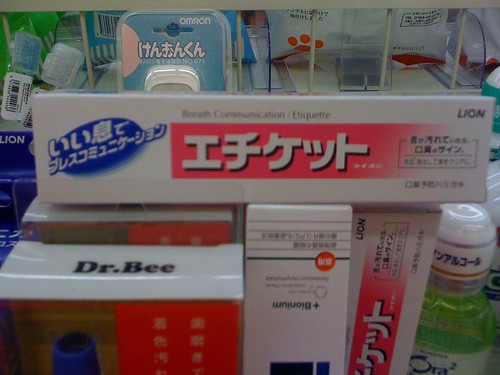
Here's some really strange marketing copy. It says:
  • Breath Communication / Etiquette
Let me give you some advice, OK? In case of someone trying to communicate with you by means of their breath, run like hell.
  • like hell 死に物狂いで、必死に (definition from Eijiro on the Web)

2009/11/18

「in case」の使い方

For a few days, I want to talk about how to use the word "case". Today is the phrase "in case". Here's the definition from Eijiro on the Web:
in case 念のため、万が一(~する場合{ばあい})の用心{ようじん}に、万が一[もしもの場合{ばあい}]に備えて、何かあるといけないので、~するといけないから、万一{まんいち}~の場合{ばあい}には◆ifよりも口語的
・(Just) in case you didn't know yet, his website is gone for good. : すでにご存じとは思いますが、一応念のために言うと、彼のウェブサイトは永久閉鎖されました。
"In case" is used like this:
in case __(a situation with a subject and verb)__, __(something you do, often beforehand, to prevent something bad from happening)__.
  • 事前 (じぜん) (n,adj-no) prior; beforehand; in advance; (P); (definition from Edict)
  • その後 (そのあと) (n-adv,n-t) after that; afterwards; thereafter; (definition from Edict)
× In case my headphones break, I have to buy a new pair. <- this is done afterwards, not before
× In case of I break my headphones, I have a backup pair. <- I'll talk about "in case of" another day.
× In the case of I break my headphones, I have a backup pair. <- I'll talk about this in another post, too.
○ In case I break my headphones, I have a backup pair. <- My headphones might break. If they do, I have a backup pair that I can use.
Read this post once more, just in case.
  • Just in case. 念のために。/万が一の場合に備えて。

2009/09/05

「enjoy」の使い方

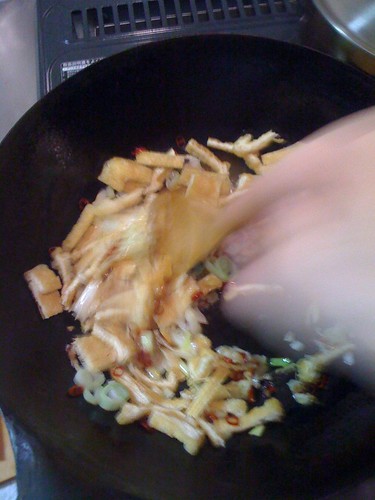
When I got home this evening, I was pretty hungry. I put my bag down and went straight to the kitchen to cook something to eat. I'm getting fast at cooking soup for noodles, so that's what I made. After chopping some vegetables and putting them in boiling water with seasonings, I started to stir-fry a topping for my bowl of noodles. That's what you can see in the picture.
× I was really enjoying.
"Enjoy" is a verb that needs to be used with an object.
  • 目的語 (もくてきご) (n) (ling) object;
That's why the sentence above is wrong. One common pattern is "enjoy oneself".
  • enjoy oneself 楽しむ、楽しく過ごす We could enjoy ourselves at the party. : パーティーを楽しみました。I enjoyed myself. : 本当に楽しかったです。/ああ楽しかった。(definition from Eijiro on the Web)
Otherwise, you can use an object to say what you enjoyed.
  • I enjoyed listening to crickets when I took a walk earlier. <- "listening" is a gerund, basically a noun
  • 蟋蟀 (こおろぎ) (n) (1) (uk) cricket (Gryllidae); (2) (arch) any insect that chirps in autumn;
I was really enjoying myself, and I decided to take a picture to share with you all. From all of my pictures of food, you must know that I enjoy cooking. I also enjoy teaching, which is lucky for me (and hopefully you, too)!

I hope you enjoy the weekend. Take care!

2009/07/14

「so」の使い方

People are sometimes confused about using "so", so let's talk about it a bit.

Look at this one first:
× I was surprised so that I couldn't think anything.
○ I was so surprised that I couldn't think of anything.
Use "so" as an adverb in front of an adjective to emphasize it.
○ It was so hot today.
Use "that" at after the complete clause to talk about the result:
○ It was so hot today that I had to take a second shower in the middle of the day.
Even though "so" can be an adverb, you can't use it in front of a verb like this:
× I don't so like cats.
○ I don't like cats so much.
However, you can use it in front of a "be" verb or "do" to mean "also".
× I was very tired, also my coworker.
○ I was very tired, and so were my coworkers.
○ I felt it was hot today, and so did you, I bet.
"So-so" is something we use in conversations, but not to modify another adjective.
× It's so-so easy.
○ It's somewhat easy.
Use it like this:
A: How was the meal?
B: So-so.
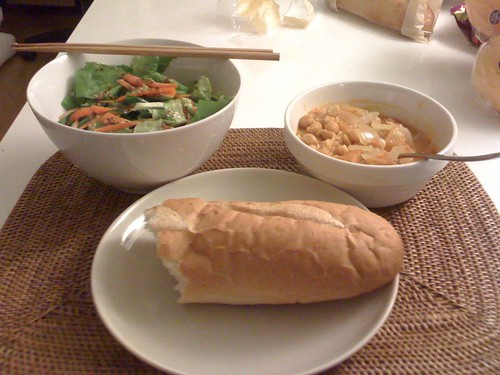
Speaking of meals, here's what I made for dinner last night. At the supermarket a few days ago, tomatoes seemed cheap, so I bought a pack of them. Even though they were cheap, they were so delicious. I used most of them last night in this dish, which is chickpeas cooked with onions, tomato, cumin, lemon juice, red pepper, and black pepper.

I don't make a salad with lettuce so often, but somehow I felt it would be good with the chickpeas. For the salad, I made a dressing of vinegar, mustard, black pepper, and a pinch of salt. It was somewhat sour and didn't quite taste like I expected. The results were just so-so.

It was hot today, but I'm cooler now thanks to the AC. Hopefully so are you. Take care in the heat tomorrow!

2009/07/02

Don't use "both" with a negative.

Today's post is short but important. You can't use "both" when it's connected a verb with "not". Using "not" is a negation.
negation 否定{ひてい}[否認{ひにん}・反論{はんろん}]の言葉{ことば}[考え・表現{ひょうげん}]◆【用法】可算名詞。
・There are too many negations in the sentence to be understood. : その文には否定表現
× I don't want both of them.
○ I don't want either of them.
× Both of them don't need it.
○ Neither of them need it.
Don't get confused with the difference between negation and a negative meaning (as in, "not good").
○ Neither of them are wrong. = They are both correct.
○ Both of them are wrong. = They are both incorrect.
Both of us, Johnny and I, are from the US. Neither of us drinks. We both have summer birthdays. You can ask both of us questions about English. If your question can't be answered by either of us, I bet there's no answer. Please ask!

2009/05/18

Even if you're serving beer, articles do matter!

This evening I went to Ebisu for dinner. I visited one of my favorite shops, and I also tried a kind of new restaurant specializing in vegetables. The vegetables were delicious, but the cooking wasn't so creative. In fact, it was kind of bland. What's more, it was overpriced.
  • お負けに (おまけに) (conj,exp) to make matters worse; besides; what's more; in addition; on top of that;
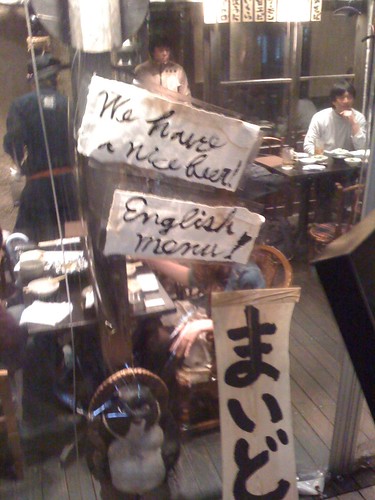
Anyway, while I was walking to the restaurant, I spotted these signs in another restaurant. They are trying to advertise their friendliness to foreigners. I suppose most English speakers would read these signs and feel extra welcome, so maybe they have achieved their purpose.

However, they should ask at least one of their foreign customers to check the grammar of their signs, and probably their menu as well. The upper sign says:
  • × We have a nice beer.
  • ~ We have nice beer.
  • ○ We have good/tasty/delicious/thirst-quenching beer.
  • 渇を癒やす (exp) to quench one's thirst;
"A" always means "one". "Beer" is often uncountable, and counted by "can" or "bottle". However, native speakers sometimes count "beer" itself.
  • Hey, could you grab a beer for me from the fridge?
If they have "a nice beer", then it means that if we are a group of thirsty foreigners, we will have to play "paper, scissor, stones" in order to see who can drink that one beer they have.
  • じゃん拳 (じゃんけん) (n,vs) (uk) rock, paper, scissors game; paper, scissors, stones game;
I hope the next time you go to an izakaya they have more than "a beer", otherwise you may have to drink tea instead.

2009/04/26

Did you really meet Namie Amuro?

Someone told me:
  • × I met Namie Amuro!
The intended meaning was this:
  • 安室奈美恵に会ったことがある。
Meeting someone means the two of you shook hands, exchanged business cards, had an introductory conversation, or something like that. Here's the correct version:
  • ○ I saw Namie Amuro in person on the street!
"In person" means in the physical presence of someone or something. Look at Space Alc's definition; their example sentence is almost exactly the same situation.
  • in person〔映画{えいが}やテレビではなく〕じかに、生で
  • I saw a famous actor in person at the restaurant the other day. : 先日そのレストランで有名な俳優を直に見ましたよ。
Here's another example:
  • A: Should I give him the bad news by email?
  • B: No, it would be better to tell him in person.
"On the street" could be substituted with "in a cafe", "in a convenience store", or any other place. The reason to include it in the sentence is to emphasize that when you saw her, it wasn't at one of her concerts.

I remember the first time I saw a local celebrity in person when I was a kid. It was one of the weathermen from a local TV station. I was surprised by how much thinner he looked in person than on TV. It turns out that the harsh studio lights eliminate the shadows on people's faces, making them look heavier than they actually are.

2009/04/22

わかりましたか。

Japanese always say 「はい、はい、はい、今わかりました。」
  • The literal translation is "OK, OK, OK, now I understood." ×
  • 直訳 (ちょくやく) (n,vs) literal translation; (definition from Edict)
However, it's not correct! The sentence contains the word "now", right? If you are talking about now, you should use a present tense. So, instead of saying "I understood", say "I understand". In this case, don't use 現在進行形 (some verbs like this are "understand", "know", and "have").
  • 現在進行形 (げんざいしんこうけい) (n) (ling) present continuous tense; present progressive form; (definition from Edict)
Now, everyone say "oh! I understand!"

2009/04/20

Maybe one of your mistakes is "as same as" this one.

Here's another common mistake; it's a mix of two different patterns for saying two things are equivalent:
  • × "Maybe her age was as same as me."
The two patterns are:
  • as __(adj)__ as __(n)__
    and
  • the same as __(n)__
You can say
  • She was as old as I was.
or you can say
  • She was the same age as me.
There is a little bit of a difference in meaning. "As __(adj)" says that with regards to that aspect of the noun, the two things are the same. It doesn't compare the other aspects. "The same as" sometimes means that two things are equal. Compare these two examples:
  • Japan is as big as California. (while they are different in many regards, their sizes are the same)
  • This computer is the same as that one. (the two computers are equal in every regard)
If you are using sentences as wrong as the example at the top of the page or the same as the one above, please stop :).

I'm looking forward to seeing you all at 三越前 soon.

2009/04/10

Almost all of these are wrong.

Which of these sentences is correct?
  1. Almost Japanese make this mistake.
  2. Almost these sentences are wrong.
  3. Almost people forget that "almost" is an adverb.
  4. I hear this mistake almost every day.
  5. This word is almost used correctly.
While the meaning of all of these sentences is true, the only one which is grammatically correct is number 4. Please remember that "almost" is an adverb. That means it can modify another adverb or an adjective, but it cannot be used to directly modify a noun. Here are the correct versions:
  1. Almost all Japanese make this mistake.
  2. Almost all of these sentences are wrong.
  3. Almost all people forget that "almost" is an adverb.
  4. I hear this mistake almost every day.
  5. This word is almost never used correctly.

2009/04/08

You must hope that the economy is going to get better, but do you really expect it to?

There's a lot of confusion about hope and expect. "Hope" is only for something the subject views as positive. "Expect" can be for positive or negative things.
  • I hope he's on time, but I expect him to be late.
The confusion probably comes from thinking in Japanese about English; Edict shows this definition:
  • 期待 (きたい) (n,vs) expectation; anticipation; hope; (P):
However, Space Alc also shows this as one of the meanings:
  • expect【自動】予期する
So you can say something like this:

フォロワー