ラベル 句読点 の投稿を表示しています。 すべての投稿を表示

2010/03/30

「its」と「it's」の違い, アポストロフィの使い方、part 4

This restaurant is one that I often eat it.
× Its an Italian restaurant in the Yaechika.
◯ It's an Italian restaurant in the Yaechika.

× It's pasta is priced really reasonably.
◯ Its pasta is priced really reasonably.
"Its" is the possessive version, but it doesn't use an apostrophe. The reason is that somehow "it's", which means "it is" or "it has", gets the priority.
  • possessive noun 所有格名詞 (definition from Eijiro on the Web)
  • have priority (~よりも)優先権を持っている、(~よりも)優先{ゆうせん}する (definition from Eijiro on the Web)
You might even see native speakers make this mistake. I make it from time to time.

Thinking back to the previous posts in this series, you might say "wait! I thought I can only use the 's' for people and animals!"

Well, there is a rule, but native speakers don't always follow it; that's typical for English.

However, if you go to Google and search, you can find these results:
  • "the restaurant's food" - 455,000 results
  • "the food at the restaurant" - 2,400,000 results
You can see that the non-apostrophe version is more common.

Anyway, I recommend this restaurant for cheap and delicious pasta. It's located at the end of the Yaechika near Bridgestone. Its atmosphere might not be the greatest, but it's got good food.

2010/03/23

アポストロフィの使い方、part 3

I've been talking about apostrophes for a few posts now. Here are the two previous posts:
http://upgradeenglish.blogspot.com/2010/03/part-1.html
http://upgradeenglish.blogspot.com/2010/03/part-2.html
Last time, I said you should only use apostrophes for animals and people, but there's one other case that's common: you can use an apostrophe to talk about a noun related to a time.
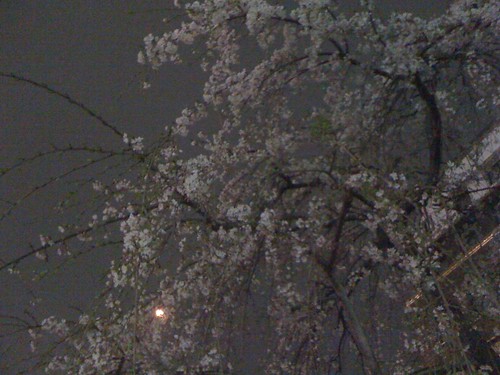
  • Today's blooming cherry trees are really beautiful, even at night.
  • I'm not sure if they are more beautiful than last year's, though.
  • I hope that tomorrow's forecasted rain doesn't spoil the blossoms.
  • 打ち壊す (うちこわす) (v5s) to destroy; to spoil; to crush; to wreck; (definition from Edict)
  • 損なう (そこなう) (suf,v5u) to harm; to hurt; to injure; to damage; to fail in doing; (P); <- similar to "spoil"
However, using the apostrophe for times which are shorter than an hour is less common or strange.
× It started raining earlier tonight, but the last minute's rain has been lighter. <- not exactly wrong, but...
◯ It started raining earlier tonight, but the rain in the last minute has been lighter. <- this sentence is more natural, I think.
I'll look at some more common mistakes with apostrophes next time. In the meantime, enjoy this year's cherry blossoms!

2010/03/17

アポストロフィの使い方、part 1

As I always say, people should be more careful about their English signage!
  • signage 標識
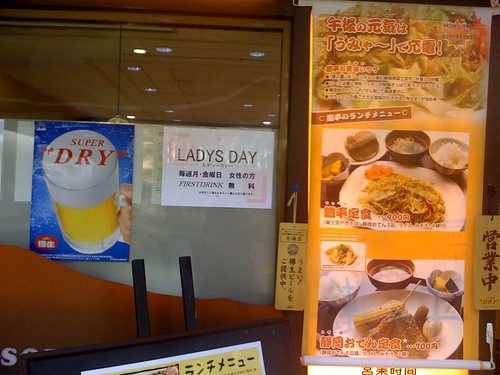
Here's a shop in the Yaechika. One problem is that the sign says "FIRSTDRINK" when it should say "FIRST DRINK".

That's not what I want to talk about. I want to talk about the other mistake. Their sign says:

× Ladys Day
× Lady's Day
× Ladie's Day
× Ladies's Day
◯ Ladies' Day

Here are the reasons.

First, a possessive noun needs an apostrophe. That's what you call that little mark that looks like a comma.
  • possessive noun 所有格名詞 (definition from Eijiro on the Web)
  • 読点 (とうてん) (n) comma; (definition from Edict)
Second, I suppose they want to serve more than one lady. Don't use a singular noun in this case!

Third, if the noun ends in an "s", don't put the apostrophe before that "s". Also, don't add another "s". Please put the apostrope after the final "s".

I'll have more on using an apostrophe next time.

2010/01/29

八重地下は英語の使い方に注意した方が良い。

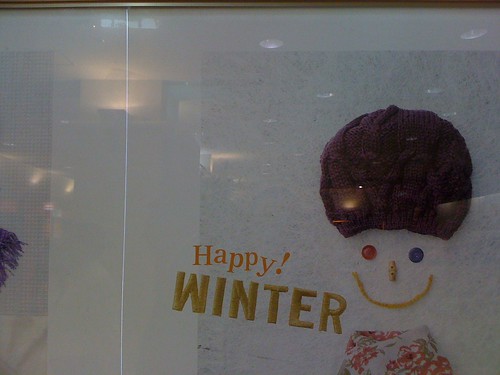
Passing through the underground shopping mall on the east side of Tokyo Station, I saw this sign. It says:
× Happy! Winter
○ Happy Winter!
○ Have a happy winter!
○ Enjoy winter!
I often see this pattern in Japanese English usage: two words, with the first followed by an exclamation point.
  • 感嘆符 (かんたんふ) (n) (ling) exclamation point; exclamation mark; (definition from Edict)
I've got to tell you that we NEVER do that in English. Exclamation points always go at the end of a phrase, never in the middle.

Here's an example of something a native speaker might do:

Even though I could find this image on the left, we really seldom wish people "happy __(season)__". The usual things, at least for Americans, are "Merry Christmas!" (not "happy Christmas"), "Happy Easter!", "Happy Valentine's", "Happy Halloween!", and "Happy Thanksgiving!". I've never been told or faced with advertising in the US wishing me "Happy Spring!" At least, I think I haven't.

The next holiday greeting I can give you is "Happy Groundhog Day", which is February 2. (explanation below from Eijiro on the Web)
groundhog ウッドチャック◆【同】woodchuckカナグラウンドゥハッグ、グラウンドホッグ、分節

Groundhog Day
恋はデジャ・ブ◆米1993《監督》ハロルド・ライミス《出演》ビル・マーレイ、アンディ・マクドウェル聖燭節、グラウンドホッグ・デイ、マーモットの日◆2月2日。米国ペンシルヴァニア州の祝日。冬眠していたウッドチャック(Groundhog)が2月2日に穴から出てきて、自分の影が見えるかどうかで春の訪れを調べるという伝説。影が見えると春はまだ遠くあと6週間ばかり冬が続くといわれる。ペンシルベニア州パンクサトーニー(Punxsutawney)ではこの日に恒例行事が催され、パンクサトーニー・グラウンドホッグ・クラブの会長がフィル (Phil)と名づけたウッドチャックを穴から出して天気予報を行う。
The weather this winter has made me really happy, at least here in Tokyo, so I'm hoping that winter will last a little longer.

2009/10/14

他の東京メトロで見つけた間違い

I think people are confused about punctuation.
  • 句読点 (くとうてん) (n) (ling) punctuation mark(s); (P);
Sometimes it seems people don't care about it. However, it has meaning!

For example, using a period (.) in a word. The reason to use a period in a word is for an abbreviation. The period is used at the end of the abbreviation.
  • 省略 (しょうりゃく) (n,vs) omission; abbreviation; abridgment; abridgement; (P);
For example, "mister" becomes "Mr." in a title. "Et cetera" becomes "etc.".

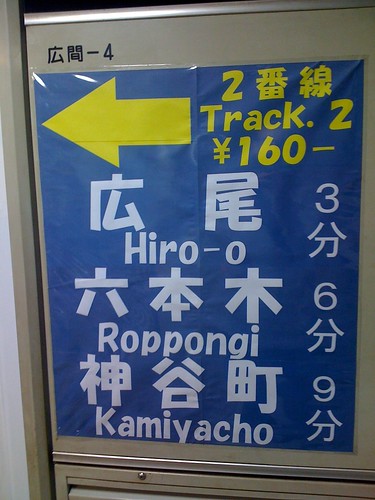
This photo has some English which reads:
× Track. 2
That period after "Track" is really strange. I think what they meant was:
○ Track Number 2
○ Track No. 2
○ No. 2
That's a funny abbreviation, though, isn't it? If "number" doesn't have an "o", why do we write "no."? The answer is here:
http://en.wikipedia.org/wiki/No.
In short, it comes from Latin-based languages, like French and Spanish, in which "numero" means "number". It's interesting to note that in Middle English, "number" was spelled "nombre", also with an "o".

I don't want to abbreviate my sleep, so it's time for me to end this post. Good night!

フォロワー