2012/06/12

Tully'sはよくできました!


I had posted about Tully's funny mistake in front of the Yaesu store before:
http://upgradeenglish.blogspot.jp/2011/10/tullys.html
I was pleased to see yesterday that they had fixed the spelling mistake on the sign!

It seems that they changed their operating hours, opening half an hour later than they used to. I guess they took that opportunity to fix the spelling, too.

I sometimes make spelling mistakes. Today I made a mistake with "causative", writing "causitive".
  • causative verb 使役動詞
There's really no justification for spelling mistakes, though, particularly when it's so easy to use a spell-checker. Computer grammar checkers might still have a long way to go, and sometimes people use the wrong words, like "their" instead of "there" or "sacred" instead of "scared".
  • sacred【形】〔神にささげた〕神聖な、聖なる
  • scared【形】おびえた、怖がる、怖がって
  • (definitions from Eijiro on the Web)
However, when it comes to plain spelling mistakes, like mine above, there's no excuse.

Good job, Tully's! I'm glad you fixed your sign.

2012/06/02

「so that」の使い方


Someone was complaining to me about a leader.
× He is too old style so that he can't push people.
○ His style is so old that he can't lead people in the right direction .
The pattern above is:
  • so [adj] that [sentence]
It means that the degree of the adjective is very high, which causes some result.
You might be thinking "but Renick, I've heard 'so that' before." You are right, but "so that" has a different meaning.
  • [sentence A] so that [sentence B]
"So that" means "for the purpose of" or "in order to". The difference is the grammar. "So that" connects sentences, but notice these patterns:
  • for the purpose of [noun]
  • in order to [verb]
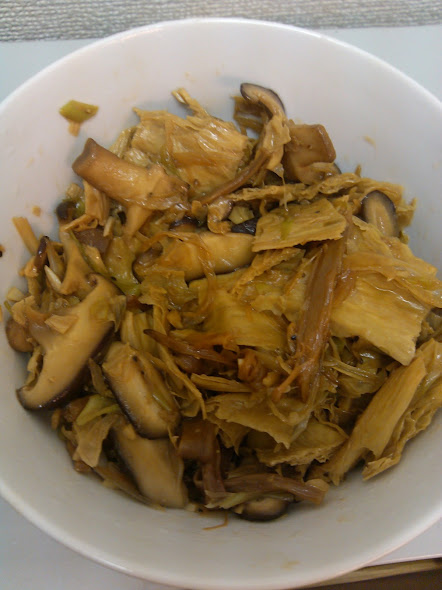
There's another recipe that I'm practicing these days. It's this Chinese-style cold dish that uses dried tofu and mushrooms with sweet soy sauce. It's so delicious that I want to eat it every week, but I'm not good at making it yet. I'm going to practice this weekend so that I can improve my skill.

I have written about this subject a few times before. Take a look:


2012/05/29

「schedule」と「appointment」の違い


Recently someone told me:
× Sorry, I can't meet you at that time because I have a schedule.
○ Sorry, I can't meet you at that time because I have another appointment.
○ Sorry, I can't meet you at that time because I have something on my schedule at that time.
Everyone has a schedule. Your schedule is your list of appointments and free time. You might have two schedules: your work schedule, and your private schedule. You can talk about your Monday schedule, meaning the set of appointments you have on Monday.

When you have to meet someone, that is an appointment. When you are seeing a doctor, that is an appointment. Both of these appointments are on your schedule.

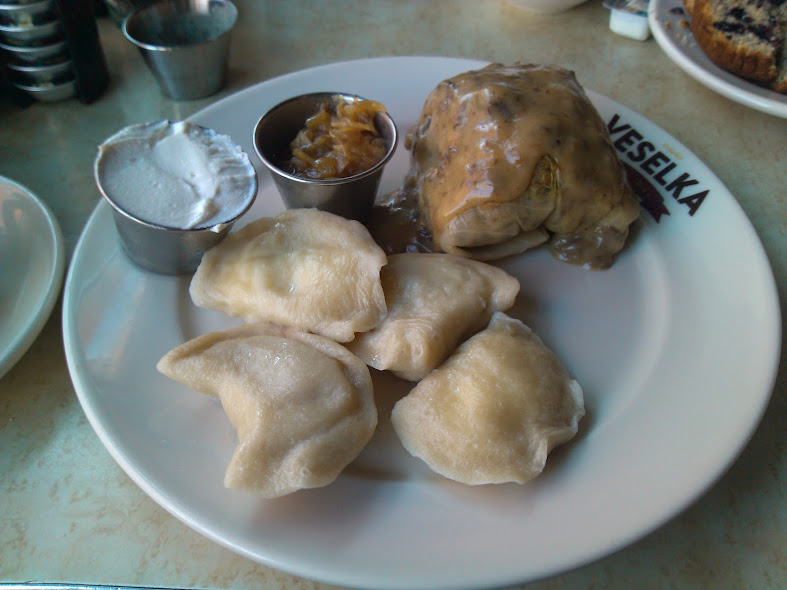
Back in March, I visited America. I had a busy schedule. One of the appointments I had in New York City was to meet some people at a restaurant I used to frequently go to. The restaurant is called Veselka, and it serves Ukrainian food like these pierogis. Two of them were cheese pierogis, and the other two were potato, if my memory is correct. There's also a stuffed cabbage on this plate with mushroom gravy. It's a great restaurant, and you should eat there if you visit New York.

2012/05/19

「business trip」の使い方


"Where's A-san this week?" I asked.
× "He went to a business trip," someone told me.
○ "He went on a business trip," someone told me.
Use "to" to talk about the destination.
  • He went to Osaka.
You can also say:
  • He is on a business trip at the moment.
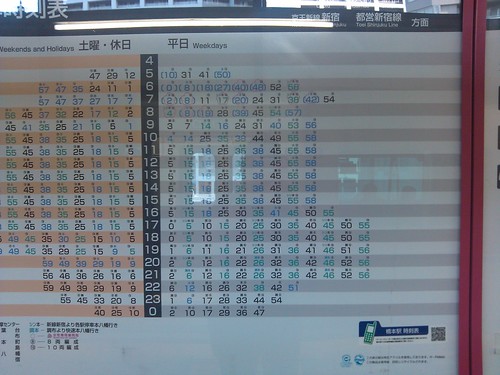
My trip to America in March was partly a business trip. Last week, I didn't take a business trip, but I did go on a daytrip to western Tokyo. It's not like central Tokyo, where there are plenty of trains all of the time. It really pays to check the train schedule in order to catch the fastest express.
  • daytrip 日帰り旅行
Business trips can be tough, especially these days when companies are trying to cut costs. I've heard of people having to leave early in the morning and come back late at night, only to have to be in the office again the next day at the regular time. That's hard on the employees for sure. I guess that's a business trip, but your colleagues might just say:
  • She's out of the office today on business.
Some of you need to take business trips abroad. I hope that you'll join one of our English classes to help you upgrade your English for success on your trips.

2012/05/15

「favorite」の使い方


I know someone who said recently:
  • This is my favorite shop!
In fact, she had said the same thing about a different shop only a few days earlier.
It's true that Americans often exaggerate, and in some ways, this pattern isn't so wrong.
  • exaggerate【自動】誇張する、大げさに言う (definition from Eijiro on the Web)
However, you should remember that "favorite" is a kind of superlative, and as such, there should only be one thing that is your favorite in a particular category. The better way to say this is:
  • This is one of my favorite shops!
  • superlative【名】《文法》最上級
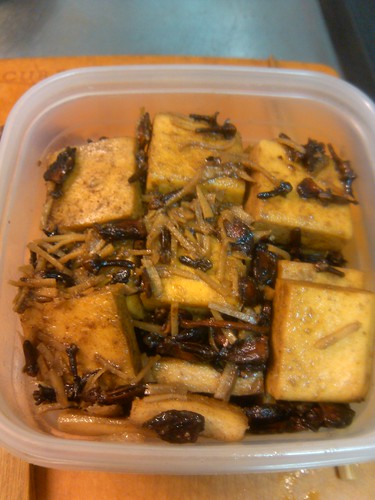
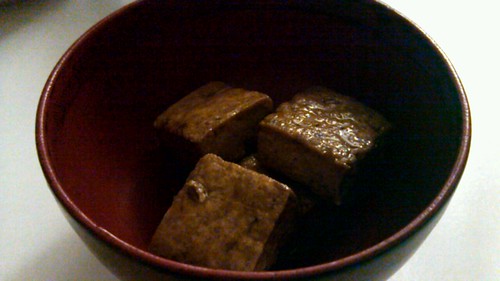
This five-spice tofu is becoming one of my favorite dishes. I've been practicing cooking it a lot, and I'm getting better at it. One of the difficult steps is pan-frying the tofu. You have to be careful to keep the heat very low so that the tofu doesn't stick to the pan. It has taken some practice to get used to it, but I'm getting better each time. It helps if you use Okinawa-style tofu (島豆腐) because it's firmer. Sometimes I use the regular firm tofu from the supermarket, which is not my favorite, but if you press it well and fry it carefully, it works, too.

After you cook it, you put it in the refrigerator with the spices covering it. That way the flavor really sinks into the tofu. Mmm! I'm going to eat some tonight at dinner!

2012/04/21

「increase」と「become」の違い


Somebody was asking me about the difference between these two. We were talking about how people deal with cold weather.
× Cold weather becomes the demand for hot water bottles.
○ Cold weather increases the demand for hot water bottles.
○ Demand for hot water bottles becomes greater in cold weather.
○ Normally low demand becomes high demand in cold weather.
  • hot water bottle 湯たんぽ (definition from Weblio)
The key point to remember is that "increase" means a number is growing, while "become" can talk about any change. We can talk about "demand" as a number, so we can use "increase".
  • increase (数量・程度などが)ふえる,増加する (definition from Weblio)
  • become〈…に〉なる (definition from Weblio)
Another example we talked about was related to North Korea. We were discussing some possibilities, and these sentences came up:
× The crisis will increase more severe. <- a "crisis" is not a number
○ The crisis will become more severe.
○ A less-serious situation becomes a severe crisis.
○ The severity of the crisis will increase. <- "severity" can be ranked on a numeric scale
  • crisis 危機,決定的段階,重大局面 (definition from Weblio)
  • severe ひどい,猛烈な (definition from Weblio)
  • severity 重症度 (definition from Weblio)
I have been practicing making this five-spice tofu for a few weeks. It is becoming better each time I make it. The number of dishes that I can make is increasing, but I think I still can't become a restaurant owner. Not yet, anyway.

2012/04/11

このレストランは英語の使い方に注意した方が良い。


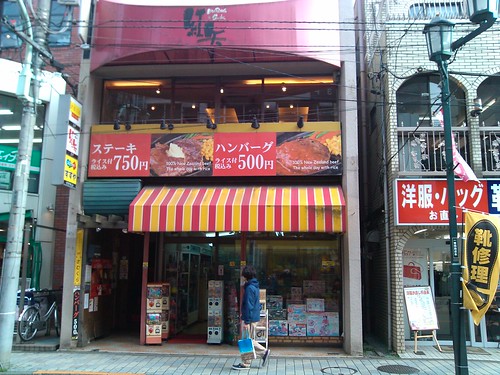
I was in Kunitachi the other day and noticed this sign. It says:
× 100% New Zealand Beef, The whole day with rice.
○ serving 100% New Zealand beef with rice, all day
The main problem here is the word order.

  • word order 語順 (definition from Eijiro)

If you follow a noun with a prepositional phrase, it sometimes can sound like the prepositional phrase is describing the noun.

  • prepositional phrase 前置詞句 (definition from Eijiro)

This restaurant's phrase is hard to understand. It sounds like there are days with rice and days without rice, which would mean:

  • On days with rice, we serve 100 percent New Zealand beef all day.

That means they aren't serving the New Zealand beef on the days without rice. I'm pretty sure that isn't what they mean, but I didn't go in to check. I'm a vegetarian, so my interest in the restaurant doesn't go beyond the sign.

  • one's interest doesn't go beyond [noun] ~にしか興味を示さない

The other thing to remember is that after the verb, a common order is to put time last, after manner and place, like:

  • I'm in my classroom on the sixth floor right now. <- place = sixth floor; time = now

If I look out the window, I can see the water on the street and umbrellas in people's hands. The smartphone on my desk is kind of dirty. The fingerprints on the screen are mine, and I don't really know how to avoid smudging the screen like that. My stomach is growling in my belly on this typical Wednesday evening, so I'd better finish up this post and go eat some dinner.

2012/04/04

「rent, lend, borrow」の違い


The other day somebody came to class and realized she had forgotten her pen. She asked me:
× Can you borrow a pen?
○ Can I borrow a pen? Can you lend me a pen?
  • borrow 借りる
  • lend 貸す
"Borrow" and "lend" have a direction. The subject of "borrow" is receiving something. The subject of "lend" is giving something.

I was talking about a book with someone. It sounded like an interesting book. The person I was talking to sensed my interest in the book and said:
× I can rent it to you.
○ I can lend it to you.
  • rent 賃借[賃貸]する
If you rent something, it means you are a business person. You are earning money by allowing someone to use something that you own. I know that the pronunciation of these two is a little similar. You have to be really careful about "r" and "l".

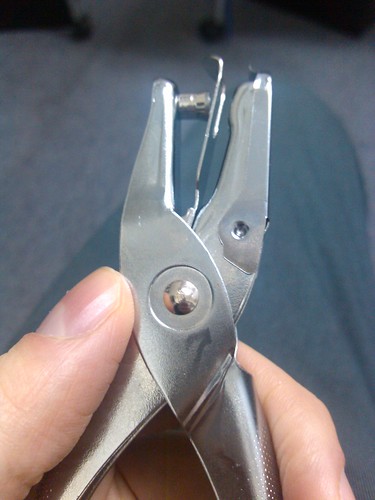
One student has been collecting notes from class in her notebook. She always punches holes in her paper using the rings in her binder. I had been meaning to get a hole punch, but every time I go to the 100 yen shop or office supply store, I always seem to forget what I wanted to buy.
  • hole punch 穴あけ器 (definition from Eijiro on the Web)
This week, though, my memory was working well, and I remembered to get the hole punch.

If you ever visit me at my classroom, I'd be happy to lend you a pen or my hole punch. I'll even lend you a sympathetic ear.
  • lend a sympathetic ear 親身になって耳を貸す、同情して話を聞く、じっくり話を聞く (definition from Eijiro on the Web)

フォロワー