2011/04/12
ブリヂストン美術館は英語の使い方に注意した方が良い。
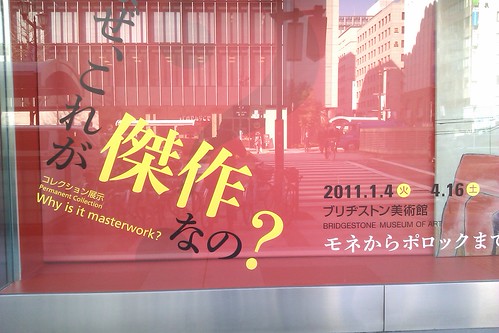
I often pass by the Bridgestone Museum of Art. It's near our school at Nihonbashi Station. Their current exhibition is called:
△ Why is it masterwork?
◯ Why is it a masterpiece?
● masterpiece 【名】名作、最高傑作、絶品、名人芸 (definition from Eijiro on the Web)
The problem is a common one for students.
× I had a lot of works today.
◯ I had a lot of work today.
"Work" as we usually think about it, meaning going to the office and so on, is an uncountable noun. "Work" does have a countable version which is usually used for artistic creations like paintings.
Since the exhibition is talking about art, I think the countable version is more correct, though it's hard for me to say it's wrong. I can say, though, that "masterpiece" is much more common than "masterwork". That's the word I would suggest that you remember.
I studied painting in university, but I never produced a masterpiece. Doing so must be a lot of work. Now I need to get to work on something else, so until next time...
● get to work on (~に)着手する、(~を)始める、(~に)取り掛かる (definition from Eijiro on the Web)
ラベル:
よくある質問
2011/04/05
税務署は英語の使いかたに注意した方が良い。
Last month the deadline for filing tax returns came.
● file a tax return〔税務署に〕申告書{しんこくしょ}を提出{ていしゅつ}する、確定{かくてい}[納税{のうぜい}]申告{しんこく}をする (definition from Eijiro on the Web)
When it was time for me to pay the taxes I owed, I went to a particular counter on the first floor of the tax office.
● tax office 税務署
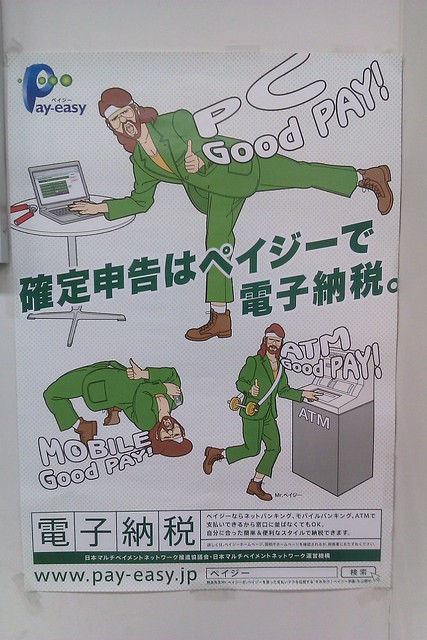
I had paid, and then I needed to wait for them to give me a receipt. While I was waiting, I saw this poster on the wall. It says:
× PC good pay! Mobile good pay! ATM good pay!
◯ Paying by PC? OK! Cell phone? OK! ATM? OK!
◯ Paying by PC? Easy! Cell phone? Easy! ATM? Easy!
I'm not sure what to say about their mistake. Maybe the first point is that "pay" is a verb, while "good" is an adjective.
The second point is that they are a large organization, so they definitely have the budget to check this kind of thing with a professional editor. Someone is making a management mistake.
The third mistake might be marketing. Does this drawing of a foreign guy make you excited about paying your taxes?
I didn't pay with any of those methods, but for me paying at the counter was easy enough.
● file a tax return〔税務署に〕申告書{しんこくしょ}を提出{ていしゅつ}する、確定{かくてい}[納税{のうぜい}]申告{しんこく}をする (definition from Eijiro on the Web)
When it was time for me to pay the taxes I owed, I went to a particular counter on the first floor of the tax office.
● tax office 税務署
I had paid, and then I needed to wait for them to give me a receipt. While I was waiting, I saw this poster on the wall. It says:
× PC good pay! Mobile good pay! ATM good pay!
◯ Paying by PC? OK! Cell phone? OK! ATM? OK!
◯ Paying by PC? Easy! Cell phone? Easy! ATM? Easy!
I'm not sure what to say about their mistake. Maybe the first point is that "pay" is a verb, while "good" is an adjective.
The second point is that they are a large organization, so they definitely have the budget to check this kind of thing with a professional editor. Someone is making a management mistake.
The third mistake might be marketing. Does this drawing of a foreign guy make you excited about paying your taxes?
I didn't pay with any of those methods, but for me paying at the counter was easy enough.
2011/03/29
「so」と「so that」の違い
I've been grateful for the live translation of much of the reporting on NHK about the earthquake, tsunami, and situation at the Fukushima Number 1 nuclear power plant.
However, it's interesting for me to hear the mistakes that the interpreters make. For example, one woman said:
× Some of the damage was too great so that they couldn't restore it.
◯ Some of the damage was too great, so they couldn't repair it.
See, even trained professionals make mistakes, so you shouldn't feel so bad about your own mistakes. However, you should practice so that you make fewer mistakes.
Remember that "so" is used when explaining a reason. "So that" means "in order to"; it tells the intended result of a particular action.
● so that ~できるように (definition from Eijiro on the Web)

I am writing this blog post so that you can understand the difference between "so" and "so that".
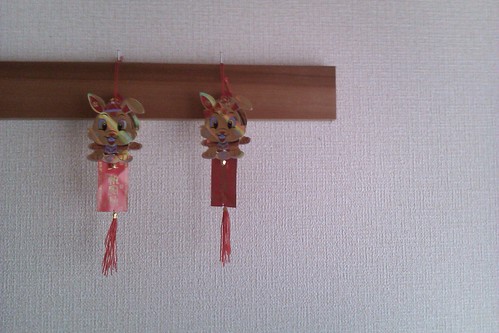
Someone in Singapore sent these two rabbit decorations in late January so that we could decorate our apartment for the lunar new year celebration. We don't usually display holiday decorations. However, we had them so we hung them. The celebration ended back in February, so we took them down. Every year has a different animal, so we can't reuse them next year. Could I declare next year a rabbit year again so that I can hang these cute rabbits on the wall again?
For more about "so", you can see the blog posts I wrote in July of 2009. I gathered all of the links in this post so that you could access them conveniently:
http://upgradeenglish.blogspot.com/2009/07/so_22.html
Give your support to the crews at the Fukushima Number 1 power plant so that they can complete their dangerous work quickly and safely.
However, it's interesting for me to hear the mistakes that the interpreters make. For example, one woman said:
× Some of the damage was too great so that they couldn't restore it.
◯ Some of the damage was too great, so they couldn't repair it.
See, even trained professionals make mistakes, so you shouldn't feel so bad about your own mistakes. However, you should practice so that you make fewer mistakes.
Remember that "so" is used when explaining a reason. "So that" means "in order to"; it tells the intended result of a particular action.
● so that ~できるように (definition from Eijiro on the Web)
I am writing this blog post so that you can understand the difference between "so" and "so that".
Someone in Singapore sent these two rabbit decorations in late January so that we could decorate our apartment for the lunar new year celebration. We don't usually display holiday decorations. However, we had them so we hung them. The celebration ended back in February, so we took them down. Every year has a different animal, so we can't reuse them next year. Could I declare next year a rabbit year again so that I can hang these cute rabbits on the wall again?
For more about "so", you can see the blog posts I wrote in July of 2009. I gathered all of the links in this post so that you could access them conveniently:
http://upgradeenglish.blogspot.com/2009/07/so_22.html
Give your support to the crews at the Fukushima Number 1 power plant so that they can complete their dangerous work quickly and safely.
ラベル:
よくある質問
2011/03/22
「tell、talk、speak、say」の違い (part 4)
I haven't said anything on this blog since the earthquake. Google says that this site has readers in Fukushima, Miyagi, and other places hit by the quake. I think I have only met one of you, but I want to say to all of you that we have been so concerned. I feel so sorry for the whole region. At first, I wanted to say that I hope our readers and their friends and families are OK. Then I thought that saying that would be strange. I want everyone to be OK. I want all of the suffering to end.
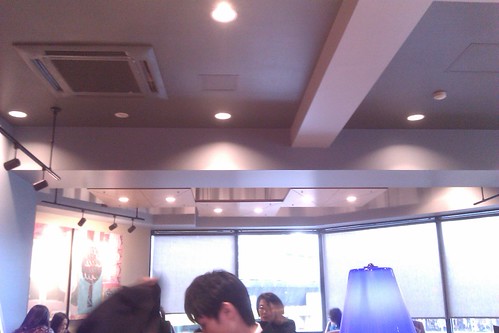
During the earthquake, I was sitting in Starbucks and trying to study Japanese. The building started to shake. I was watching the things hanging from the ceiling (in the photo above) begin to sway. The swaying got more and more violent.
× I can tell that I was afraid. <- see this post for more about "tell"
◯ I can say that I was afraid.
I cannot imagine how terrifying it must have been for those who were closer to the epicenter.
● epicenter 震源 しんげん 震源地 しんげんち 震央 しんおう (definition from jmdict)
"Say" is similar to "tell", except that it doesn't need a target. It just needs to be followed by content.
× After the earthquake, my parents and I said. <- no content!
◯ After the earthquake, my parents and I talked. <- casual
◯ After the earthquake, my parents and I spoke. <- a bit more formal
× They told that they were really worried.
◯ They told me that they were really worried.
◯ They said that they were really worried.
I'm also worried about the situation, especially with the nuclear power plant in Fukushima, but NHK says that engineers there are making progress with the help of fire fighters. I also frequently look at various websites where data on radiation monitoring has been posted. They say the radiation in Tokyo is just slightly higher than normal, so I don't feel so nervous.
I hope that in a couple of weeks I will be able to say that the worst part of the crisis has past. However, this being such a huge disaster, who can say when Japan will have recovered from it? I can only say that it will be a long time from now.
During the earthquake, I was sitting in Starbucks and trying to study Japanese. The building started to shake. I was watching the things hanging from the ceiling (in the photo above) begin to sway. The swaying got more and more violent.
× I can tell that I was afraid. <- see this post for more about "tell"
◯ I can say that I was afraid.
I cannot imagine how terrifying it must have been for those who were closer to the epicenter.
● epicenter 震源 しんげん 震源地 しんげんち 震央 しんおう (definition from jmdict)
"Say" is similar to "tell", except that it doesn't need a target. It just needs to be followed by content.
× After the earthquake, my parents and I said. <- no content!
◯ After the earthquake, my parents and I talked. <- casual
◯ After the earthquake, my parents and I spoke. <- a bit more formal
× They told that they were really worried.
◯ They told me that they were really worried.
◯ They said that they were really worried.
I'm also worried about the situation, especially with the nuclear power plant in Fukushima, but NHK says that engineers there are making progress with the help of fire fighters. I also frequently look at various websites where data on radiation monitoring has been posted. They say the radiation in Tokyo is just slightly higher than normal, so I don't feel so nervous.
I hope that in a couple of weeks I will be able to say that the worst part of the crisis has past. However, this being such a huge disaster, who can say when Japan will have recovered from it? I can only say that it will be a long time from now.
2011/03/10
「tell、talk、speak、say」の違い (part 3)
These days I've had to take care of a lot of business. Notice how "speak" is used.
× As a result, I have had to talk Japanese a lot. <- don't use "talk" for a language
◯ As a result, I have had to speak Japanese a lot.
× I told a government officer yesterday. <- "tell" needs some content
△ I talked to a government officer yesterday. <- this is OK, but it's a little bit too light. My conversation was kind of serious.
◯ I spoke to a government officer yesterday. <- best
× I was filling out a form, and he spoke to me about some points to be careful about. <- "about" doesn't feel direct enough, and using "about" twice feels strange here
◯ I was filling out a form, and he told me some points to be careful about.
× Can you speak what this is a photo of? <- the action of speaking isn't important; the content is...
◯ Can you tell me what this is a photo of?
More in the next post...
× As a result, I have had to talk Japanese a lot. <- don't use "talk" for a language
◯ As a result, I have had to speak Japanese a lot.
× I told a government officer yesterday. <- "tell" needs some content
△ I talked to a government officer yesterday. <- this is OK, but it's a little bit too light. My conversation was kind of serious.
◯ I spoke to a government officer yesterday. <- best
× I was filling out a form, and he spoke to me about some points to be careful about. <- "about" doesn't feel direct enough, and using "about" twice feels strange here
◯ I was filling out a form, and he told me some points to be careful about.
× Can you speak what this is a photo of? <- the action of speaking isn't important; the content is...
◯ Can you tell me what this is a photo of?
More in the next post...
2011/03/09
「tell、talk、speak、say」の違い (part 2)
I was talking about the difference between these words in my last post. You might want to read it to catch up with this series.
We usually don't use a noun directly after "talk". Instead, we put a preposition after it.
◯ I talked with my friend yesterday. <- "with" feels more like a discussion
◯ We talked about the difference between English schools. <- use "about" to describe the content
When you want to emphasize the act of speech, don't use "talk". Use "speak" instead.
× I talked some Chinese yesterday.
When I got in the elevator two nights ago, a woman I didn't know started talking to me suddenly. I couldn't hear what she was saying at first because I was listening to music on my headphones. I could tell that she had been drinking (see the last post for more about "tell") because of the strong smell of alcohol. We talked about the snow that fell that morning, and then I told her "good night" when she got off the elevator on her floor.
I told you that I'd tell you what the photo in the last post was of. It's a lamp as seen between someone's fingers. This photo is of a meal I cooked last month, I think. I like to talk about what I cook, but this post is already too long. More in the next post.
We usually don't use a noun directly after "talk". Instead, we put a preposition after it.
◯ I talked with my friend yesterday. <- "with" feels more like a discussion
◯ I talked to my friend yesterday. <- "to" sounds like brief contact, or sometimes one-way contact
◯ We talked about the difference between English schools. <- use "about" to describe the content
When you want to emphasize the act of speech, don't use "talk". Use "speak" instead.
× I talked some Chinese yesterday.
◯ I spoke some Chinese yesterday.
When I got in the elevator two nights ago, a woman I didn't know started talking to me suddenly. I couldn't hear what she was saying at first because I was listening to music on my headphones. I could tell that she had been drinking (see the last post for more about "tell") because of the strong smell of alcohol. We talked about the snow that fell that morning, and then I told her "good night" when she got off the elevator on her floor.
I told you that I'd tell you what the photo in the last post was of. It's a lamp as seen between someone's fingers. This photo is of a meal I cooked last month, I think. I like to talk about what I cook, but this post is already too long. More in the next post.
2011/03/08
「tell、talk、speak、say」の違い (part 1)
Sometimes people tell me that these words are confusing, so I want to talk about them over a few posts. However, first I want to tell you that I'm sorry it has been so long since my last post.
First, let me tell you about "tell". "Tell" has several meanings. The most common one uses a person as an object, like the "tell" in this sentence and the one above it, and then it is followed by some content that is told. The other day someone I know wrote:
× He told he's a college student. <- "he's a college student" is the content
◯ He told me that he's a college student. <- "tell" needs a person as an object
First, let me tell you about "tell". "Tell" has several meanings. The most common one uses a person as an object, like the "tell" in this sentence and the one above it, and then it is followed by some content that is told. The other day someone I know wrote:
× He told he's a college student. <- "he's a college student" is the content
◯ He told me that he's a college student. <- "tell" needs a person as an object
◯ He said that he's college student. <- or you can use "said" instead
Sometimes we use "tell" with an object like "story" or "joke" or another word that describes the content of what you are saying.
◯ I can't tell a lie; I've been working on an important secret project. I'll tell the story of my recent business later.
Another really common meaning for "tell" is to say that someone can understand something based on what you perceive.
● tell ~ apart ~を見分ける、~を区別する (definition from Eijiro on the Web)

● tell ~ from ~と…を識別する・How can you tell the flu from a cold? : インフルエンザと風邪は、どうやって見分けることができますか。 (definition and example from Eijiro on the Web)
Can you tell what that is a photo of? I'll tell you in the next post I make.
2011/02/23
「every」の使い方について
Last month there was an interesting set of performances in at SuperDeluxe in Roppongi. Some musicians visiting Tokyo from Norway played noise music with some musicians living in Tokyo.
I couldn't make it to both nights, unfortunately, but I did catch the Sunday performance. That's where I took this picture of Jim O'Rourke on guitar and Lasse Marhaug on electronics. The superb drummer, Paal Nilssen-Love, can't be seen because of the large speaker cabinet on the left.
× Does the guitarist do that every his concert?
I couldn't make it to both nights, unfortunately, but I did catch the Sunday performance. That's where I took this picture of Jim O'Rourke on guitar and Lasse Marhaug on electronics. The superb drummer, Paal Nilssen-Love, can't be seen because of the large speaker cabinet on the left.
× Does the guitarist do that every his concert?
◯ Does the guitarist do that at every concert?
◯ Does the guitarist do that at every one of his concerts?
Nope. I have seen him play several times, and that was the first time I had seen him play the guitar like that.
"Every" has to be followed by a noun. You can't put a possessive pronoun between "every" and the noun you want to use.
This is something that I want to teach to every one of my students.
ラベル:
よくある間違い
登録:
投稿 (Atom)