2012/11/06

東京駅は英語の使い方に注意した方が良い。

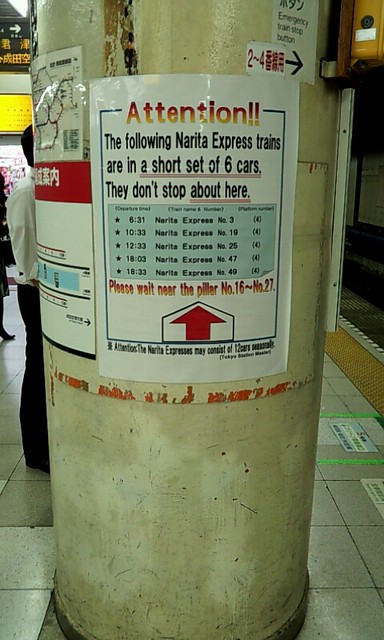
I just returned from a trip. I departed from Tokyo Station on the Narita Express. While I was waiting on the train, I noticed this sign. It says:
× The following Narita Express trains are in a short set of 6 cars. They don't stop about here. Please wait near the pillar No. 16 ~ No. 27.
○ The following Narita Express trains are in a short set of six cars. They don't stop in this area. Please wait between pillars 16-27.
  • pillar【名】〔建物などの細い〕柱、支柱、装飾柱 (definition from Eijiro on the Web)
Probably the writer wanted to say "around here". However, "around here" sounds a bit too casual for a public sign.

You can say "about here", such as:
  • It was about here that I took the photo. ← said when standing in a place which is roughly the correct place
We usually don't use "not" with "about here" when saying that the approximate position is not correct.
  • approximate【形】おおよその、概算の、近似の (definition from Eijiro on the Web)
However, you might hear something like this:
  • The article is not about here. It's about another place. ← "about" means "regarding", not "roughly"
The other mistake the Tokyo Station staff have made is using "the". In this case, "pillar" is a title, like "Mount" or "Mr.". In such cases, we don't use "the" in front.

I'm about finished with this post. There's lots to catch up on from being out of town. I'll write again about this time next week, if not before! I'm not sure what I will write about, though. Maybe I'll look for some mistakes around here.

2012/10/23

T-Houseは英語の使い方に注意した方が良い。


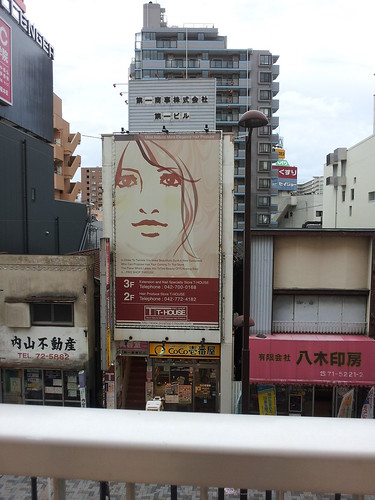
On the north side of Hashimoto Station, there's a store selling beauty supplies called T-House, and they are in desperate need of help with their English. They have a giant sign on the building which barely makes any sense:
In Order To Twinkle You More Beautifully,Such A New Salesclerk
Who Can Propose Has Your Coming To The Store
The Place Which Leads You ToThe Beauty Of Following Step
It,,,,PRO SHOP T-HOUSE.
It's hard to decide what to point out in this text. First, let's try to guess what they mean. Maybe they want to say:
To make you twinkle beautifully like a star, our clerks can suggest the best things for you and lead you on the steps towards beauty. Come to our store: Pro Shop T-House!
Some of the mistakes they have made include:
  1. using title case for a sentence. Don't Capitalize Each Word In A Sentence Unless It Is A Title!!!
  2. ignoring proper spacing after punctuation. Put a space after periods and commas.
  3. meaning mistakes. You can't twinkle me, since "twinkle" is usually used without an object.
There are others, but the funniest is probably the "new salesclerk who can propose". It sounds like one of the staff will propose marriage to me if I go in. While that might make for an interesting experience, it's a little too heavy for my tastes. Some light flirting might be fun, but a marriage proposal is too much.
  • propose (without an object) - to propose marriage. propose to ~にプロポーズ[求婚]する、~に結婚を申し込む (definition from Eijiro on the Web)
  • flirt with 面白半分に(人)の気を引く、(人)にお上手[お世辞]を言う、(人)に面白半分に手を出す、(人)を誘惑する[もてあそぶ]、(人)といちゃつく[イチャイチャする・ベタベタする](definition from Eijiro on the Web)

2012/10/09

「パーカー」は英語で何、part 2

I'm surprised that this post from 2010 about パーカー is still really popular. A lot of people find this post using Google.
http://upgradeenglish.blogspot.jp/2010/01/blog-post_20.html
Just to recap, we don't use "parka" to mean the same thing as Japanese do; we say "hooded sweatshirt" or "hoodie" for short.
  • to recap 要点をまとめると (definition from Eijiro on the Web)
For us, a parka is a kind of longer jacket, often for rain or very cold weather.
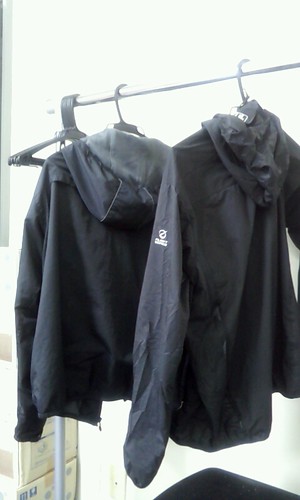
In the first picture above, those aren't hoodies or parkas either. They are hooded windbreakers. That's what all of these things have in common: hoods.
  • hood 【1名】〔コートの首の回りにつける〕フード、頭巾 (definition from Eijiro on the Web)
  • windbreaker《衣服》ウインド・ブレーカー、風よけ用ジャンパー (definition from Eijiro on the Web) <- my note, "jumper" sounds like a kind of dress for women or children to my American ears, though it's a pullover sweater in the UK
I think it's not quite cool enough to start wearing hoodies here, but maybe a lot of people are thinking about it. As for us here, we are just wearing our hooded windbreakers, which feels just right for the temperature at the moment.

2012/10/02

「college」と「collage」の違い


I was reading a blog post the other day in which the writer was talking about:
× a student studying at his collage
○ a student studying at his college
"College" is pronounced like KAH-lij (カリジ without the "i" at the end) in American English, while "collage" is pronounce like koh-LAHJ (コラージ without the "i" at the end). Be careful about the difference in stress.
  • collage 【名】《美術》コラージュ◆さまざまな素材を同一画面に組み合わせる芸術的手法。【他動】《美術》~のコラージュを作る
In the dictionary, I found "collage" is コラージュ, which is closer to the French pronunciation. The dictionary has カレッジ for college, but I think if you say that, the pronunciation will sound strange, too. Say it without ッ.

The photo above is a collage I just made for this post. I studied art in college, but I'm not sure that this collage is any good. Anyway, it's full of mistakes I've found in public. Can you remember the correct English for these?

2012/09/18

「work」と「walk」の発音の違い


I sometimes find people confused about the difference in pronunciation between "walk" and "work".

"Work" sounds like "perk", "lurk", and "jerk". Your mouth is open about as much as when you say "え", but the sound is not "eh", but "er", like in "bird". You need a strong "r" sound, which means curling your tongue. There's more about "r" sounds in this blog post.
"Walk" sounds like "talk". The "a" is like "ah" (あ).

I have been working on this lucky bamboo plant for a while. We took some cuttings from the plant, and now they are growing quite well, as you can see in the photo above.

I've also been working on some spider plants.
  • spider plant オリヅルラン (definition from Eijiro on the Web)
You can see a very healthy one when you walk out of the elevator in our building. Come by and pay us a visit sometime!

2012/09/12

「want」と「won't」の違い

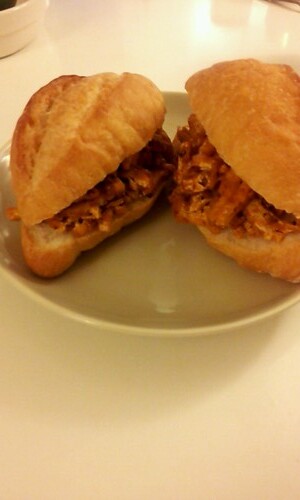
A tiny bit of nostalgia for my youth led to me making BBQ sandwiches. These sandwiches are full of mock BBQ chicken, made from strips of fried tofu and homemade Texas-style barbecue sauce.
  • nostalgia 【名】懐旧、懐古の情、ノスタルジア・郷愁、望郷の念 (definition from Eijiro on the Web)
× Somehow I won't to eat BBQ sauce these days.
○ Somehow I want to eat BBQ sauce these days.

I think it's because of the really good BBQ tempe that I had at this vegetarian restaurant in NYC back when I visited in March:

http://nymag.com/listings/restaurant/bliss/

× I want live in NYC again, I think...
○ I won't live in NYC again, I think...

... but that is a great restaurant!

In the sentences above, people who are listening sometimes get confused between the two. That's dangerous, because the meanings are very different. However, it should be simple to tell which is being used. There are two reasons.

The first is the difference in pronunciation:
want ~ taunt, flaunt, font. This is an "ah" sound in American English.
won't ~ This is an "oh" sound in American English.

The second difference is in grammar. "Won't" is an auxiliary verb, so it's never followed by "to". "Want" is a regular verb, so when a verb comes after it, you have to use "to" first.

I won't use the same recipe for barbecue sauce next time. This one was good, but not as rich or deep as I had wanted to eat.

2012/09/07

「clear」と「clean」の違い・「room」と「apartment」の違い


Two weekends ago I found that USB cables had been breeding in a box in my apartment, and that their population had really increased!
  • breed〔動物が〕子を産む、繁殖する (definition from Eijiro on the Web)
× I was clearing my room at that time.
○ I was cleaning my apartment at that time.

"Clear" means to get rid of everything, so that the space is empty. If a room is dangerous, the police might tell everyone to "clear the room!" They mean for everyone to get out of the room. 

"Clean" is a better choice when you are organizing things. I did clear the box of USB cables, though. The cables for some peripherals that I'd thrown away long ago were still in this box. Almost all of them got thrown out.

The other thing is that "room" means just one room in your apartment, which is one unit in your apartment building. My building has a lot of units, and my apartment has a few rooms, including the bathroom and the kitchen.

I always want my house to be more organized, and part of that is cleaning up clutter like these USB cables. 
  • clutter【名】散乱物、がらくたの山 (definition from Eijiro on the Web)
 I recommend you spend some time this weekend cleaning up clutter at your home.

2012/09/04

「チャックが全開だ」は英語でどう言う?


The other day I arrived at the office after teaching a lesson outside in the morning. I hadn't used the restroom since leaving home, so when I got to the office, I was kind of in a hurry to go to the restroom.

I put down my bag and started walking to the restroom. Thinking ahead, I looked down at my pants, and then I realized it. My fly was down.
  • fly チャック (also "zipper")
Since I hadn't been to the restroom since leaving home, it meant my zipper had been open for a few hours. No wonder it was a little bit cooler when I was riding my bicycle! I stopped and snapped this photo before going to the restroom.
  • no wonder 驚くに値しない、~も不思議ではない、道理で~なわけだ、無理もない、~も無理はない、なるほど~なわけだ、~も当然である (definition from Eijiro on the Web)
It seems that when I was a kid in Texas, in some cases someone might lean over to you and tell you, "hey, if you don't close the barn doors, the cows are going to get out!"

If you notice someone with their fly down, I recommend that you tell them. They will probably thank you for it. I would have been grateful for someone to have mentioned it to me. In fact, all of you should check your flies now.

フォロワー