2012/12/30

大掃除で使う言葉

It's time to put away the only Christmas decoration in the house: this small folding paper Christmas tree. I'm glad that Christmas has come to an end, because I'm not a fan of Christmas music that is played too loud everywhere, other than Vince Guaraldi:

https://www.youtube.com/watch?v=2gmiSPMHrWQ
  • put away【句動】片付ける、しまう、しまい込む、収納する (definition from Eijiro on the Web)
I'm sorry not to have written any posts in December until today. I wonder if I can do better next year.

Like a lot of you must be doing, I'm trying to clean up the house.
  • clean up【句動】きれいに掃除[清掃]する、片付ける、浄化する、後片付けをする、部屋をきれいにする、きちんと整理する、きちんと身支度をする、身なりを整える、着替えをする、体を洗う (definition from Eijiro on the Web)
There are lots of things to throw away. The windows should be cleaned. The bathroom and toilet should be scrubbed with extra effort, and all of the nooks and crannies should be dusted or vacuumed.
  • throw away【句動】~を投げ捨てる (definition from Eijiro on the Web)
  • scrub 洗う、磨く (definition from Eijiro on the Web)
  • nooks and crannies 隅々
  • dust【句動】~のほこりを払う、~のちりを払う (definition from Eijiro on the Web)
  • vacuum【他動】~を電気掃除機で掃除する (definition from Eijiro on the Web)
I think getting rid of a lot of things over the course of the year will make cleaning this year easier. It's nice to have more space, as well.
  • get rid of〔好ましくない物を〕取り除く、駆除する、一掃する、処分する (definition from Eijiro on the Web)
It seems to really be true that sprucing up your living space can do the same to your thinking. It's refreshing!
  • spruce up【句動】こぎれいにする、めかす、身なりを整える、美化する (definition from Eijiro on the Web)
After I have done some cleaning, I'll be back to wrap up our posts for 2012. I hope your cleaning up goes smoothly! I hope you will consider sprucing up your English next year at our school, too.

2012/11/28

「cost」と「cheap」の使い方

This is what I've really got to learn to cook. It's vegetarian char siu, which is Cantonese-style BBQ pork. This is a vegetarian one, so it's made with gluten and spices. The black parts, rather than being burnt meat, are a kind of fermented black bean sauce. I ate this in Hong Kong. It was so delicious, and I keep thinking about it and how to make it.
  • fermented【形】発酵した (definition from Eijiro on the Web)
There are vegetarian restaurants in Tokyo, but...
× the cost is cheaper in Hong Kong.
○ the [food is/restaurants are] cheaper in Hong Kong.
○ the cost is lower in Hong Kong.
The vegetarian food in Hong Kong is generally more delicious, too.

"Cheaper" means "lower in price". "Cost" is a synonym for "price". That means that the incorrect sentence above means:
  • The price is lower in price in Hong Kong. ← strange!
"Cost" or "price" is a number, so you should use "lower" or "higher". Use "cheap" for products.

If you happen to know a good recipe or tips for cooking char sui at home, please let me know, especially if you know how to cook the vegetarian version. The cost of making it at home is certainly lower than flying to Hong Kong to eat it again. If you know a way to get cheaper tickets to Hong Kong, though, I'd like to hear that, too!

2012/11/27

「claim」と「complain」の違い, part 2

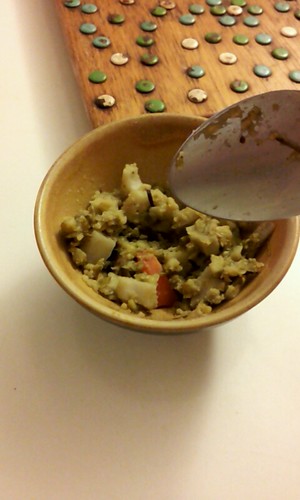
This was a really successful dish. I was already eating it when I realized I should take a picture of it so that I could show it to you. It's pan-fried mung beans with chopped lotus root, carrot, rosemary, and oregano.
  • mung bean 緑豆
  • lotus root レンコン
○ You might claim that it looks awful, but it really was yummy. ← you think it doesn't look delicious, but some people might not believe you

○ You might complain that it looks awful, but it really was yummy. ← you are expressing your dissatisfaction with the photo
  • dissatisfaction【名】不満、不平、不満の種 (definition from Eijiro on the Web)
Notice that "claim" and "complain" can both be used above, but that the meanings are different.   The common mistake, though, is to use "claim" when you mean to use "complain".

× Rather than claim about learning unfamiliar English words, just use them as often as possible to learn them naturally.
 Rather than complain about learning unfamiliar English words, just use them as often as possible to learn them naturally.

Exactly two years ago, I wrote a blog post about the difference between "claim" and "complain". You can read the definitions of the two words there:
http://upgradeenglish.blogspot.jp/2010/11/claimcomplain.html
It doesn't look so appetizing, especially since it's in the middle of being eaten, but I promise that it was great. Next time I'll take more care with the presentation.
  • appetizing【形】食欲をそそる、人の気をそそる (definition from Eijiro on the Web)
2012/11/07

「too」の使い方について


One of the restaurants I ate at on my trip was Pure Veggie House.

http://www.topstandard.com.hk/pureveggiehouse/home.html

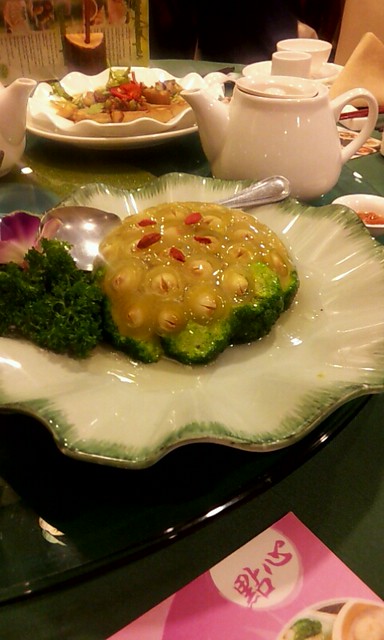
This dish is lotus seeds wrapped in strips of winter melon arranged on a bed of broccoli.
  • lotus【名】《植物》ハス、蓮 (definition from Eijiro on the Web)
  • winter melon《植物》冬瓜 (definition from Eijiro on the Web)
You might say it looks like an alien brain, but actually it had a very mild and pleasant flavor.

It was a vegetarian restaurant, and the menu was overwhelming. There were too many dishes to choose from.
In other words, there were so many dishes that I couldn't choose. At least, it was really difficult to choose. I will have to go again to try different dishes.

I'm too busy in Tokyo to travel as much as I'd like, but every time I go abroad I feel it's refreshing to get a change of perspective. There are so many places that I'd like to visit that I can't see them all in one year. Maybe not even in five years is enough.
  • change of perspective《a ~》観点の変化[を変えること](definition from Eijiro on the Web)
Maybe you feel the same about traveling. If so, English is a really useful skill. It's too useful not to work on improving it now. If you aren't doing so already, I hope you'll start coming to a class to improve your English.

2012/11/06

東京駅は英語の使い方に注意した方が良い。

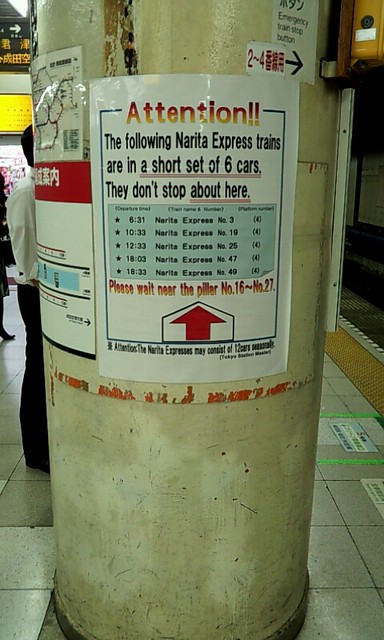
I just returned from a trip. I departed from Tokyo Station on the Narita Express. While I was waiting on the train, I noticed this sign. It says:
× The following Narita Express trains are in a short set of 6 cars. They don't stop about here. Please wait near the pillar No. 16 ~ No. 27.
○ The following Narita Express trains are in a short set of six cars. They don't stop in this area. Please wait between pillars 16-27.
  • pillar【名】〔建物などの細い〕柱、支柱、装飾柱 (definition from Eijiro on the Web)
Probably the writer wanted to say "around here". However, "around here" sounds a bit too casual for a public sign.

You can say "about here", such as:
  • It was about here that I took the photo. ← said when standing in a place which is roughly the correct place
We usually don't use "not" with "about here" when saying that the approximate position is not correct.
  • approximate【形】おおよその、概算の、近似の (definition from Eijiro on the Web)
However, you might hear something like this:
  • The article is not about here. It's about another place.  "about" means "regarding", not "roughly"
The other mistake the Tokyo Station staff have made is using "the". In this case, "pillar" is a title, like "Mount" or "Mr.". In such cases, we don't use "the" in front.

I'm about finished with this post. There's lots to catch up on from being out of town. I'll write again about this time next week, if not before! I'm not sure what I will write about, though. Maybe I'll look for some mistakes around here.

2012/10/23

T-Houseは英語の使い方に注意した方が良い。


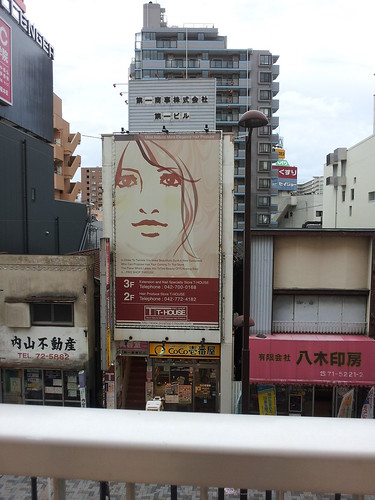
On the north side of Hashimoto Station, there's a store selling beauty supplies called T-House, and they are in desperate need of help with their English. They have a giant sign on the building which barely makes any sense:
In Order To Twinkle You More Beautifully,Such A New Salesclerk
Who Can Propose Has Your Coming To The Store
The Place Which Leads You ToThe Beauty Of Following Step
It,,,,PRO SHOP T-HOUSE.
It's hard to decide what to point out in this text. First, let's try to guess what they mean. Maybe they want to say:
To make you twinkle beautifully like a star, our clerks can suggest the best things for you and lead you on the steps towards beauty. Come to our store: Pro Shop T-House!
Some of the mistakes they have made include:
  1. using title case for a sentence. Don't Capitalize Each Word In A Sentence Unless It Is A Title!!!
  2. ignoring proper spacing after punctuation. Put a space after periods and commas.
  3. meaning mistakes. You can't twinkle me, since "twinkle" is usually used without an object.
There are others, but the funniest is probably the "new salesclerk who can propose". It sounds like one of the staff will propose marriage to me if I go in. While that might make for an interesting experience, it's a little too heavy for my tastes. Some light flirting might be fun, but a marriage proposal is too much.
  • propose (without an object) - to propose marriage. propose to ~にプロポーズ[求婚]する、~に結婚を申し込む (definition from Eijiro on the Web)
  • flirt with 面白半分に(人)の気を引く、(人)にお上手[お世辞]を言う、(人)に面白半分に手を出す、(人)を誘惑する[もてあそぶ]、(人)といちゃつく[イチャイチャする・ベタベタする](definition from Eijiro on the Web)

2012/10/09

「パーカー」は英語で何、part 2

I'm surprised that this post from 2010 about パーカー is still really popular. A lot of people find this post using Google.
http://upgradeenglish.blogspot.jp/2010/01/blog-post_20.html
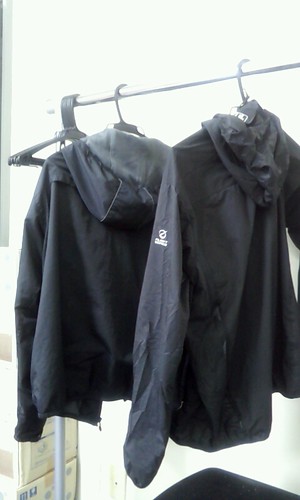
Just to recap, we don't use "parka" to mean the same thing as Japanese do; we say "hooded sweatshirt" or "hoodie" for short.
  • to recap 要点をまとめると (definition from Eijiro on the Web)
For us, a parka is a kind of longer jacket, often for rain or very cold weather.
In the first picture above, those aren't hoodies or parkas either. They are hooded windbreakers. That's what all of these things have in common: hoods.
  • hood 【1名】〔コートの首の回りにつける〕フード、頭巾 (definition from Eijiro on the Web)
  • windbreaker《衣服》ウインド・ブレーカー、風よけ用ジャンパー (definition from Eijiro on the Web) <- my note, "jumper" sounds like a kind of dress for women or children to my American ears, though it's a pullover sweater in the UK
I think it's not quite cool enough to start wearing hoodies here, but maybe a lot of people are thinking about it. As for us here, we are just wearing our hooded windbreakers, which feels just right for the temperature at the moment.

2012/10/02

「college」と「collage」の違い


I was reading a blog post the other day in which the writer was talking about:
× a student studying at his collage
○ a student studying at his college
"College" is pronounced like KAH-lij (カリジ without the "i" at the end) in American English, while "collage" is pronounce like koh-LAHJ (コラージ without the "i" at the end). Be careful about the difference in stress.
  • collage 【名】《美術》コラージュ◆さまざまな素材を同一画面に組み合わせる芸術的手法。【他動】《美術》~のコラージュを作る
In the dictionary, I found "collage" is コラージュ, which is closer to the French pronunciation. The dictionary has カレッジ for college, but I think if you say that, the pronunciation will sound strange, too. Say it without ッ.

The photo above is a collage I just made for this post. I studied art in college, but I'm not sure that this collage is any good. Anyway, it's full of mistakes I've found in public. Can you remember the correct English for these?

フォロワー