2009/06/08

If you don't understand conditional sentences, you are in luck! (条件文)


Yes, you're in luck!
in luck 運がよくて、運が向いて
・Oh, you're in luck! We have one left in the back. : ああ、あなたは運がいいですね。一つだけ在庫があります。
・I'm in luck! : これはついてる、何とラッキー!
As I said last week, I'm going to spend a week discussing conditional sentences. If you ask me which parts of English give students the most trouble, I will tell you that conditional sentences is one of them.
  • conditional sentence 条件文
There are four types of conditional sentences, which we can label this way: zero, first, second, and third. Look at some examples.
  • If I'm hungry, I eat something. (zero)
  • If I am hungry, I will eat something. (first)
  • If I were hungry, I would eat something. (second)
  • If I had been hungry, I would have eaten something. (third)
If I ask you, can you tell me the differences between these sentences? If you can't, that's OK, because I'm going to explain them over the next few days.

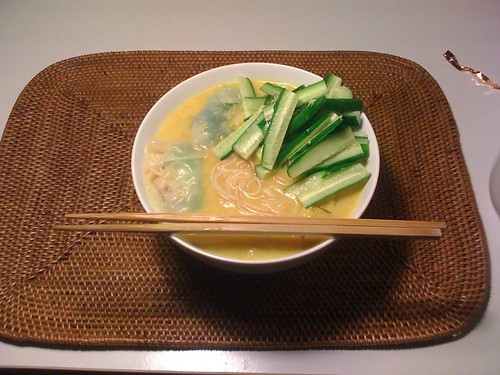
In the meantime, take a look at the dinner I prepared for myself this evening. It's laksa, which is a southeast Asian dish, on egg noodles with vegetarian dumplings and cucumber. The laksa included some nice tumeric from Mumbai, nice onions from Tsukiji, and nice dried lemongrass from California. Here's more about laksa:
http://en.wikipedia.org/wiki/Laksa
If you could eat like this every day, would you become a vegetarian, too? OK, I know you like to eat fish or something, but if you asked me, I would be happy to give you advice on being a vegetarian. More on conditional sentences tomorrow.

2009/06/06

「take leave」は自然な英語ですか?

We were talking about this today. "Take leave" is natural English, but look at the meaning (definitions from 英辞郎 on the web):
  • take leave 休みを取る; She took leave to have a baby. : 彼女は赤ちゃんを産むために休みを取った。; いとま乞{ご}いする、いとまを告げる、告別する
  • take a leave from work 仕事{しごと}の休暇{きゅうか}を取る
  • take a leave of absence from ~から休暇{きゅうか}[休み]を取る[もらう]I've taken a leave of absence from my job.
  • take bereavement leave 忌引{きびき}で休む; 表現パターン take bereavement [compassionate, mourning] leave
You can see that "taking leave" is not so common, and often done in situations which are not so good. An employee might be forced to take sick leave because of a serious illness. Having a child is a reason to take a leave of absence.

Probably what people want to say is "take a day off" or "take some time off".
  • take a day off 休業する、1日休暇[休み]を取る I'm taking the day off tomorrow to make up for last Sunday. : 明日は先週の日曜日の代休を取ります。
  • take a day off from work 仕事を1日休む
  • take a full day off 丸一日休みを取る
  • take time off 時間を割く、休みを取る
Usually, I'd be happy for you if you got to take a day off. If you were taking a leave of absence from work, I'd probably be concerned about you, unless it was to go back to school.

I'm thinking about taking some days off in the fall to visit India. If you are planning on taking any days off in the near future, I hope you have a fun and safe time!

Enjoy the rest of your weekend, assuming you have the weekend off.

「familiar」の使い方

When a student made this mistake, it seemed familiar. Other students have made similar mistakes.
× I felt something familar with you.
○ I felt something familiar about you. <- I felt I had seen you before. Somehow, I knew something about you.
Look at some definitions from 英辞郎 on the web:
familiar with《be ~》~をよく知っている、~に詳しい[精通{せいつう}している・通じている]、~を熟知{じゅくち}している、~の勝手{かって}を知っている、~に慣れ親しんでいる、~になじんでいる、~となじみのある
・The user must be thoroughly familiar with its function before printing out. : 《マニュアル》印刷作業を開始する前に各機能について完全に理解しておいてください。

familiar (adj) おなじみの、精通{せいつう}している、よく知られている、(~に)通じている、(~の)様子{ようす}を知っている、造詣{ぞうけい}が深い、心当たりがある
・I thought the voice sounded familiar. : 聞き覚えのある[どこかで聞いたことのある]声だと思いました。
Now that you know that, you can say:
× I am familiar about it.
○ I am familiar with it. <- I know of it.
I know prepositions are tricky, but they can change the meaning of your sentence. Be careful! The more familiar you are with these expressions, the better your English will be.

2009/06/04

「future」と「feature」…気をつけて!

I keep running across people confusing "future" and "feature".
  • run across ~に偶然会う We ran across an old friend of mine from high school. : 私たちは、高校時代からの古い友人に、偶然会った。
  • 機能 (きのう) (n,vs) function; facility; faculty; feature; (P); (definition from Edict)
  • feature an interview with(人)のインタビューを特集{とくしゅう}する (definition from 英辞郎 on the web)
  • 未来 (みらい) (n) (1) the future (definition from Edict)
Here are some example mistakes.
×___ is futured. <- there's no such word in English
○ ___ is featured.
× What kind of futures does it have?
○ What kind of features does it have? それにはどんな機能がありますか。
but
○ What kind of future does it have? (have a future 将来性がある, definition from 英辞郎 on the web)
The problem, I think, is that these two are pronounced similarly. However, they are not pronounced the same.
feature = "fee" + "chur" (like in "churn", or like "purr" with a "ch" at the beginning)
future = "few" + "chur" (the same as above)
In the near future, this site will feature a series of posts on conditional sentences. You can expect that next week!
  • conditional sentence 条件文
People should be careful with their use of English on signs to avoid being featured on our blog.

We're looking forward to talking with you in the future.

私が何を見ていると思う? Guess what I'm lookin' at?


This is something I see from time to time in my afternoon class right after lunch. However it is the first time I have ever seen it on the train.
Why are these high school kids on the train with their desks? Can you guess??
~と推測{すいそく}する
・You could guess as well as I could. :
私にもよく分かりません。
・I'm just guessing. :
想像ですが。

うまく言い当てる、言い当てる、解きあてる
・I would never have guessed that. ; That isn't something I would have ever guessed. : そのことは全く予想していませんでした。
〈米俗〉~だと思う
・I guess I can do that. : 《相手に誘われて》じゃあそうさせてもらおうかな。
・I guess I never will. : とても無理のようです。
・I guess you could say that. : そのようだね。
Guess what?
何だか分かる?/当ててみて。◆話を切り出すときや、相手の注意を引くときなどに使われる。

Wouldn't you like a massage with every fax?


My students found this pad of fax cover sheets in their office. There are too many silly things about this cover sheet. Notice the top right-hand corner.
× telefax massage
○ telefax message; more commonly, fax cover sheet
One student said "this sounds a bit naughty." I don't think I've ever seen a fax machine that looked like it could give a good massage. I'd like to receive a fax that said I could get a free massage, though, as long as it was a decent human giving the massage.

You know, it's funny to say "telefax message." Of course it's a fax; it arrives at the fax machine! Calling it a cover sheet is better, because then we can be sure that the real document begins on the second page. Still, most people should realize that anyway.

Once again, it's puzzling that a company would fax something abroad with such an obvious mistake. You want your customers to have confidence in dealing with you, so why not have a native speaker proofreader something that you will probably send thousands of? Strange, strange, strange...

I don't really offer massages to students, but I would be happy to check this kind of critical document for you. Please be careful and pay attention to your company's documents at least!

2009/06/02

A question about a new non-fiction book.

Someone wrote me this question:
I've come across the following sentence. I do not get the meaning of it.
What's the meaning of "background"?
I do not get the structure of from to. Which of two "tos" is the one of "from .. to" structure?
Here's the sentence being asked about:
When you get a new cell phone, for example, you have series of choices to make. The fancier the phone, the more of the choices you face, from the background to the ring sound to the number of times the phone rings before the caller is sent to voice mail.
Usually the phrase is "from A to B". However, sometimes we extend the use of the phrase to "from A to B to C (to D to E...)". By doing so,
we are giving steps within the range from A to the final point.

Personally, I don't like this style of writing so much. I prefer the style below:
I drove from New York to Washington DC to Asheville, NC. <- not so good
I drove from New York to Washington DC, and then on to Asheville, NC. <- better
In this case, the meaning is that there are three features that come with fancier phones. The fancier the phone, the more choices you face, such as background image, ringtone, and the number of times the phone rings before the caller is sent to voice mail.

Then the next question was:
Does " the background to the ring sound", if it is a phrase, mean manner mode?
"The background" refers to the background image of the screen. You can call it a wallpaper. "The ring sound" means "ring tone", the sound when the phone rings.

The text being asked about appears to be from a book called "Nudge".
http://books.google.com/books?id=dSJQn8egXvUC&dq=Nudge+by+Thaler+%26+Sunstein&printsec=frontcover&source=bn&hl=en&ei=ajUlSsntD4aUkAWxsaysBw&sa=X&oi=book_result&ct=result&resnum=4
There's an excerpt of it here, including the sentence asked about above:
http://aliciakan.wordpress.com/2009/03/21/good-marketers-are-good-choice-architects/
From questions about grammar to confusion over vocabulary, I can take them all. Please ask!

2009/06/01

「offer」と「ask」の違いは何ですか。

Tonight in class we had this discussion. We were talking about the difference between "offer" and "ask".

Our discussion started with a question I asked:
Have you ever been offered anything on the street? Did you take what you were offered?
"Offer" means to ask someone if they want something. "Ask" just means to pose a question to someone.

Look at these definitions for "offer" from 英辞郎 on the web:
  • 〔人が~を受け入れるよう〕申し出る、提示する
    ・He offered me a glass of wine. : 彼は私にグラス1杯のワインを勧めてくれました。
  • 〔ほかの人のために~しようと〕提案する、言う
    ・They offered me to stay at their house. : 彼らは私に家に泊まるように言ってくれました。
    ・He offered to drive me home. : 彼は私に、(車で)家まで送ろうかと言ってくれました。
  • So these sentences are strange:
    × I was offered the direction from here to the station. <- "Would you like me to give you directions from here to the station?"
    ○ I was asked the directions from here to the station. <- Someone wanted to know how to get to the station.
    × I'd like to offer you to lend your pen.
    ○ I'd like to ask you to lend me your pen. <- Could I borrow your pen?
    Look at the question at the top of the page again. Another way to ask the same thing is:
    Has anyone tried to give you something on the street? Did you take what they tried to give you?
    However, be careful. "Offer" and "give" aren't exactly the same thing.
    × She gave me a cup of tea, so I took it.
    ○ She offered me a cup of tea, so I took it. = She asked me if I wanted a cup of tea, so I said yes. Then she gave it to me.
    You could answer the question at the top of the page like this:
    I was offered some tissues as I was coming out of the station. They're really convenient to have in my bag, so I took them.
    We're always offering you advice on your English; we hope you'll take it.

    フォロワー