2011/11/18

「wear」の使い方


The weather has been getting cooler, so I've started wearing my hoodies.

You all might have felt with the cooler weather that it was time for shopping for clothing. 
  • clothing = clothes =  服
I was out shopping somewhere (I can't remember where) and I saw this sign. It says:
× goods, wear
○ goods, clothes/clothing/apparel
"Wear" is a verb or a suffix, usually. It's most common as a verb, like "make sure you wear enough when you go out, since it's cold."

As a suffix, we use it in words like "underwear" and "formalwear".
  • underwear【名】肌着類{はだぎ るい}、下着{したぎ}、肌着{はだぎ}、パンツ (definition from Eijiro on the Web)
  • formalwear【名】正装{せいそう}(definition from Eijiro on the Web) 
  • suffix  接尾辞 (definition from Eijiro on the Web)
Sometimes we use it with an adjective as an independent word, like:
  • I guess you have already put away all of your summer wear.
However, I prefer this:
  • I guess you have already put away all of your summer clothing.
If you've been making this mistake, don't worry! Just wear a smile and try to avoid making it in the future.
  •  wear a smile 笑みをたたえる (definition from Eijiro on the Web)

2011/11/16

「1兆」は英語で何と言う?


$1,000,000,000,000
How do you say this number in English? Most students have trouble reading big numbers in class. One major reason is because numbers are read/written very differently in Japanese.

For example,
一千円 (1,000) is one thousand yen
. (No problem)
九千九百九十九円 (9,999)
is nine thousand nine hundred ninety-nine yen. (No problem there either)

however 一万円  (10,000)
is... ten thousand. (Here is where things get tricky)
十万円 (
100,000) is one hundred thousand.
百万円 (1,000,000) is one million.
一千万円 (10,000,000) is ten million.

Japanese numbers move in four digits but many Western languages move in three.
So what can you do?

Simple, just look for the first comma on the left. That will tell you how to read the number.
1,000 (ONE thousand)
Secondly, how many digits are there after the first comma.
1,
000 (there are three digits after the first comma so it is thousand)

If there are
6 digits after the first comma, it is million (1,000,000)
If there are
9 digits after the first comma, it is billion (1,000,000,000)
If there are
12 digits after the first comma, it is trillion (1,000,000,000,000)
If there are
15 digits after the first comma, (you most likely will not need to know this number unless you are a hardcore scrabble player.)


Do you know how to read the numbers below? 
The earth's population recently reached 7,000,000,000. 
The population in Japan is  around 125,000,000.
The U.S. public debt is $14,993,980,920,226. 
The price tag of my dream car, a Mercedes AMG SLS is at least $185,750.
The average household income in Japan (in 2009) was ¥5,475,000.

2011/11/15

「money tree」とは?


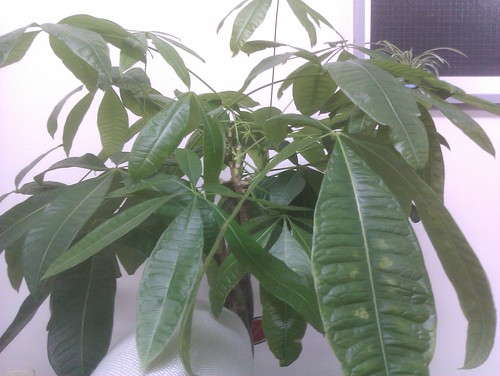
This is our money tree. That's what we call this tree in English.
http://en.wikipedia.org/wiki/Pachira_aquatica
  • money tree パキラ属、金のなる木、金づる (definition on Eijiro on the Web)
  • cash-cow, money tree 金の成る木
People keep telling me that our money tree is too dense. They say I should trim some of the inner leaves. I'm worried about doing that, though, because it seems healthy enough. If I cut a bunch off, I'm afraid I might kill it.

What do you think I should do?

I would hire a specialist, but money doesn't grow on trees. So instead, I'm turning to you all for advice. Do you have good suggestions on how to trim the tree?
  • Money doesn't grow on trees.《諺》金のなる木はない。/お金を楽に得る方法はない。(definition on Eijiro on the Web)
By they way, has anybody started trimming their Christmas tree? I think I'd rather do some kind of pagan winter solstice celebration.
http://en.wikipedia.org/wiki/Winter_solstice
  • trim a tree to make it look better 見栄えがするように木を剪定{せんてい}する (definition from Eijiro on the Web)
  • trim a Christmas tree クリスマスツリーに飾りを付ける、クリスマスツリーの飾り付けをする(definition from Eijiro on the Web)
  • winter solstice 《the ~》《天文》冬至点{とうじてん}(definition from Eijiro on the Web)
It's about five weeks away. Some people might feel it's early, but I am sure Starbucks is already playing Christmas music. I am avoiding it for that reason. I wonder if their seasonal drinks are a money tree?

2011/11/02

「AXE」は英語の使い方に注意した方が良い。+リストの作り方


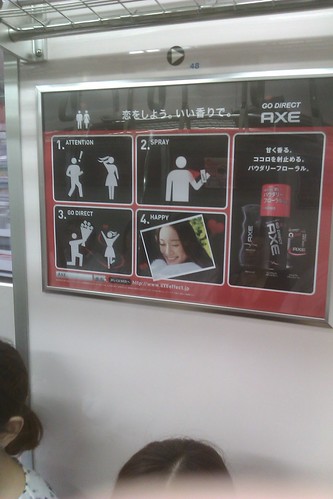
I wonder if you saw this ad on the train. It's by AXE, encouraging men to smell good in order to attract women. They have given us a checklist to help us find love. It says:
  1. × Attention -> ○ Notice, Pay attention
  2. Spray
  3. Go direct
  4. × Happy -> ○ Be happy
The reason "happy" is wrong is because of the way we make lists. When you make a list, all of the items need to be of the same grammatical type (part of speech).
  • part of speech《文法》品詞{ひんし}(definition from Eijiro on the Web)
In the list, "attention" is a noun, and "happy" is an adjective. The other two are verbs, so let's assume they meant to use verbs. To fix it, we change those two items to verbs.

Your lists can use nouns:
  • I've got to buy tofu, green onions, and noodles at the supermarket.
You can also use verbs:
  • Today I went to the bank, ran by the electronics store, and wrote this blog post.
Even adjectives are OK:
  • The weather today was clear, comfortable, and cool.
What you can't do is mix types, like AXE did in their list. When you are making lists, make sure to keep the part of speech of each item the same.

2011/10/15

INAXは英語の使い方に注意した方が良い。


I was in the restroom at Haneda Airport last week when this sign caught my eye:
× Equipment to cleansing the buttocks with warm water.
○ A device to clean the buttocks with warm water.
  • buttock【名】尻、臀部{でんぶ}◆通例buttocks (definition from Eijiro on the Web)
The main mistake here is "to cleansing". Unless "to" is a preposition, don't use a v+ing after it.
○ I am looking forward to seeing you soon.
× I hope to seeing you soon.
○ I hope to see you soon.
The other thing I suggest changing is "equipment" to "a device". The first difference between these two is that "equipment" is uncountable, while "device" is countable. "Equipment" often feels like a set of tools, and it is also often large things. The toilet seat is not so big, and we don't think of it as a set. That's why I think "device" is better.

There is no device to clean up all of the English mistakes I see everywhere. The only thing that can be done is for people to study English more. I hope to help those people in class. Contact us if you want to avoid making mistakes like Inax has.

2011/10/07

「much」の使い方


OK, who keeps letting people put up nonsense English in Yaechika? I found this one:
× Much the Autumn
○ ???
This one is hard to guess. I wonder what they meant?
  • Bountiful Autumn 
  • bountiful【形】〔物が〕豊富{ほうふ}な; 〔人が〕気前{きまえ}の良い; 〔人が〕慈悲深い、恩寵{おんちょう}の豊かな (definition from Eijiro on the Web)
  • It's very much autumn now!
  • It's much like autumn.
  • Will you buy much this autumn?
Maybe they are making a pronunciation mistake!
Match the Autumn 秋に会う <- is this Japanese OK?
Don't say this though:
× I bought much at Yaechiku.
○ I bought a lot at Yaechiku.
Only use "much" for negative sentences and questions. In a positive sentence, you should use "lots" or "a lot".

I keep finding mistakes at Yaechika. I'm going to search at Kanda Station more. I feel like I might find a lot of mistakes there, too. Do you think I will have much success finding them there? I think it's going to be a bountiful autumn. Wish me luck!

2011/10/05

Tully'sは英語の使い方に注意した方が良い


I hadn't been to Yaechika in a while. I can always find English mistakes, there, and this time was no exception.
  • no exception《be ~》例外{れいがい}でない (definition from Eijiro on the Web)
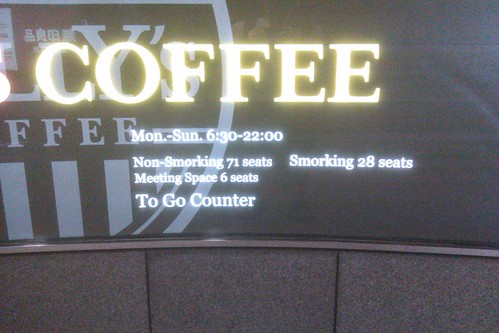
Just when you come down the stairs on the Yaesu Avenue northeast entrance, there's a new Tully's. They have a gorgeous new sign, which says:
× Non-Smorking 71 Seats; Smorking 28 Seats
○ 71 non-smoking seats, 28 smoking seats
What do you suppose "smorking" is? I looked it up, and the Urban Dictionary had this funny definition:
  • smork - someone who is so smitten, they are acting like a absolute dork. Slightly embarrassing, usually someone who is not an obviously smitten person, hence the lame name Smork. "You are acting like such a smork, you're definitely smorko over him" <- my note: "smork" is not common English. Don't expect many to know this.
  • smitten【形】〈英俗〉ぞっこんほれ込んだ (definition from Eijiro on the Web)
  • dork【名】〈俗〉ばか、あほ、とんま、愚か者、のろま (definition from Eijiro on the Web)
So I suppose it's nice of Tully's to provide special seats for those who have fallen head over heels for someone.
  • ぞっこんほれ込みなさい。 Fall head over heels. (definition from Eijiro on the Web)
The sign also says:
× To Go Counter
○ to-go counter
When you use a phrase as an adjective, you should connect the words with a hyphen.

Because of that, I would also say:

× Meeting Space 6 seats
○ 6-seat meeting space

Good luck everybody, smorks included. Even I can be a mistake-making dork sometimes.

2011/10/01

too と very の違いは何です?

Here is one that often confuses Japanese students. What is the difference between too and very? This is one is very easy.

When the temperature outside is 34 degrees, it is very hot.

(You can still go out.  I see many office workers dressed in suits. Be sure to carry a bottle of water.)

When the thermometer reaches 50 degrees, it is too hot.
(It has passed a limit.  It might be dangerous to go out.)

Here is another example.
A 3LDK house in Hamadayama costs 80,000,000 yen. That is very expensive (But if you work hard, save a large part of your earnings and invest prudently in the stock market, you have a good chance of owning one.)

Some houses in the Pacific Heights area in San Francisco are in the neighborhood of 1,000,000,000 Yen. That is too expensive. (It is impossible for an average office worker to buy such a house.  It's over the limit for 99.7% of buyers.)

For emphasis, intonate too. For example, that is tooooooooo expensive.

Useful vocabulary
Be in the neighborhood of--
  1. ~の近くに、~の近所に、~の周りに、~の付近に
  1. およそ、~くらいの、約~◆【同】about
    ・My fee for this service would be somewhere in the neighborhood of $__. : 当サービスの料金は約_ドルとなります。
Over the limit-- 限度を超えて、法定許容アルコール量を超える


フォロワー