2012/02/15

「どうやって○○」は英語で何?「how」の使い方


Some people in class the other day were asking about how to use "how". Here's the advice I gave them. "How" has at least three meanings when used in a question.
  • How do I do it? "how" = "way", どうやって..., answer with a method, as in "Do it this way."
  • How does he feel? "how" = どのよう..., answer with an adjective, as in "It feels great!"
  • How cold was it? "how" = どのくらい...[how + adj/adv]... answer with an adverb, as in "It was very cold."
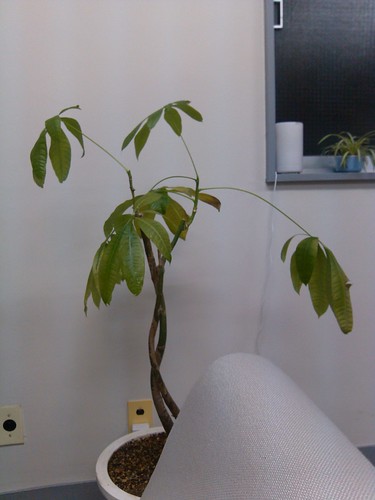
The money tree is doing really badly. It was so dense back in November, but not now. How do I prevent it from dying?
  • prevent ~ from 〔主語は〕~が…するのを防ぐ[邪魔{じゃま}する]、~に…させない、~が…できないようにする、~が…にならないように予防{よぼう}する、〔主語が原因{げんいん}で〕~は…できない (definition from Eijiro on the Web)
There were five trunks. Three of them died. There are two left, and those two don't look so good. How bad do you think it is?
  • trunk〔木の〕幹 (definition from Eijiro on the Web)
I wonder how the money tree feels. Maybe it's just feeling too cold. We tried changing the pot, but that didn't seem to help. How long can it survive? I hope it can make it until spring. Maybe it will start growing better once the weather is warmer.

2012/02/14

Natural Houseは英語の使い方に注意した方が良い。


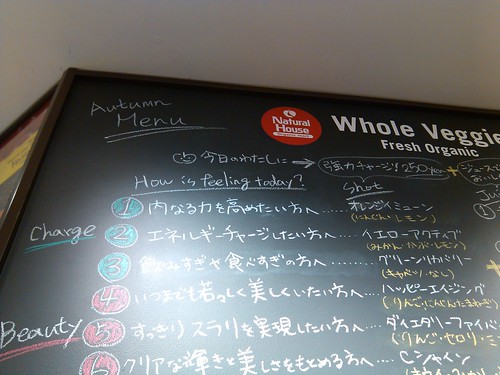
I was in Natural House on the weekend. While checking out, I noticed a sign they had over the area where they were selling fresh juice. It asks us:
× How is feeling today?
○ How are you feeling today? How do you feel today?
  • check out〔レジ係が〕合計{ごうけい}を計算{けいさん}する、精算{せいさん}をする (definition from Eijiro on the Web) 
The important grammar mistake here is the missing "you". In Japanese, it's often possible to omit the subject, but in English you can't do that in most cases.

The really funny thing is the top left corner. It says "autumn menu". We know that autumn was over a long time ago! I guess that probably they have updated the menu but simply overlooked the English in the corner.
  • overlook 見落{みお}とす(definition from Eijiro on the Web)
My advice to any company using English in their signage is that you need to pay attention to exactly what it is you are expressing!
  • signage【名】〔指示・警告の〕文字、記号{きごう}、信号{しんごう}、表記{ひょうき}、看板{かんばん}、標識{ひょうしき}(definition from Eijiro on the Web)
A grammar mistake, while embarrassing, might not interfere too much with the meaning.
  • interfere 【自動】邪魔{じゃま}をする、妨げる、遅らせる(definition from Eijiro on the Web)
On the other hand, wrong vocabulary can result in a completely wrong meaning, like in this case. That's when communication fails.

I hope that Natural House will join the rest of us. Spring will be here soon!

2012/02/08

過去完了形の使い方


In class the other day someone was asking about past perfect tense.
  • past perfect 《文法》過去完了(形){かこ かんりょう(けい)}(definition from Eijiro on the Web)
My summary of how to use past perfect was this:
  1. two past events
  2. A happens before B
  3. A is important for B
You should use past perfect to describe A.

For example:
  • I was interested in ways to cook with Japanese mountain yam other than grinding it and putting it on soba. <- A  (Japanese mountain yam 山芋 )
  • I experimented with stir-frying it. <- B, the reason for this was A
  • Since I had been interested in ways to cook Japanese mountain yam other than grinding it and putting it on soba, I experimented with stir-frying it.
The sauce was made with miso, soy sauce, and sesame oil. It turned out delicious!

For more about past perfect tense, check these posts:

http://upgradeenglish.blogspot.com/2009/06/when-do-i-use-them.html
http://upgradeenglish.blogspot.com/2009/06/when-do-i-use-them-part-2.html
http://upgradeenglish.blogspot.com/2009/06/when-do-i-use-them-part-3.html
http://upgradeenglish.blogspot.com/2009/06/when-do-i-use-them-part-4.html

If you have any tips for cooking Japanese mountain yam, I'd like to hear them. Send me a comment or mail!

2012/02/03

風邪の話


Sorry for the long silence on the blog since the last post. Last week was really busy, and I think I'll write about it in my next post. This week I had the worst cold I've had in a long time.

I started to come down with this cold on Sunday. The symptoms were typical. By Sunday night, I was suffering from chills and body aches.

  • come down with a cold 風邪{かぜ}で倒れる[ダウンする](definition from Eijiro on the Web)
  • symptom 症状
  • chills 悪寒 (definition from Eijiro on the Web)
  • body aches 体の痛み (definition from Eijiro on the Web)

When I woke up on Monday morning, I felt like death warmed up.

  • feel like death warmed up ひどく疲れている、ひどく具合が悪い (definition from Eijiro on the Web)

Still, somehow by late Monday evening I had recovered a lot, I thought, so Tuesday I went ahead with teaching.

  • go ahead with 〔計画{けいかく}・仕事{しごと}などを〕進める、推進{すいしん}する、強行{きょうこう}する (definition from Eijiro on the Web)

That might have been a mistake. I got a runny nose, and I couldn't stop sneezing. When I got home, I found out that I was running a fever. I started coughing. I really hope I didn't pass my cold to my student on Tuesday evening.


  • runny nose 鼻水の垂れている鼻
  • sneeze くしゃみをする
  • run a fever 熱を出す
  • cough 咳をする
  • (definitions from Eijiro on the Web)


Wednesday I finally went to the doctor to get some medicine, which seemed to help with my fever. I was still coughing, though, and the runny nose turned to a stuffed-up nose. The staff at the clinic told me they had seen many patients with colds. This is one trend that I don't want to take part in, though.

  • have a stuffed-up nose 鼻が詰まっている (definition from Eijiro on the Web)
  • take part in ~に参加{さんか}[出場{しゅつじょう}]する (definition from Eijiro on the Web)

Finally today I feel back to about 75% of my usual self, with a normal body temperature and no runny nose.

  • body temperature 体温 (definition from Eijiro on the Web)

If you are one of those people suffering from a cold, I hope you get well soon!

  • Get well soon. 早く元気になってくださいね。/お大事に。◆【場面】見舞いなどで病人の早期回復を願う。(definition from Eijiro on the Web)

2012/01/14

「doubt」と「suspect」の違いパート2、「allege」の意味


This question came up in class this week, particularly because we ran across the word "allege".

  • run across ~に偶然会う (definition from Eijiro on the Web)
  • allege【他動】〔~が事実だと〕断言{だんげん}する、主張{しゅちょう}する; 《法律》〔証拠がないか提示される前に~を〕申し立てる、陳述{ちんじゅつ}する (definition from Eijiro on the Web)

For example, America and Israel allege Iran is making nuclear weapons.

So someone said:
× America doubts Iran is doing that. <- America thinks Iran is not making nuclear weapons.
○ America suspects Iran is doing that. <- America thinks Iran is making nuclear weapons.
We talked about this difference about one year ago:
http://upgradeenglish.blogspot.com/2011/02/doubtsuspect.html
After this difference was clear, the next question was "what's the difference between 'suspect' and 'allege'?"

"Suspect" means that you think something is true, but "allege" means that you say what you think. First America suspects Iran is making nuclear weapons, then they allege Iran is making nuclear weapons.

America alleges that, but Iran denies it. Either way, I hope that war will not break out.


  • deny 【他動】〔~が事実{じじつ}でないとして〕否定{ひてい}する (definition from Eijiro on the Web)
  • If a war broke out, it would be like hell on earth. 戦争が起こったら、生き地獄を見ることになるだろう。(definition from Eijiro on the Web)


There have to be better ways to solve these problems than fighting.

Last year's radish cakes (大根モチ) (the ones in the post above) didn't turn out great, but this year my skill has increased a lot. Look at this beautiful radish cake! I doubt that I could work in a real Chinese restaurant yet, but I suspect you would think this radish cake is delicious if you tried it. You might allege that I am boasting, though.

  • boast 自慢{じまん}する、誇る、鼻にかける、豪語{ごうご}する (definition from Eijiro on the Web)
Here's the recipe. You can try making it yourself:
http://www.renickbell.net/doku.php?id=luo_bo_gao_recipe

2012/01/10

去年の人気ある検索キーワード


People find our blog looking for all kinds of things.

For example, somebody found our blog while searching for "スキルアップ 英語で". The answer is "improve one's skills", as in "my Japanese reading ability is still really weak. I need to improve my skill at Chinese characters."

Here's the top five English-related search terms that brought people to our blog.

5. because of 使い方
4. look look like 違い
3. パーカー 英語
2. as to as for 違い
1. パプリカ 英語

For "because of", we wrote this blog post: http://upgradeenglish.blogspot.com/2010/08/becausebecause-of.html

The difference between "look" and "look like" was explained here: http://upgradeenglish.blogspot.com/2010/05/looklook-like.html

Like I wrote the other day, the post explaining that パーカー in English is "hoodie" is here: http://upgradeenglish.blogspot.com/2010/01/blog-post_20.html

Distinguishing between "as to" and "as for" was done in this post: http://upgradeenglish.blogspot.com/2009/10/as-toas-for.html

Finally, I talked about peppers (パプリカ) in this post: http://upgradeenglish.blogspot.com/2009/09/blog-post_12.html

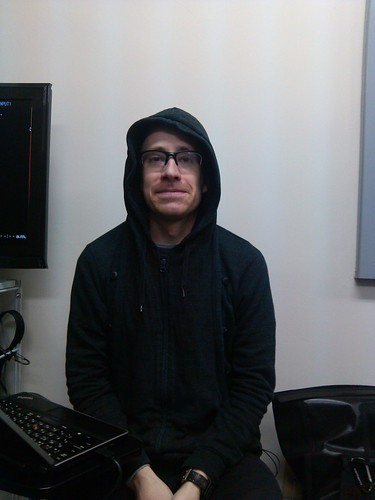
The other day, some people commented about the photo I had posted of my self. They said that I looked like a strange gnome.


  • gnome【2名】〔大地{だいち}の精の〕ノーム◆地中に住むとされる伝説上の小人で、伝統的に色鮮やかな、先のとがった丸い帽子をかぶり、ひげを生やした老人の姿で描かれる。ゴブリン(goblin)と異なり、おとなしくまた自然を慈しむとされる。(definition from Eijiro on the Web)
Since they thought I looked strange, they suggested that I put a better picture of myself. Because of that, one student took this picture of me in my hoodie. After taking the picture, she said "you look normal". Maybe you think I still look strange to be wearing the hood indoors!

Did you notice those popular key word searches above? As for peppers, I haven't cooked with them recently. However, because of this post, I have now realized it has been a while since I've eaten green peppers. I think I'll cook such a dish soon. 

2012/01/06

去年の人気があるポスト


Happy New Year!

I hope you all had a pleasant break. I didn't finish reporting about the popular posts from last year before the break, so I want to finish up that before talking about new things.

Among the posts from last year, this one was the third-most viewed: 「久しぶり」は英語で何?

Coming in second place was the post titled "忍耐は美徳である。Patience is a virtue."
  • come in __ place = _位[番]になる◆_には序数が入る。(definition from Eijiro on the Web)
The most popular post was about "the week before last".

Next time, I'll write about what people were searching for in 2011 when they found our posts.

2011/12/28

今年の人気があるポスト


At the end of the year, lots of media outlets give retrospectives.

  • media outlet 報道発信地[源]、メディアの支局 (definition from Eijiro on the Web)
  • retrospective【名】回顧展 (definition from Eijiro on the Web)

Let's do the same thing here!

First, we can talk about which of our blog posts were the most popular this year. All of these posts were from 2010, but it seems that they were relevant for people this year.

  • relevant 【形】〔検討中の課題などと〕関係のある、関連(性)のある (definition from Eijiro on the Web)
The third most popular post was about the difference between "because" and "because of".
http://upgradeenglish.blogspot.com//2010/08/becausebecause-of.html
The second most popular post was about how to use "depend on".
http://upgradeenglish.blogspot.com//2010/08/depend-on.html
The most popular post was the one about my hoodie, which Japanese call パーカー.
http://upgradeenglish.blogspot.com//2010/01/blog-post_20.html
Next time, I'll tell which of this year's blog posts were the most popular. In the meantime, I'm putting up the hood on my hoodie. It's cold!

フォロワー