2009/10/14

他の東京メトロで見つけた間違い

I think people are confused about punctuation.
  • 句読点 (くとうてん) (n) (ling) punctuation mark(s); (P);
Sometimes it seems people don't care about it. However, it has meaning!

For example, using a period (.) in a word. The reason to use a period in a word is for an abbreviation. The period is used at the end of the abbreviation.
  • 省略 (しょうりゃく) (n,vs) omission; abbreviation; abridgment; abridgement; (P);
For example, "mister" becomes "Mr." in a title. "Et cetera" becomes "etc.".

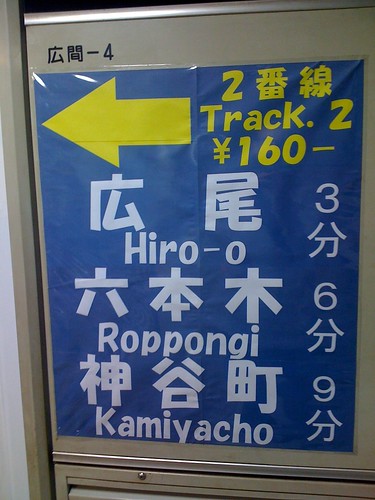
This photo has some English which reads:
× Track. 2
That period after "Track" is really strange. I think what they meant was:
○ Track Number 2
○ Track No. 2
○ No. 2
That's a funny abbreviation, though, isn't it? If "number" doesn't have an "o", why do we write "no."? The answer is here:
http://en.wikipedia.org/wiki/No.
In short, it comes from Latin-based languages, like French and Spanish, in which "numero" means "number". It's interesting to note that in Middle English, "number" was spelled "nombre", also with an "o".

I don't want to abbreviate my sleep, so it's time for me to end this post. Good night!

2009/10/12

私は自分の日本語の使い方に注意した方が良い!

On Friday, someone kindly brought something to my attention.
  • There is something I'd like to bring to your attention. あなたにお伝えして[お話して]おきたいことがあります。(definition from Eijiro on the Web)
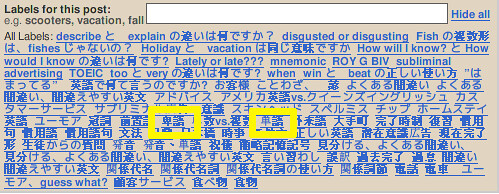
At the bottom of our posts, there's a place for a label. It's supposed to be a convenient way for people to find posts on similar topics. I don't always remember to use it, but I try to do it most of the time.

Unfortunately, over the past two months, I've been making a big mistake: choosing the wrong Japanese label for some posts! I wanted to say "vocabulary", but instead I was saying "vulgar expression". That's embarrassing!
  • 卑語 (ひご) (n) vulgar expression; vulgarism;
  • 単語 (たんご) (n,adj-no) (ling) word; vocabulary; (usually) single-character word; (P);
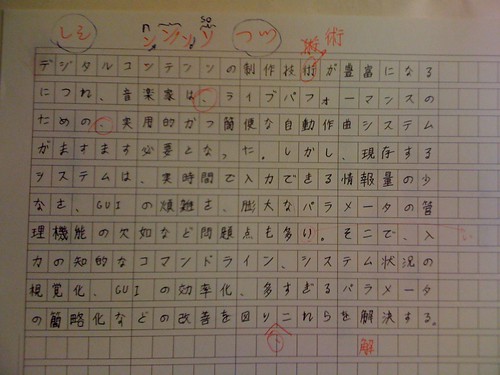
There are a few reasons. One is just carelessness on my part. Another is my poor Japanese. Look at this photo; last year, and even today, I have trouble telling the difference between ツ and シ, and also ン and ソ. I also make mistakes when writing kanji. Look at how I wrote 術. Here's my best excuse, though.
  • 言い訳 (いいわけ) (n,vs) (1) excuse; (2) explanation; (P);
Look at this screen shot. When I write, I'm given a list of labels I've used before. For me, 卑語 and 単語 look almost the same. It's just like how "quiet" and "quite" look almost the same for many non-native English speakers. We've all got to be careful! I think I've fixed all of the 卑語 mistakes, but if you ever find a mistake in my Japanese, please let me know! I'd really appreciate it!

2009/10/09

東京メトロも英語の使い方に注意した方が良い。

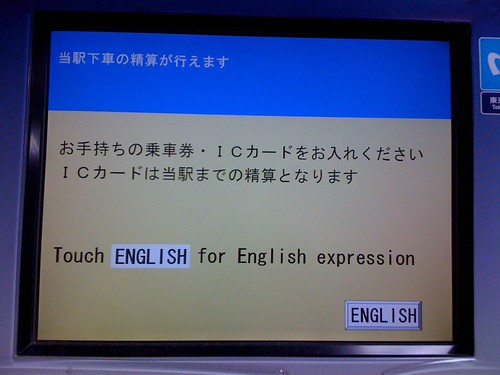
This is another photo I took the other day in Ebisu. It was on the screen of a machine in the Ebisu subway station. It says:
× Touch English for English expression
It should say:
○ Touch the button labeled "English" for text in English.
...or something like that. To be honest, I'm not even sure they need that sentence. Most people should understand what that button does without it.
  • label (v) 付票を付ける
First, notice that they forgot the period. Never forget punctuation at the end of your sentences!
  • 句読点 (くとうてん) (n) (ling) punctuation mark(s); (P);
After that, they are using the word "expression" incorrectly. There are several ways to use it, though, like these:
  • 顔付き (かおつき) (n) (outward) looks; features; face; countenance; expression; (P);
She had a surprised expression on her face.
  • 詞 (ことば) (n) (1) language; dialect; (2) word; words; phrase; term; expression; remark; (3) speech; (manner of) speaking;
"I couldn't be better" is a fixed expression.
  • fixed phrase 定型文{ていけい ぶん}、固定句{こてい く}(definition from Eijiro on the Web)
Here's more on fixed expressions:
http://en.wikipedia.org/wiki/Fixed_expression
I'm surprised that the Tokyo Metro doesn't take more care with their English. At least they used an imperative sentence and not "let's". I have another sign from the subway with mistakes to talk about another day.

2009/10/07

「L」と「R」の違いは何?

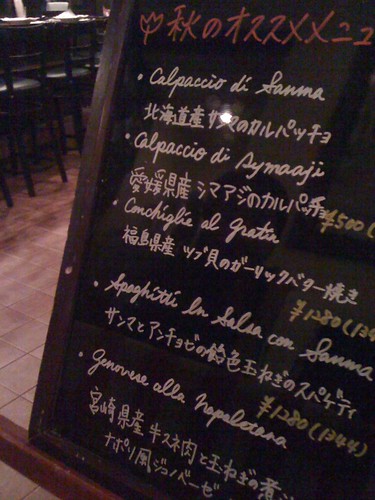
After walking past the restaurant serving "meatfood", I passed this Italian restaurant. I talked about how "meatfood" is incorrect yesterday:
http://upgradeenglish.blogspot.com/2009/10/meal.html
The first two dishes on this sign say:
× Calpaccio di Sanma
× Calpaccio di Aymaaji
I don't know if it's good or bad, but it was interesting to see that the "L" sound and the "R" sound are often confused by Japanese, even if it's in Italian and not English. This sign should say carpaccio, which means raw meat or fish. It's like sushi, but Wikipedia says this dish was invented in 1950.
http://en.wikipedia.org/wiki/Carpaccio
I know it might be hard to hear the difference between an "L" and an "R". However, pronouncing them correctly isn't as hard.
  • 発音する (v) pronounce
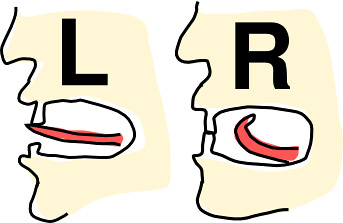
For an "L", start with your tongue touching the bottom side of your top teeth, like the picture below. For an "R", curl your tongue.

「meal」と「meat」の違い

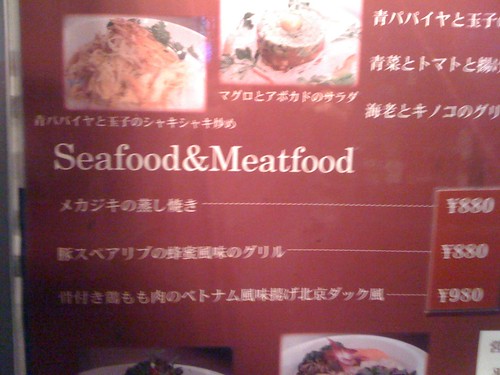
I'm sorry for the blurry photo; this is the same sign I was talking about yesterday. This part of the sign says:
× Seafood&Meatfood
While I admire the creativity the sign-maker is showing, "meatfood" is not an English word.
  • 憧れる (あこがれる) (v1,vi) to long for; to yearn after; to admire; to be attracted by; (P);
  • 創造力 (そうぞうりょく) (n) creative power; (P); creativity
I wish I could give you a good reason why we say "seafood" but not "meatfood", but I just can't think of one.

The sign should read:
Seafood & Meat
× As a vegetarian, I don't eat any seafood, or any meal either.
○ As a vegetarian, I don't eat any seafood, or any meat either.
  • 食事 (しょくじ) (n) (1) meal;
  • 肉 (にく) (n) (2) meat;
For my meals, it's vegetables only. I hope you enjoy your next meal!

2009/10/05

「サラダ」は英語じゃない

I don't know why it is that when going to Ebisu I can find lots of English mistakes. Take a look at this photo:
Sarada&Vegetabele
Here are the comments from your picky native English-speaking friend. The most common mistake here is "sarada". Neither "sarada" nor "salada" is English. It's supposed to be "salad". Notice that the English doesn't end with ダ, but ends with "d". Be careful when pronouncing this word!
  • サラダ (n) salad
Also, on the menu, if there are several kinds of salads, you should use a plural noun, not a singular one.

After that, if you're going to put English on a sign, at least use a spell-check! It's so easy! "Vegetabele" should be "vegetable".

Finally, there's the issue of spaces. If you are going to use "&", which is called an ampersand, you need a space on either side of it.
  • アンド (n) ampersand sign; and; (P);
Here's what the sign should have said:
Salads & Vegetables
You know, one of my favorite vegetarian restaurants has a lot of English mistakes on its menu. Still, I didn't try this restaurant; I went down the street to an Italian restaurant I usually eat at. I had olives, a salad, gorgonzola risotto, and tomato, basil, and mozarella gnocchi. It was delicious!

I hope you all had a nice weekend.

2009/10/02

「so」と「very」、もう一回

The other day I asked you to find this mistake in this description. Here's the answer:
Last week, I made some very tasty curry. You can see it in this photo. It's chickpeas with lots of tumeric, cumin, and curry powder. It was also cooked with a tomato, and onion, and a lot of ginger. It was a so quickly made curry, but I made some a month ago that was so much better. I don't know why this one wasn't as good. I'd like to hear your recipes for delicious food that can be made very easily.

× It was a so quickly made curry. <- don't use "so" with a noun. ○ It was a very quickly-made curry.
You can review the post here:
http://upgradeenglish.blogspot.com/2009/09/veryso_17.html
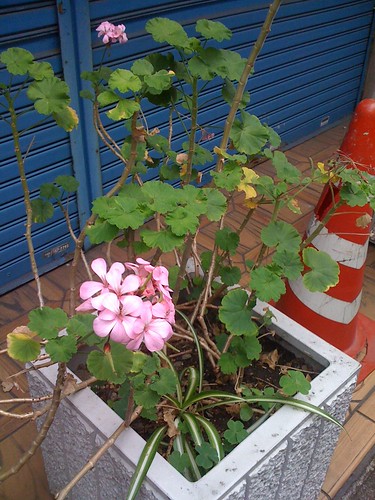
× In Kanda I saw this so strangely-placed planter.
○ In Kanda I saw this very strangely-placed planter.
I thought the flower was nice, though, so I took a picture of it. What kind of flower is this?

Today I wanted to eat at that vegetarian restaurant again, but I ran out of time. Instead, I picked up some maki (rice and other stuff rolled and wrapped with seaweed) at a local supermarket. I didn't pay close attention, though, and grabbed a tuna salad roll instead of a fermented soy bean roll. When I bit into it about seven minutes later, I was so terribly disappointed! Fortunately, they were very cheaply priced, so I didn't feel too bad throwing it away. I also had another one with cucumber and plum, so I didn't starve.

The lesson for me is not to be so hasty!
  • せっかち (adj-na,n) hasty; impatient; (P);

2009/10/01

「neighborhood」と「neighbor」の違いは何?

I often hear some confusion about the difference between "neighborhood" and "neighbor".

(definitions from Eijiro on the Web)

neighborhood
【名】
  1. 近所{きんじょ}、近辺{きんぺん}、自宅周辺{じたく しゅうへん}、近郊{きんこう}、近傍{きんぼう}
  2. 近所{きんじょ}の人々{ひとびと}
    ・My neighborhood has a large number of Brazilian immigrants. : 私の近所にブラジル人移民がたくさんいる。
neighbor
【名】
  1. 〔困ったときに助けてくれる〕隣人{りんじん}
    ・Good fences make good neighbors. : 《諺》良い塀は良い隣人を作る。/しっかりした垣根は隣近所を仲良く保つ。/親しき仲にも礼儀あり。
  2. 近所{きんじょ}の人、隣席{りんせき}の人
    ・My nearest neighbors are cows. : 近所には牛しかいないよ。
Usually "neighborhood" means a place, but one definition also means "people", so that confuses a lot of people. Look at some examples:
○ Some of my neighborhood likes to celebrate holidays with decorations. <- "neighborhood" means people here, but it's an uncountable noun

○ Some of my neighbors like to celebrate holidays with decorations. <- "neighbors" can be a plural noun
In this photo, you can see a wreath with a small sign on it. You can't read it in the photo, but it says "Happy Halloween!" So, we can say:
× One neighborhood is celebrating Halloween. <- remember, if you mean "people", "neighborhood" is uncountable
○ One neighbor is celebrating Halloween.
Another neighbor also has a wreath on her door. Maybe she's celebrating the coming of fall.

Still, most of my neighborhood is free of holiday decorations. <- "neighborhood" means a place, not people, in this sentence

Maybe they're too busy to hang decorations, like me. I love this season more than any other, but I'd rather things just be clean than see a lot of holiday stuff that will probably hang on doors too long.

Anyway, a happy autumn to you!

フォロワー