A funny thing happened a few weeks back at Coredo Nihonbashi (コレド日本橋).
Coredo Nihonbashi is near our school. I had run over there in the afternoon for a quick lunch. When I had finished eating, I ran back to school. On the way, one of my gloves fell out of my pocket.
● run over to ~まで走っていく、~に駆け寄る (definition from Eijiro on the Web)
Later that evening, I was preparing to ride my bicycle home when I realized that one of my gloves was missing. I figured I must have dropped it at Coredo, so I went back there to find it. I looked all of the places that I had been and asked the staff in the restaurant if they had seen it. They said they hadn't.
● figure 計算する (definition from Eijiro on the Web)
Finally, I went looking for the security staff. I thought they must have a lost-and-found. I found the employee entrance, which was locked, and knocked on the door to get the attention of the guard. He came and opened the door and asked me what I wanted. I explained to him in Japanese the story of my glove. He understood, and let me come to the counter while he checked a kind of log of found items.
● lost and found 〈米〉遺失物取扱所、遺失物係
He seemed to have found it in the log, asked me to wait, and stepped away to a locker where those items could be found. Bringing back a plastic bag with my glove in it, he asked me if it was mine. I told him that it was and thanked him for keeping it for me. He then asked me to fill out a form, which I did.
I thanked him again and started to walk back to the door which I had entered from. Then he told me something that I couldn't quite understand. I asked him to repeat it, but somehow my Japanese wasn't good enough to make out what he meant. That's when something really funny happened.
● make out 理解する、分かる、判読する、認識する、~をようやく見分ける、見分ける、聞き分ける (definition from Eijiro on the Web)
"Th.. th... that... d... d... doooooooooor...* he struggled to tell me in English about the door, as if he couldn't make his mouth pronounce the words "... is locked," he continued, suddenly in perfectly pronounced English. He instantly sounded like a native speaker.
"Oh! You can speak English!" I said, surprised.
"Yes, I used to live in the US when I was a kid," he told me, again in perfectly pronounced native-speed English.
We talked for just a second, and then I left. It seems that he just hadn't spoken English for some time. He had just gotten rusty.
● be rusty〔練習不足により技術などが〕下手になった、鈍くなった、なまった (definition from Eijiro on the Web)
It seems that you don't really forget language that you have learned before. However, if you don't practice, it may not be right there at your disposal when you need it.
● at one's disposal (人)が自由に[好きなように・勝手に]使える[できる]、(人)の思う[意の]ままに (definition from Eijiro on the Web)
The moral of the story is: don't stop practicing English! Keep your skills sharp!
By the way, how is that headline? Is it strange?
2011/02/22
2011/02/17
忍耐は美徳である。Patience is a virtue.
You may have seen my not-so-successful radish cake the other day. I tried again, and this time it worked out pretty well.
● work out well うまくいく (definition from Eijiro on the Web)
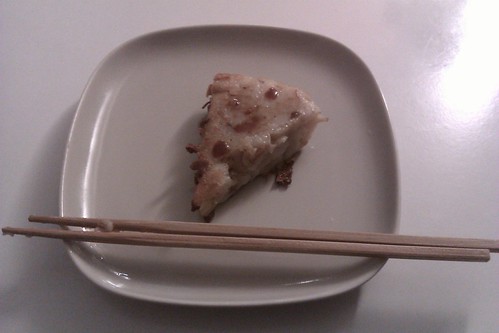
Rather than cook the radish cake in a wok on the stove, I used the rice cooker. That was not only easier to use, but it also turned out better. Here's a slice of it, with a bit of soy sauce on top.
● wok 【名】《料理》中華鍋◆取っ手が片手持ち型は北京鍋、両手持ちは広東鍋。鉄、アルミ、チタン製がある。アルミ・チタンは軽くて熱廻りが均一だが、価格は鉄の10倍。北京鍋の取っ手に持つのに熱くない木製のもある(木取っ手の押えねじが緩みやすいのでしっかり増し締めすること)。プレスで型打ちするのと、手打ちのがある(手打ちは多数の円形模様がある、熱廻りが均一)。(definition from Eijiro on the Web)
Cooking is really satisfying. You can finish the whole activity within a couple of hours and enjoy the result right away. I guess it's not quite instant gratification, but it's much closer to it than long-term activities like learning a foreign language or computer programming.
● instant gratification すぐに得られる喜び (definition from Eijiro on the Web)
That's important for us students of language to remember; since the results from study don't always come immediately, we've got to be patient. However, when you look back one year or more, you should be able to see the difference.
● Be patient. 我慢してください。 (definition from Eijiro on the Web)
As for my radish cake, it tasted good, and I enjoyed it, but I'm not a dim sum chef yet. Maybe some day. I'll patiently work on it.
● dim sum 《中華料理》点心 (definition from Eijiro on the Web)
● work out well うまくいく (definition from Eijiro on the Web)
Rather than cook the radish cake in a wok on the stove, I used the rice cooker. That was not only easier to use, but it also turned out better. Here's a slice of it, with a bit of soy sauce on top.
● wok 【名】《料理》中華鍋◆取っ手が片手持ち型は北京鍋、両手持ちは広東鍋。鉄、アルミ、チタン製がある。アルミ・チタンは軽くて熱廻りが均一だが、価格は鉄の10倍。北京鍋の取っ手に持つのに熱くない木製のもある(木取っ手の押えねじが緩みやすいのでしっかり増し締めすること)。プレスで型打ちするのと、手打ちのがある(手打ちは多数の円形模様がある、熱廻りが均一)。(definition from Eijiro on the Web)
Cooking is really satisfying. You can finish the whole activity within a couple of hours and enjoy the result right away. I guess it's not quite instant gratification, but it's much closer to it than long-term activities like learning a foreign language or computer programming.
● instant gratification すぐに得られる喜び (definition from Eijiro on the Web)
That's important for us students of language to remember; since the results from study don't always come immediately, we've got to be patient. However, when you look back one year or more, you should be able to see the difference.
● Be patient. 我慢してください。 (definition from Eijiro on the Web)
As for my radish cake, it tasted good, and I enjoyed it, but I'm not a dim sum chef yet. Maybe some day. I'll patiently work on it.
● dim sum 《中華料理》点心 (definition from Eijiro on the Web)
2011/02/10
「doubt」と「suspect」の違い
There was a good question this week about the difference between "doubt" and "suspect". When I check my Japanese dictionary for 疑う, I see that both of these are listed. That's not so helpful, so let me explain.
"Doubt" has a negative meaning which is similar to "don't think". "Suspect" also has a negative meaning, but means "think". The key difference is the "not" hidden inside "doubt".
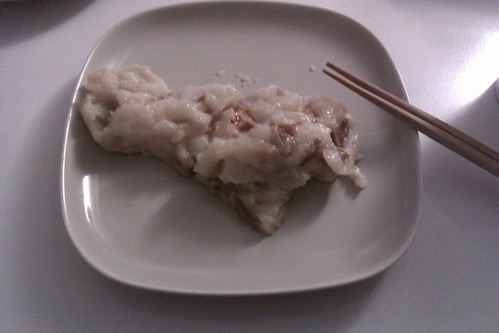
Over the Lunar New Year holiday, I cooked radish cakes. It looked good in the photo, but when I was trying to take it out of the pan, it broke. This piece you see on my plate is the result. Ugly, isn't it?
● Lunar New Year 旧正月、春節、小正月◆中国・台湾・海外華僑の旧正月ならばChinese New Yearが良い。韓国・北朝鮮ではLunar New Year(中国の属国、植民地の歴史観から)(definition from Eijiro on the Web)
Actually, though, when I was cooking it, I thought I would have trouble. That's because even after steaming it for 90 minutes, when I stuck a chopstick in it, the chopstick didn't come out clean. At that point:
I doubted that it would turn out correctly. = I suspected that it wouldn't turn out correctly.
It's OK, though, because my second try was much better. The Lunar New Year holiday may be over, but I'm going to try again this weekend.
"Doubt" has a negative meaning which is similar to "don't think". "Suspect" also has a negative meaning, but means "think". The key difference is the "not" hidden inside "doubt".
Over the Lunar New Year holiday, I cooked radish cakes. It looked good in the photo, but when I was trying to take it out of the pan, it broke. This piece you see on my plate is the result. Ugly, isn't it?
● Lunar New Year 旧正月、春節、小正月◆中国・台湾・海外華僑の旧正月ならばChinese New Yearが良い。韓国・北朝鮮ではLunar New Year(中国の属国、植民地の歴史観から)(definition from Eijiro on the Web)
Actually, though, when I was cooking it, I thought I would have trouble. That's because even after steaming it for 90 minutes, when I stuck a chopstick in it, the chopstick didn't come out clean. At that point:
I doubted that it would turn out correctly. = I suspected that it wouldn't turn out correctly.
It's OK, though, because my second try was much better. The Lunar New Year holiday may be over, but I'm going to try again this weekend.
2011/01/31
「raise」と「rise」の違い、part 2
It has taken me all of January to catch up with topics from 2010. The last thing I need to do is revisit my post last year about "raise" and "rise", which several people said still confused them.
Let's try to clear things up.
● Let's clear up a couple of things. いくつかのことをはっりさせましょう。(example from Eijiro on the Web)
"Raise" is a verb that usually requires an object: a transitive verb. You can make a sentence in passive voice with it.
● transitive verb 他動 たどう (definition from jmdict)
"Rise" is a verb that isn't used with an object: an intransitive verb. You can't make a sentence in passive voice with it.
● intransitive verb 自動詞 じどうし (definition from jmdict)
Radish cakes (or turnip cakes) are a traditional dish at Chinese New Year. One Chinese name for them means something like "rising height every year" or "growing taller every year".
In other words, your height rises every year (notice, no object). That's the auspicious meaning of the dish.
● auspicious 吉祥、愛でたい (definition from jmdict)
I tried to make them this weekend, and while it looks pretty good in this photo, the texture was actually pretty wrong.
From the photo in my next post, you will see that I have to raise my skill level at making radish cakes (notice "skill level" is the object).
Let's try to clear things up.
● Let's clear up a couple of things. いくつかのことをはっりさせましょう。(example from Eijiro on the Web)
"Raise" is a verb that usually requires an object: a transitive verb. You can make a sentence in passive voice with it.
● transitive verb 他動 たどう (definition from jmdict)
"Rise" is a verb that isn't used with an object: an intransitive verb. You can't make a sentence in passive voice with it.
● intransitive verb 自動詞 じどうし (definition from jmdict)
Radish cakes (or turnip cakes) are a traditional dish at Chinese New Year. One Chinese name for them means something like "rising height every year" or "growing taller every year".
In other words, your height rises every year (notice, no object). That's the auspicious meaning of the dish.
● auspicious 吉祥、愛でたい (definition from jmdict)
I tried to make them this weekend, and while it looks pretty good in this photo, the texture was actually pretty wrong.
From the photo in my next post, you will see that I have to raise my skill level at making radish cakes (notice "skill level" is the object).
2011/01/25
私は英語の使い方に注意した方が良い。
Before I get on to this year's important topics, there's still a bit of catching up to do regarding last year's posts.
I'm writing this post while I have a cup of tea and cookies at a cafe near our classrooms.
I am encouraged by the progress of my students. Back on December 14, I was writing about the difference between "raise" and "rise". In that post, I made an English mistake!
A few of you had not only the sharp eyes to catch my mistake, but also the confidence to bring it to my attention.
・sharp eye 鋭い[刺すような]目[視線](definition from Eijiro on the Web)
・bring ~ to someone's attention ~を(人)に気付かせる、~に(人)の目[注意]を向けさせる、(人)を~に注目させる (definition from Eijiro on the Web)
Here's my mistake:
× If you want to ask me a question, you don't have to raise you hand; just send me email!
◯ If you want to ask me a question, you don't have to raise your hand; just send me email!
There's no explanation for the mistake; it's just a silly mistake that I should have caught. Thanks again to everyone who pointed it out.
ラベル:
間違い
2011/01/21
2010年ベスト検索キーワード
It was interesting to see what kind of searches people did with Google and Yahoo that brought people to our blog.
The third-most-popular search was for "look look like 違い". We have posts about this topic!
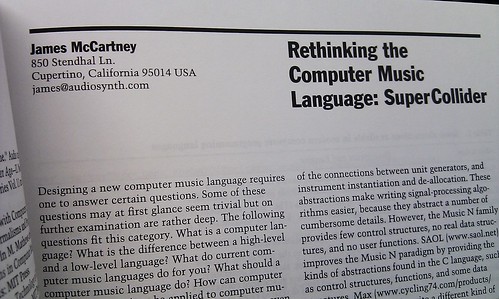
Most of my searches in 2010 were about programming computers, so I won't bore you with those pages. My searches lead me to articles like the one in the picture above.
We're looking forward to answering your questions in 2011!
The third-most-popular search was for "look look like 違い". We have posts about this topic!
http://upgradeenglish.blogspot.com/2010/05/looklook-like.html
http://upgradeenglish.blogspot.com/2009/06/dont-make-these-simple-mistakes.htmlThe second-most-popular search was for "enjoy 使い方". We have written a post about this one, too!
http://upgradeenglish.blogspot.com/2009/09/enjoy.html
http://upgradeenglish.blogspot.com/2010/07/enjoypart-2.html
http://upgradeenglish.blogspot.com/2009/07/enjoying-sunset.htmlThe most popular search was "as to as for 違い". Here's the link to our post about that.
http://upgradeenglish.blogspot.com/2009/10/as-toas-for.htmlSince these questions seem to be popular, we'll be writing more about them in 2011. Please let us know what other questions you have.
Most of my searches in 2010 were about programming computers, so I won't bore you with those pages. My searches lead me to articles like the one in the picture above.
We're looking forward to answering your questions in 2011!
ラベル:
よくある質問
2011/01/20
2010年人気のあったポスト
I thought you might be interested to know what readers of our blog were interested in last year. I bet that my headline has a mistake. I'll check it and then correct it.
The third-most-popular post was about the difference between "look" and "look like". It was a post from May, and it also resulted in a lot of people telling me to post a better photo myself.
http://upgradeenglish.blogspot.com/2010/06/withoutbesides.html
For me, one of the best things in 2010 was the Ryoji Ikeda performance I went to. That's what is shown in this photo. I wrote about it in this post talking about the difference between how to use "so" and "such".
The third-most-popular post was about the difference between "look" and "look like". It was a post from May, and it also resulted in a lot of people telling me to post a better photo myself.
http://upgradeenglish.blogspot.com/2010/05/looklook-like.htmlThe second-most-popular post was a post from 2009 about the difference between "as to" and "as for".
http://upgradeenglish.blogspot.com/2009/10/as-toas-for.htmlThe most popular post was about the difference between "without" and "besides". I wrote about a guitar that I found in the garbage.
http://upgradeenglish.blogspot.com/2010/06/withoutbesides.html
For me, one of the best things in 2010 was the Ryoji Ikeda performance I went to. That's what is shown in this photo. I wrote about it in this post talking about the difference between how to use "so" and "such".
http://upgradeenglish.blogspot.com/2010/11/sosuch.htmlIf you have any questions left over from 2010, please ask me!
2011/01/19
A Belated Happy New Year!
That word in the headline is a good word for you when you forget someone's birthday.
I had a busy holiday, and I have had an even busier new year. Still, one of my new year's resolutions is to bring your more blog posts in 2011. I'll do my best!
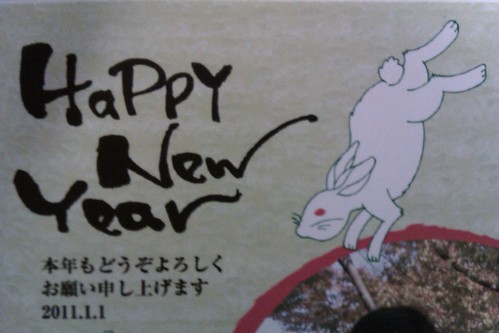
Greeting cards like this one came at the new year. It's a nice idea; I wonder how long it will take for them to become totally digital, just like other mail.
I hope you all will send me your comments and suggestions this year. If you're still a bit wary of using English, you can send me your thoughts in Japanese. I encourage you to use English, though.
If you or someone you know needs an English teacher, I especially hope you will get in touch.
Happy New Year!
- I'm wishing you a belated happy birthday.
- belated【形】遅れて到着した、手遅れになった、時代遅れの、遅ればせながら、少し遅れの・"I got married last year." "Well, congratulations -- a little belated, though." : 「私、昨年結婚したんです」「それはそれはおめでとうございます。遅ればせながら」・Belated Merry Christmas and Happy New Year! : 遅ればせながらメリークリスマス&ハッピーニューイヤー。(definition and examples from Eijiro on the Web)
I had a busy holiday, and I have had an even busier new year. Still, one of my new year's resolutions is to bring your more blog posts in 2011. I'll do my best!
- new year's resolution 新年の誓い[決意・抱負]、元旦の決心 (defintion from Eijiro on the Web)
Greeting cards like this one came at the new year. It's a nice idea; I wonder how long it will take for them to become totally digital, just like other mail.
- greeting card グリーティングカード、挨拶状◆クリスマスや新年など季節の節目に知人・友人・恋人などに送るカード (definition from Eijiro on the Web)
I hope you all will send me your comments and suggestions this year. If you're still a bit wary of using English, you can send me your thoughts in Japanese. I encourage you to use English, though.
- become wary of~に警戒するようになる (definition from Eijiro on the Web)
If you or someone you know needs an English teacher, I especially hope you will get in touch.
Happy New Year!
ラベル:
単語
登録:
投稿 (Atom)