2009/12/10

「let's」は誰かと一緒にしたいことを表わす。

First, I have to admit that the headline of this post might be really broken Japanese. I'm not quite sure how to say that. Someone please email me a better version!
  • broken English
    片言英語 (definition from Eijiro on the Web)
What I want to say is that "let's" expresses something that you want to do together with someone else. I've talked about that before on this blog:
http://upgradeenglish.blogspot.com/2009/04/dont-use-lets-if-you-are-giving-someone.html
http://upgradeenglish.blogspot.com/2009/09/blog-post.html
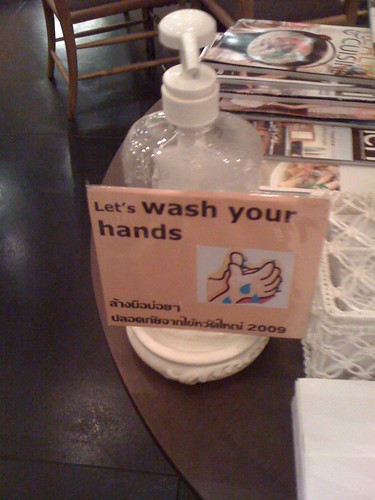
I was eating at a nice vegetarian restaurant in Bangkok where I also saw this mistake. Now I know it's not a mistake which is only found in Japan. The sign reads:
× Let's wash your hands <- "let's" is wrong, and there's no period either.
○ Please wash your hands.
I wonder if it would be nice for someone to help me wash my hands. After all, at a salon, people wash your hair. When you get a foot massage, the masseur washes your feet.
  • マッサージ師 (マッサージし) (n) masseuse; masseur;
However, no one has ever helped me to wash my hands, at least not in the past 30 years, I think.

Anyway, everywhere people are worried about the flu, and at least washing hands is a better defense than wearing a mask.

Let's help each other to learn new languages. I've written this post, so now somebody check my headline for me, please!

2009/12/09

日本国際教育支援協会は英語の使い方に注意した方が良い。

I took a Japanese test on Sunday at one of the Tokyo University campuses. It was a bit harder than I expected, but I think everything went OK.

It was interesting that there was a cute kid sitting in front of me. I could see his name card. His name was Clarence, he was eight years old, and he was from India.

His legs were too short to reach the floor, and my legs were too long for the narrow seating. Consequently, we kept accidentally kicking each other under the table. I said "sorry" and said "OK, OK" with a smile.

After the test, I asked him how long he had been studying Japanese.

"Two years," he said.

"Was the test hard?" I asked him.

"Kind of," he said.

Another interesting fact was the one English mistake I could find on my answer sheet. It said:
× Check up on your test vouchers.
〜 Check this up on your test voucher.
○ Check this against your test voucher. <- make sure that this matches the one on the test voucher
  • 証票 (しょうひょう) (n) certificate; voucher; chit;
There are two mistakes. First, I only have one test voucher, not multiple ones. Also, "check up" without an object has a different usage, I feel.
Please check up on the children in the other room. <- verb
How did your check-up at the doctor go? <- noun
  • 人間ドック (にんげんドック) (n) medical check-up; thorough physical examination; (P);
I was also a little frustrated that a test which lasts for only 140 minutes took from 9:30 to 14:35 to complete. Anyway, it was an interesting experience, and there were some beautiful trees on the university campus as well.

2009/12/05

「in any case」の使い方

Some people have told me they aren't so crazy about Thai food.
  • not too crazy about ~についてあまり気乗りがしない (definition from Eijiro on the Web)
Some said it's too spicy. Some don't like coriander. Others said it's the fish sauce that turns them off.
  • turn someone off from(人)に~する気をなくさせる
In any case, I thought it was super!

Here's the definition of "in any case" from Eijiro on the Web:
  • in any case どんな場合{ばあい}でも、とにかく、ともかく
We usually use it at the beginning of a sentence, followed by a comma and a complete sentence.

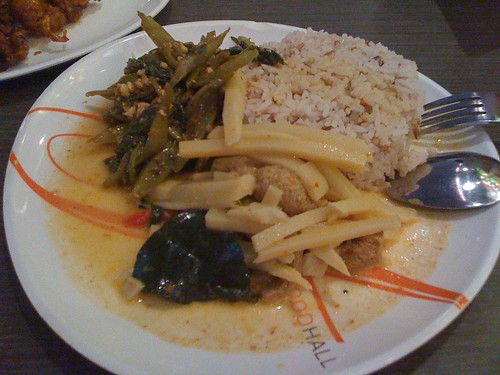
In Bangkok, this plate of vegetables and rice was only about ¥100. Great, right?

That's about it for this series about "in" and "case". Just in case you missed the previous posts, here are links to all of the posts in the series:
in case: http://upgradeenglish.blogspot.com/2009/11/in-case.html
in case of: http://upgradeenglish.blogspot.com/2009/11/in-case-of.html
in the case of: http://upgradeenglish.blogspot.com/2009/12/in-case-of.html
in someone's case: http://upgradeenglish.blogspot.com/2009/12/in-someones-case.html

2009/12/02

スターバックス コーヒーが「あなたのWISHをかなえます」キャンペーンをやっています ...


This month Starbucks is running the wish on a red cup campaign. Coincidentally, my lesson this week is about the grammatical usage of wish. Let's take a closer look at how to use wish in a sentence.
  1. I wish I (simple past verb) ~ I wish I had a big house.
  2. I wish I (past perfect verb)~ I wish I hadn't drunk so much.
  3. I wish (somebody) would/ wouldn't (verb) ~ I wish my husband would help me do the dishes.
Take a look at the Starbucks poster. The second ornament in the third column reads "I wish I had a puppy." We use wish + past verb to say we regret something, that something is not the way we would like it to be . The reality is that I don't have a puppy but in a perfect world I would have one. Here are some more examples:

Using can
(Reality) ~ I can't play the cello.
(I can't play the cello and I regret it) I wish I could play the cello.

Using be
(Reality) ~ I am not strong.
(I am not strong and I regret this) I wish I were strong.

Next, let's look at when to use wish + past perfect. We use this when we wish something had/hadn't happened. We are sorry that it didn't happen. For example, I went shopping and made an impulse purchase. I bought a 300,000 Yen coat on my credit card and now I can't afford to pay for it. I wish I hadn't bought the coat.

Here is another example: My friend who is a stockbroker tells me to buy XYZ stock but I don't listen to his advice. Six months later, the stock is 80 times the original price. At that moment you are thinking... Ooh, I wish I had bought XYZ stocks.


Last but not least is the I wish (somebody) would/ wouldn't (verb) form. We use this to complain about a situation or to complain about things that people do repeatedly. For example, your partner never helps around the house but of course you would like him/her to. ~~I wish my husband would help around the house.

My wife snores at night and I can't sleep.~~ I wish my wife would stop snoring.

So, what are your wishes this holiday season? I wish...

Vocabulary
impulse purchase~ 衝動買い(したもの)

stockbroker~ 株式仲買人

2009/12/01

「in someone's case」の使い方

At a very large weekend market in the suburbs of Bangkok, there were some women trying to raise money for a charity.
  • 金を調える (かねをととのえる) (exp) to raise money; (definition from Edict)
  • 慈善 (じぜん) (n,adj-no) charity; philanthropy; (P); (definition from Edict)
I was talking about "in the case of" yesterday.
http://upgradeenglish.blogspot.com/2009/12/in-case-of.html
Think about that while looking at the following sentences.

The woman on the left looks really excited about what she is doing.
× In case of the woman in the middle though, it seems she is confused.
× In case the woman in the middle though, it seems she is confused.
○ In the case of the woman in the middle though, it seems she is confused.
In other words, there's a woman in the middle of the photo, too.
× In the case of her, it seems she is confused. <- don't use "in the case of" followed by a pronoun
○ In her case, it seems she is confused.
  • in someone's case (人)の場合
The sign she is holding isn't quite right. It says:
× Donate for helping illtreated children.
○ Donate to help ill-treated children.
  • ill-treated child 被虐待児 (definition from Eijiro on the Web)
However, in the case of philanthropists, we can forgive a few small mistakes, right?
  • 慈善家 (じぜんか) (n) charitable person; philanthropist;

「in the case of」の使い方

I've talked about "in case" and "in case of", so today I want to talk about "in the case of". Here's the definition from Eijiro on the Web:
  • in the case of ~の場合{ばあい}は、~について言えば、~ついては、~にしてみれば
"Of" is a preposition, so you have to follow it with a noun, like this:
  • in the case of __(n)__, (sentence).
You can also reverse the order, putting the "in the case of" phrase at the end. In that case, don't use a comma.

Someone gave me some nice vegetables on the weekend. Having recently tasted a lot of Southeast and South Asian dishes, I had those flavors on my mind. However, this is Japan, and my vegetables were Japanese ones.
× I have to be honest -- I love Asian food, but in case of Japanese food, I find the flavors are often a bit too weak for me. <- what's the emergency?
× I have to be honest -- I love Asian food, but in Japanese food's case, I find the flavors are often a bit too weak for me. <- Japanese food is not a person, so apostrophe "s" cannot be used
○ I have to be honest -- I love Asian food, but in the case of Japanese food, I find the flavors are often a bit too weak for me.
Maybe it's because I'm a vegetarian that a lot of Japanese food has a weak flavor for me.

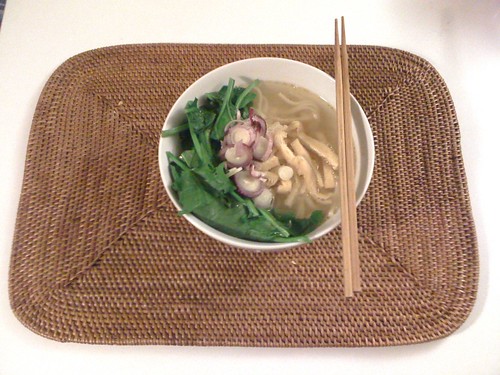
Anyway, in order to make my noodles, I used a whole Japanese citron, a lot of Japanese powdered chili pepper, red scallions, and some fresh spinach. The soup also had seaweed bullion and sweet cooking rice wine.
  • 長葱 (ながねぎ) (n) scallion; shallot; green onion; spring onion;
  • 柚子 (ゆず) (n) (uk) Japanese citron (Citrus junos, Citrus ichangensis x Citrus reticulata var. austera); yuzu;
  • みりん sweet cooking rice wine
It didn't taste so much like Southeast Asian food, but it was pretty yummy.

2009/11/28

「in case of」の使い方

When I was on the airplane, there was a message to the effect that:
  • In case of an emergency landing in water, use the seat cushion as a flotation device.
  • to the effect that ~という旨の The government made a statement to the effect that it's against the war. : 政府は、その戦争には反対であるという趣旨の声明を発表しました。(definition from Eijiro on the Web)
  • 降下 (こうか) (n,vs) fall; descent; (plane) landing; (atmos.) depression; (P); (definition from Edict)
  • flotation device 救命胴衣{きゅうめい どうい}、救命具{きゅうめいぐ}(definition from Eijiro on the Web)
It means "if there is an emergency landing in water, you should use the seat to avoid drowning."
  • 水死 (すいし) (n,vs) drowning; (P);
In the case of "in case of", use it like this:
  • In case of __(n)__, (imperative sentence).
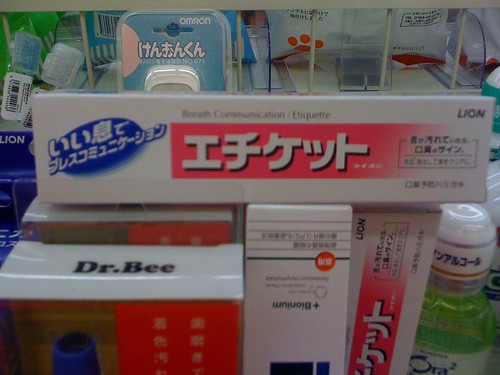
Here's some really strange marketing copy. It says:
  • Breath Communication / Etiquette
Let me give you some advice, OK? In case of someone trying to communicate with you by means of their breath, run like hell.
  • like hell 死に物狂いで、必死に (definition from Eijiro on the Web)

2009/11/18

コカコーラ ゼロ 飲んだことありますか?


I have been in good health and recently I have been in pretty bad health. I am still recovering from a cold. However I have never been in wild health. Will drinking Coke zero give me wild health? In that case I am not so sure it is a good idea to drink coke Zero.

Here are some common meanings of the word "wild"

  • not domesticated, cultivated, or tamed: wild geese; edible wild plants.
  • Lacking supervision or restraint: wild children living in the street.
  • Disorderly; unruly: a wild scene in the school cafeteria.
  • Full of, marked by, or suggestive of strong, uncontrolled emotion: wild with jealousy; a wild look in his eye; a wild rage.
  • Extravagant; fantastic: a wild idea.
  • Furiously disturbed or turbulent; stormy: wild weather.
  • Deviating greatly from an intended course; erratic: a wild bullet.
Here are some sample sentences:
  • Kaka scored a goal in the 90th minute and the crowd went wild.
  • I went to Madonna's last concert. It was wild! Some fans took off their clothes.
  • Where are your manners, you wild animal!
Can you make some sentences using wild?


フォロワー