2010/07/22

この店は英語の使い方に注意した方が良い。スペルミスしないで。

I was out walking around on the holiday. Hot, wasn't it?
× I passed a suits shop. <- don't use a plural noun as an adjective
◯ I passed a suit shop.
It's no wonder this shop needs to advertise suits. Who wants to buy a suit when it's 35 degrees outside?

However, this shop needs help. Not only does their graphic design leave a LOT to be desired, it's spelled wrong!
× Laday's suit (wrong spelling, shouldn't be singular)
◯ Ladies' suits (so-so?)
◯ Women's suits (better, maybe)
  • leave ~ to be desired どこか物足りない、不十分な点がある◆【直訳】何か望まれるものを残している The results left a lot to be desired. : あまり望ましくない結果が出た。(definition from Eijiro on the Web)
I wrote about apostrophes a few months ago. Now's a good time to review:
http://upgradeenglish.blogspot.com/2010/03/part-1.html
× You won't catch me wearing a suits in this weather. <-「suits」は日本語英語
◯ You won't catch me wearing a suit in this weather.
In fact, you'd be lucky to catch me in a suit in any weather. Take care in the heat!

2010/07/17

「take out」と「take down」の違いはなんですか?

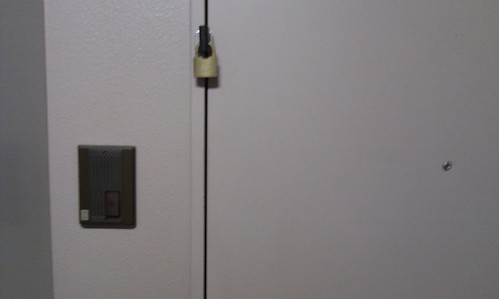
You may or may not recognize this door.

This is the door of my neighbors who seemed to really love New Years. I wrote about them twice before.
http://upgradeenglish.blogspot.com/2010/02/procrastinate.html
http://upgradeenglish.blogspot.com/2010/05/happy-2010-obviousoblivious.html
They put up a wreath at New Years, and it stayed up until last week.
× That's when it was taken out.
~That's when it was taken off (the door).
◯ That's when it was taken down. (best)
  • 外す * pitch away《野球》take off(人を勤務から / 体から衣服・帽子・靴・メガネ・指輪などを / 料理をメニューから / 計画・予定・名簿から~を)〔【反】put on〕(definition from Eijiro on the Web)
  • take down【句動】1. 〔上にある物を〕下げる、降ろす 2. 〔結った髪を〕ほどく (definition from Eijiro on the Web)
Now it seems that they have moved away. In place of the New Year's wreath, there's nothing but a temporary lock.

I had gotten used to seeing that wreath on the door. Now, when I take out the garbage late at night, I only see this lock.
  • Take out the garbage.(生)ごみを出しなさい。(definition from Eijiro on the Web)
These two phrasal verbs have a lot of other meanings. Take a look at Eijiro for more:

2010/07/14

Uniqloは英語の使い方に注意した方が良い。

On Sunday, I stopped by Uniqlo in Ginza. It was crowded everywhere in Ginza, and Uniqlo may have been doing better business than anywhere else.
  • crowded 稠密 過密 濃密 満員 (definition from jmdict)
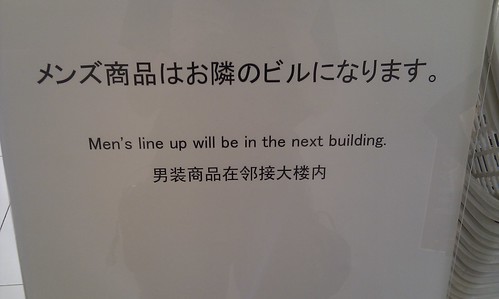
Of course, since I was in Ginza, I was doing something glamourous: shopping for underwear. While looking around, I found this sign:
× Men's line up will be in the next building.
◯ The men's line-up (lineup) is in the next building.
  • glamour 魅力 蠱惑 グラマー (definition from jmdict)
  • lineup ラインナップ 布陣 (definition from jmdict)
The first problem they have is the missing "the". "The" is necessary because we know which "men's line-up" -- it's the Uniqlo men's line-up. When your audience knows which one you mean, use "the".
  • audience 会集 観客 会見 会衆 看客 入り 引見 オーディエンス 聴衆 傍聴人 聞き手 (definition from jmdict)
The second problem Uniqlo has is "line-up". "Line up" is a phrasal verb, which means to get in line or to queue. It's possible to turn many phrasal verbs like this into nouns by adding a hyphen. Some of the more common ones have even become nouns without hyphens, like "lineup".

For me, the third problem is the biggest one. When you use "will", it generally has one of two meanings:
a) you have just decided on some future action
b) you are making a prediction about the future
  • prediction 予言 予断 予測 予知 予報 予想 (definition from jmdict)
If they have made a sign, they can't be deciding right now. It's also strange for Uniqlo to make a prediction about something like the location of their men's section.

There's a special case, which is probably which caused them to make this mistake. Some native speakers have conversations like this:
A: Excuse me, where's the toilet?
B: Oh, it will be just down the hall and on your right.
Native speakers do this, and probably most people don't feel it's strange. However, it's definitely only for conversations, and I don't recommend it to any of you. You and Bさん should say "it is just down the hall on your right."

If you have any connections at Uniqlo, you should let them know. If they are trying to become an international company, they should avoid making English mistakes, especially at their flagship store.
  • flagship store 主力店舗 (definition from Eijiro on the Web)

2010/07/07

「go」と「home」の間に「to」を付けないこと

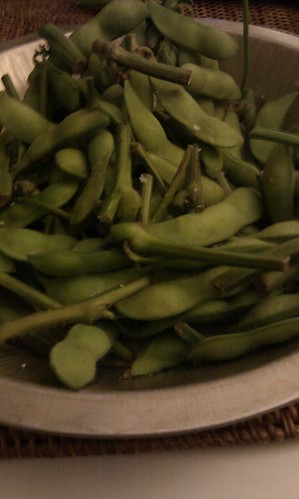
I arrived home this evening close to 11 pm, and I started to eat shortly after that. Now I've finished eating dinner, including these green soybeans.
  • 枝豆 green soybeans (definition from jmdict)
× As I was going to home, it started to sprinkle.
◯ As I was going home, it started to sprinkle. <- "home" is a special case
  • sprinkle 少量、わずか、小雨(definition from Eijiro on the Web)
A little bit of rain is actually comfortable. A lot is not.
× On Monday, as I was going work, it started pouring. <- sorry, but "work" isn't like "home" above
◯ On Monday, as I was going to work, it started pouring. 
When I got to class, I was kind of wet.
  • kind of ある程度{ていど}、やや、多少{たしょう}、 ちょっと、なんだか、いくらか、まあまあ、幾分{いくぶん}、どちらかといえば、いわば、まあ、大 体{だいたい}~といえる、~とか、あれでも~の◆断定を避けるため、表現を和らげるために使う。(from Eijiro on the Web)
× Rainy season isn't over yet, so don't forget your umbrella when you go to somewhere.
◯ Rainy season isn't over yet, so don't forget your umbrella when you go somewhere. <- "somewhere" is like "home" above; don't use "to"

2010/07/03

「ask」の後ろに「to」を付けないこと

Last week I went to Roppongi to meet friends visiting from Singapore at their hotel.

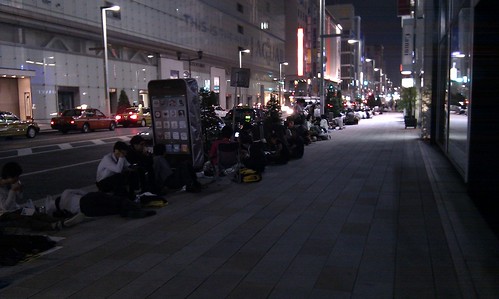
Late at night on the way home, I rode my bicycle through Ginza. There were a lot of people along the west side of Chuo Avenue, and I wondered why they were waiting there so late at night.
× Curious, I stopped and asked to some men at the end of the line.
◯ Curious, I stopped and asked some men at the end of the line.
"The new iPhone is coming out!" they told me.

Now that some problems have been revealed with the iPhone 4, I wonder how they feel. One problem is the antenna:
http://www.wired.com/gadgetlab/2010/07/iphone-4-anandtech/
  • antenna 触角, 空中線, アンテナ (definition from jmdict)
You probably know I'm not a big Apple fan; I much prefer my Android phone, especially considering the terrible service I got at the Apple store.

I hope you were at home resting rather than in a long line for a phone with problems.

2010/06/24

私は日本語の使い方に注意した方が良い。(part 2)

I've gotten some good advice about my posts recently. A few people pointed out mistakes in one of my Japanese dictionaries which I should have caught.

Back on June 16th, I was talking about the muggy weather.
http://upgradeenglish.blogspot.com/2010/06/wetty.html
In that post, I talked about the words "survive" and "evaporate", both of which are verbs. The Japanese definitions from jmdict, though, were nouns. Oops!

These definitions were suggested to me:
  • survive - 生き残る
  • evaporate (in the case of sweat) - 蒸発する
Another point was about my post on June 22nd. I was talking about the hot weather again.
http://upgradeenglish.blogspot.com/2010/06/blog-post.html
I said:
I know some people avoid using the air conditioner at all costs.
Someone suggested to me that, in this case, the best for definition for "at all costs" is 何があっても or 何としても.

It's always great to get your advice! Thank you so much!

2010/06/23

Blenzカフェは英語の使い方に注意した方が良い。

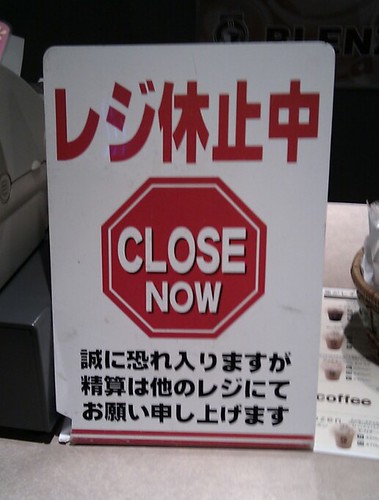
Hey! I don't work at the cafe. I'm not in charge! I can't close the cafe. Only the employees can do that.
  • Who will be in charge?
    誰が責任者になる? (from Eijiro on the Web)

That's what this sign means. It's an imperative sentence, asking me to close the cafe.
× Close now.
◯ Sorry, we're closed. Please come again.
  • imperative sentence
    無条件完結文、命令文{めいれいぶん}(from Eijiro on the Web)
If you don't use a subject and start directly with a verb, it sounds like an order.
Study this blog post carefully! <- this is an order
Starbucks may be expensive, but it has two things going for it: no smoking and (mostly) correct English!
  • have ~ going for someone
    ~が(人)に有利に働く、(人)に有利な~がある

スポーツ・グラフィック ナンバー題名について


I recently saw this title on the cover of sports graphic number. Japan had beaten Cameroon 1-0 earlier in the week. In the last World Cup game Japan lost 1-0 to a powerful Dutch team and on Friday morning Japan is playing Denmark. All Japan needs to do is draw the match. So far Okada has come up with a good strategy in the last two games. I hope the team plays well on Friday. Go Samurai blue!!!

I also wanted to mention the good use of English on the cover. As a reaction to something or someone's actions we can use the following two expressions: What (noun) e.g. What a miracle! or How (adjective) e.g. How beautiful they played! Note the exclamation at the end so be sure to sound excited.

Also note the structure of the sentence:
What (noun) (subject) (verb) ~~ What a handsome man Cristiano Ronaldo is!
How (adjective) (subject) (verb) ~~ How delicious dinner looks!

フォロワー