2009/09/15

「くたばる」は英語で何?

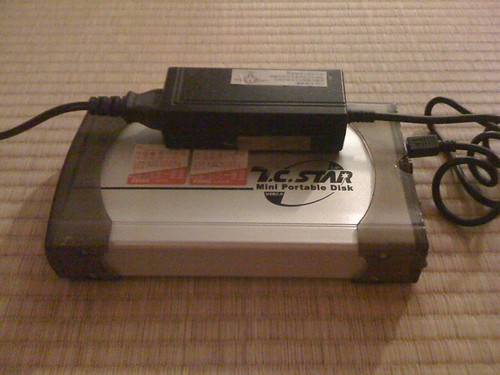
I bought this hard drive about five years ago in Taiwan. Recently, I bought a new hard drive to back up a lot of my data.
  • back up data - コンピューターのデータをバックアップする
When I was doing my backups, I wanted to move the things on this drive to the new drive. However, when I plugged it in, the light on the front just flashed green and red. I tried everything, but no matter what, I couldn't access the data inside. It had died.

It had kicked the bucket.
  • くたばる (v5r,vi) (1) (col) to kick the bucket; to drop dead; to die; (2) to be pooped; to be exhausted; (P);
It had croaked.
  • croak - くたばる、死ぬ、落第する
It had bitten the dust.
  • bite the dust - 戦いで倒れて死ぬ、戦死する
All of these phrases are slang; don't use them in a really serious situation.

I can't remember what was on the drive. I hope it wasn't important. A friend of mine says that no high-tech gear can survive more than five years. Maybe he's right. Remember to back up your data!

2009/09/12

「パプリカ」は英語で何?

This week I feel like talking about food.

One common mistake I hear is:
× I hate to eat pi~man. <- ピーマン is not English!
So I tell people that's not English, so they say:
× Oh! I mean I hate paprika.
"Paprika" is English, but it's a dried spice made from peppers, not the peppers themselves. Wikipedia says some European countries say "paprika" meaning the peppers, but as far as I know, English-speaking countries don't say that.
http://en.wikipedia.org/wiki/Paprika
  • as far as I know 私の知る限りでは、私の知っている範囲では (definition from Eijiro on the Web)
So what should you say?
○ I hate peppers!
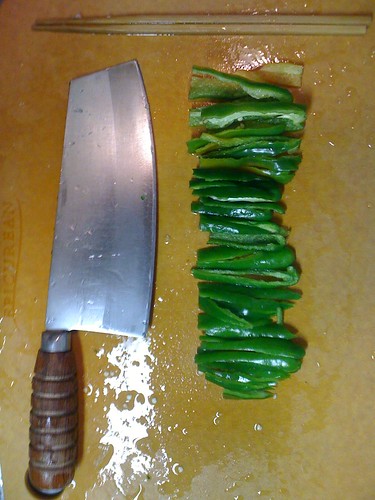
I don't hate peppers, though. I love them! These are slices of bell pepper. There are green bell peppers, red peppers, yellow peppers. There are lots of other kinds of peppers, like jalapeno peppers, chili peppers, and so on.

I read that Australians and New Zealanders call them "capisicum". I had never heard that until today, though.

After slicing these bell peppers, I diced them and stir-fried them with chili peppers, green onion, garlic, ginger, fake mince meat, soy sauce, vinegar, sesame oil, and a little salt. I put that mixture on top of a bowl of noodles. Yummy!

2009/09/11

「コストパ」は英語で何?

Here are the answers to yesterday's question:
These days I try to cook:
× a) as possible as I can
× b) as can as much
○ c) as much as possible
× d) possibly as much
○ e) as much as I can.
Even though I try to cook as much as possible, lunch is a meal I can rarely cook.

Today, I tried a relatively new vegetarian restaurant in Higashi-Nihonbashi. The interior was pleasant, and I particularly liked the natural lighting.

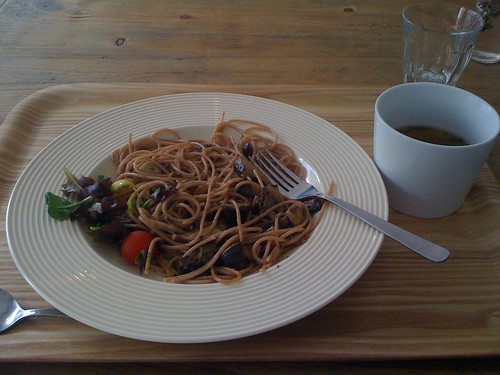
I had a mushroom pasta with a tiny salad and a cup of vegetable soup. The meal cost ¥1000. The flavor was not so bad, but to be honest, the pasta was a bit saltier than I like, and the soup was a bit more watery than what I make at home. The salad was also much too small.
  • コストパ、コスト・パフォーマンス cost performance // price vs performance (definition from Eijiro on the Web)
I'm not sure I've ever heard a native speaker use this in a conversation, especially about food. We're more likely to say something like:
  • It wasn't a very good value.
  • It wasn't worth it.
  • I didn't get my money's worth.
I'll try it again another time. If it's better, I'll give you the details on how to visit yourself.

2009/09/10

出来るだけ

In this photo, you can see the dinner I made last night. I talked about it in my post yesterday:
http://upgradeenglish.blogspot.com/2009/09/lotlots.html
The bowl in front is the sesame sauce noodles. The small bowl on the right in the back is filled with cucumber pickles. The plate on the left is stir-fried Chinese cabbage, also known as bok choi, with fake duck meat.
  • 青梗菜 (ちんげんさい) (n) qinggengcai (spinach-like green vegetable originating in China); pak choi; bok choi; bok choy;
Cooking at home saves money, and the food is generally better for my health. It's also fun!

Which of these is right?
These days I try to cook:
a) as possible as I can, b) as can as much, c) as much as possible, d) possibly as much, e) as much as I can.
Check back for the answer!

2009/09/08

「lot」と「lots」の違いは何ですか?

This question came up in class the other day: what's the difference between "lot" and "lots"?

The basic answer is that "lot" is a singular noun, while "lots" is a plural noun. That means you should use "a" in front of "lot", but don't do that with "lots".

The meaning is the same, though. Personally, I'm likely to use them like this:
  • a lot of __(uncountable noun)__
  • lots of __(countable noun)__
However, either way is OK.

This, though, is definitely wrong:
× a lots of __(n)__
I was missing Taiwanese food. In particular, I wanted to eat sesame sauce noodles. To feed my craving for sesame sauce noodles, I made some tonight for my late-night dinner.
  • craving for ~に対する欲求、~への[~に対する]憧{あこが}れ、~への渇望{かつぼう}
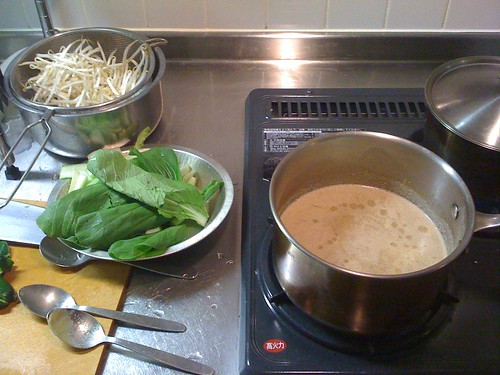
The pot is filled with a lot of sesame sauce soup which I can pour over noodles. On the side you can see there are lots of bean sprouts to put on top of the noodles.
  • 萌やし (もやし) (n) bean sprouts;
I think it turned out pretty well, but I will use a lot more sesame paste in the sauce next time. Next time I'll show you the finished noodles!

2009/09/07

ファミマは英語の使い方に注意した方がいい。

Family Mart needs help with their English. Maybe you know how to become their consultant.
  • 顧問 (こもん) (n,adj-no) adviser; advisor; consultant; (P);
If you do, you can give them this advice.
× Every Life, Every Fun
○ Fun for everyone! <- is this what they mean? I'm not sure...
I will admit that my version doesn't have the poetic repetition that theirs does. However, "every life, every fun" just doesn't make sense!
  • 詩的 (してき) (adj-na,n) poetic;
  • 折り返し (おりかえし) (adv) (4) repetition;
"Every" can only be used with singular countable nouns. "Fun" is an uncountable noun.
○ "We hope that the goods and services we provide will make your day a better and brighter one."
This one was correct. Good job!
× Let's go to Famima.
○ Come to Famima!
There are a few problems here. First, "let's" is wrong. It sounds like the Family Mart staff and I are going to go to another Family Mart together. That's just weird. This should be an imperative sentence.
  • 命令文 (めいれいぶん) (n) (ling) imperative sentence; imperative statement;
I talked about "let's" back in April in this post. Please review:
http://upgradeenglish.blogspot.com/2009/04/dont-use-lets-if-you-are-giving-someone.html
Next, why should I "go" to Family Mart. I'm already there! To welcome someone to your place, use "come", not "go".

If you know anyone in a marketing department who wants to use English in their marketing, please recommend that they study with me!

2009/09/05

「enjoy」の使い方

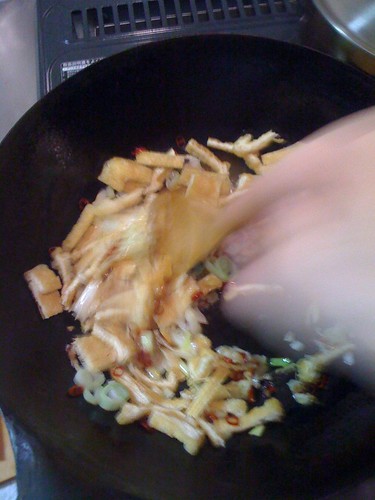
When I got home this evening, I was pretty hungry. I put my bag down and went straight to the kitchen to cook something to eat. I'm getting fast at cooking soup for noodles, so that's what I made. After chopping some vegetables and putting them in boiling water with seasonings, I started to stir-fry a topping for my bowl of noodles. That's what you can see in the picture.
× I was really enjoying.
"Enjoy" is a verb that needs to be used with an object.
  • 目的語 (もくてきご) (n) (ling) object;
That's why the sentence above is wrong. One common pattern is "enjoy oneself".
  • enjoy oneself 楽しむ、楽しく過ごす We could enjoy ourselves at the party. : パーティーを楽しみました。I enjoyed myself. : 本当に楽しかったです。/ああ楽しかった。(definition from Eijiro on the Web)
Otherwise, you can use an object to say what you enjoyed.
  • I enjoyed listening to crickets when I took a walk earlier. <- "listening" is a gerund, basically a noun
  • 蟋蟀 (こおろぎ) (n) (1) (uk) cricket (Gryllidae); (2) (arch) any insect that chirps in autumn;
I was really enjoying myself, and I decided to take a picture to share with you all. From all of my pictures of food, you must know that I enjoy cooking. I also enjoy teaching, which is lucky for me (and hopefully you, too)!

I hope you enjoy the weekend. Take care!

2009/09/03

関係代名詞の使い方 wrap-up

It's time to wrap up this series on relative pronouns.
  • wrap up
  1. 〔仕事{しごと}などを〕完成{かんせい}させる、仕上げる
    ・It took a long time for us to wrap up the project. : そのプロジェクトを完成させるのに時間がかかった。
  2. 〔会議{かいぎ}・仕事{しごと}などを〕終える、終わりにする、切り上げる◆【同】finish
    ・"Let's wrap up this job and go home." "OK." : 「この仕事を終えて、帰ろう」「ああいいよ」
    ・Let's wrap it up. : 仕事をおしまいにしよう。
  3. ~に決着{けっちゃく}をつける
  4. 要約{ようやく}する、まとめる、まとめ上げる、仕上げる、締めくくる◆【類】tie up loose ends
    ・I'm hopeful I can wrap it up in a day or two.
(definitions from Eijiro on the Web)
There's a lot to review. Here's the whole list of posts about relative pronouns:
http://upgradeenglish.blogspot.com/2009/07/no.html
http://upgradeenglish.blogspot.com/2009/07/part-2.html
http://upgradeenglish.blogspot.com/2009/07/part-3.html
http://upgradeenglish.blogspot.com/2009/08/part-4-that.html
http://upgradeenglish.blogspot.com/2009/08/part-5-who-which-where.html
http://upgradeenglish.blogspot.com/2009/08/part-6-where.html
http://upgradeenglish.blogspot.com/2009/08/part-7-comma-or-no-comma.html
http://upgradeenglish.blogspot.com/2009/08/part-8-comma-or-no-comma.html
http://upgradeenglish.blogspot.com/2009/08/part-9-comma-or-no-comma.html
http://upgradeenglish.blogspot.com/2009/08/part-10-commas-and-that.html
http://upgradeenglish.blogspot.com/2009/08/part-11-commas-and-that.html
http://upgradeenglish.blogspot.com/2009/08/part-12.html
http://upgradeenglish.blogspot.com/2009/08/part-13.html
http://upgradeenglish.blogspot.com/2009/08/part-14.html
http://upgradeenglish.blogspot.com/2009/08/part-15.html
http://upgradeenglish.blogspot.com/2009/08/part-16.html
http://upgradeenglish.blogspot.com/2009/08/part-17.html
http://upgradeenglish.blogspot.com/2009/08/part-18.html
http://upgradeenglish.blogspot.com/2009/08/part-19.html
http://upgradeenglish.blogspot.com/2009/08/part-20-whom.html
Right now, the streets, which have no people, look like this. I hope where you are is safe and quiet, and that people who care about you are thinking about you.

Of course, I'm waiting to hear any questions that you have about relative clauses.

But now, it's time for me to wrap up this day. More soon!

フォロワー